
The National Robotarium is supporting a pioneering new initiative to monitor greenhouse gases in Edinburgh.
As part of the GEMINI+ project, led by Professor Paul Palmer and team from The University of Edinburgh’s School of Geosciences, a network of monitoring sites has been set-up across the city, using specialist instrumentation to map measurements of greenhouse gases, including carbon dioxide (CO₂) and methane.
The testing compound area at The National Robotarium, located in Riccarton as part of Heriot-Watt University’s campus, is being used as one base for the Bruker equipment, which will link up with similar instruments across other locations in the monitoring network, including Port of Leith Distillery, Queen Margaret University and The University of Edinburgh to continuously collect data. The network also includes automatic weather stations to monitor wind patterns, which are crucial for interpreting the gas measurements.
The sophisticated Bruker equipment autonomously gathers real-time greenhouse gas data
Dr Will Morrison a research scientist at The University of Edinburgh led the roll-out of the monitoring sites and currently analyses the data collected from each of the locations to quantify city-wide emission estimates of CO2 and methane. This information aims to inform long-term climate strategies for the city, which has a net-zero target by 2030.
Chief Operating Officer at The National Robotarium, Steve Maclaren
Chief Operating Officer at The National Robotarium, Steve Maclaren, was integral to the facility being involved in the study. He said: “As the UK’s leading robotics centre, we’re committed to developing new technologies that promote sustainability and create a cleaner, safer planet for all.
“Our purpose-built facility is powered by solar energy and was designed with energy efficiency at its core. Hosting one of the GEMINI instruments allows us to actively support Edinburgh’s long-term carbon-neutral goals and contribute to climate science in a meaningful way.”
The National Robotarium is one of six Data-Driven Innovation hubs, funded in partnership with The University of Edinburgh, as part of the £1.5bn Edinburgh and South-East Scotland City Region Deal.
https://thenationalrobotarium.com/wp-content/uploads/ROBOTARIUM-ROOF-1000px.jpg7491000Louise Jackhttp://thenationalrobotarium.com/wp-content/uploads/Robotarium.pngLouise Jack2025-08-19 17:25:382025-09-01 09:43:14The National Robotarium supports groundbreaking greenhouse gas monitoring initiative
A new AI system that counts flowers on fruit trees is helping farmers to predict harvest sizes months in advance, making crop yields more efficient, sustainable, and profitable.
Developed by researchers at the National Robotarium, alongside scientific partners in Chile and Spain, the system uses images taken with a standard smartphone to accurately estimate the number of flowers on a fruit tree by recognising patterns and features, such as the edges and shapes of petals, even when they overlap or are partially obscured.
When tested on peach orchards in Catalonia, Spain, the AI predicted flower counts with a 90% accuracy – a significant improvement on current manual methods used by farmers, such as counting by eye or taking area samples, which can have error rates of 30-50%.
By providing more precise yield forecasts up to six months before harvest, the system could help growers optimise water use, allocate human and economic resources more efficiently, and better plan harvesting and distribution logistics.
It’s estimated that agriculture uses 65% of the world’s fresh water, almost half of which is wasted, whilst approximately 45% of fruit and vegetables produced for human consumption are lost or wasted every year across the global supply chain.
Researchers from the National Robotarium, the UK’s centre for robotics and AI based in Edinburgh, will validate the AI’s predictions against the actual peach harvest in September 2024. If proven effective, they believe the approach could be adapted for other important crops like apples, pears and cherries, benefiting fruit growers in Britain, Europe and beyond.
The National Robotarium is part of the Data-Driven Innovation initiative, supported by £21 million from the UK Government and £1.4 million from the Scottish Government. The initiative aims to turn Edinburgh into the data capital of Europe and is part of the wider £1.5 billion Edinburgh and South-East Scotland City Region Deal.
Dr Fernando Auat Cheein is associate professor in robotics and autonomous systems at the National Robotarium. He said:
“In countries all across the world, farmers often rely on manual methods to estimate their yields, which can have a significant error margin. By leveraging the power of AI and the convenience of off-the-shelf technology like smartphones, our approach seamlessly integrates with traditional farming practices, making it easier for growers to embrace and benefit from innovative solutions without overhauling their existing methods.
“Throughout the project, we worked closely with peach farmers in Spain to understand their challenges and ensure the system met their requirements. The farmers appreciated the simplicity and accuracy of the flower counting AI, noting its potential to help them make more informed decisions about crop management, such as targeted pruning and herbicide application. By focusing their efforts on areas of the farm that are expected to yield the most fruit, farmers can optimise resources, reduce their environmental footprint, and maximise both the quantity and quality of their harvest.
“While our research has focused on peaches, the principles behind this technology could be applied to a wide range of fruit crops worldwide, including those grown in the UK. As part of the National Robotarium’s mission to use AI and robotics to drive sustainable and productive agriculture, we collaborate closely with industry partners to develop innovative solutions that tackle real-world challenges, aiming to create tangible benefits for farmers, society, and the environment alike.”
The research project has been developed by academics and researchers from the National Robotarium, the Advanced Center for Electrical and Electronic Engineering from Federico Santa Maria Technical University (Valparaiso, Chile) and Universidad Andres Bello (Chile).
The National Robotarium is at the forefront of driving innovation in agriculture through the application of AI and robotics. Its world-class researchers collaborate with industry partners to develop cutting-edge solutions that address the most pressing challenges facing the agriculture sector, from improving crop yields and quality to reducing environmental impact and enhancing sustainability.
If you’re interested in learning how the National Robotarium can help your sector, please get in touch with our Business Development team.
https://thenationalrobotarium.com/wp-content/uploads/AdobeStock_18362156-scaled.jpeg15742560Louise Jackhttp://thenationalrobotarium.com/wp-content/uploads/Robotarium.pngLouise Jack2024-06-18 00:01:272024-06-18 10:08:10Fruit farmers can predict crops using AI tool
I knew when it began that 2023 was going to be an interesting year. I had secured a Royal Academy of Engineering Enterprise Fellowship to pursue Frontier Robotics, a new spin-out created to advance software for underwater robotic autonomy, exploration and inspection and had one year to make the company a reality. Little did I know that, by the year’s close, I would be exhibiting our technology in Dubai during COP28, the world’s largest climate change conference, and meeting VIPs, including royalty!
The support included in the Fellowship provided a great grounding to this whirlwind year. As well as a year’s salary, it offered new Fellows a business support programme, consisting of several days intensive business training from St John’s Innovation Centre with expert advice encompassing pitching, branding and marketing, finance, and legal – all the foundational elements of a fledgling business – as well as access network of ~600 other startup companies. The Fellowship also provided a £15k business support grant that I put towards early-stage financing, webservers, and integrating our core produce AUIP (Autonomous Underwater Inspection Payload) with an ROV manufacturer for a potential future partnership in Norway.
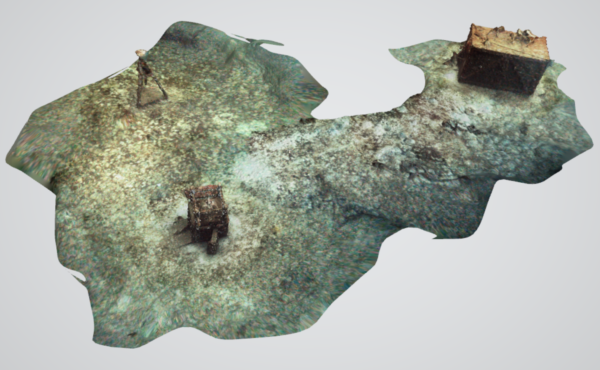
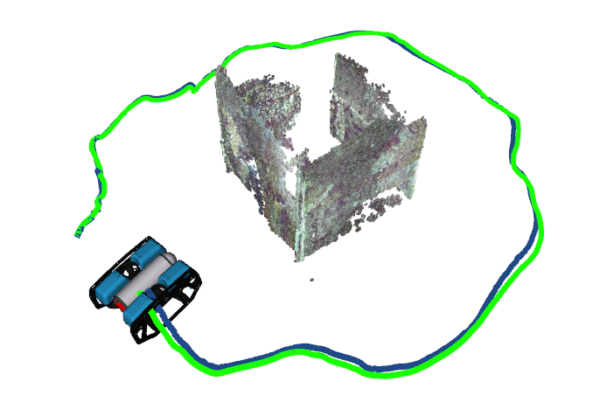
3D reconstruction from testing in a harbour in Norway
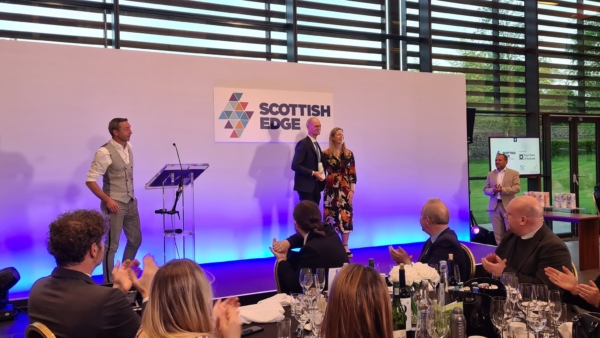
The advice and insight from the Fellowship proved invaluable. In May, Frontier Robotics won £100k grant at the Scottish EDGE Awards, the highest possible funding, including a special EDGE prize for Net Zero. This was only our first attempt (I’d heard anecdotally that most successful companies take at least two), so it really proves the effectiveness of the business support I’d had to that point. Particularly learning how to effectively pitch our business in less than 3 minutes.
The Scottish EDGE win changed everything. The investment allowed me to expand the team – I now employ 1 full-time and 2 part-time engineers, as well as a PhD student one day per week – and establish a base for developing Frontier’s technology from theoretical research developed during ORCA Hub(the offshore robotics research project that was a precursor to the National Robotarium’s autonomous underwater robotics research theme), to practical commercial applications that can be adopted by industry.
Jonatan Scharff-Willners winning the top prize of £100k at Scottish EDGE 2023
The win also led to an invite to join the Scottish Enterprise High-Growth Venture Programme, matching me with a mentor to support entrepreneurial skills development, develoeping my business models and helping me engage with investors to raise additional funding. I look forward to working with them over the next few months to accelerate the growth of the company.
Being part of the Heriot-Watt University ecosystem has reaped its rewards. In 2022, ORCA won ‘Research team of the year’ at the Heriot-Watt people celebration awards, and we were a finalist in the Times Higher Education Awards, two significant achievements that felt like the peak of success. Little did I know it was just the beginning of a much larger adventure, preceding a year when I gained more knowledge and experience than I could have imagined!
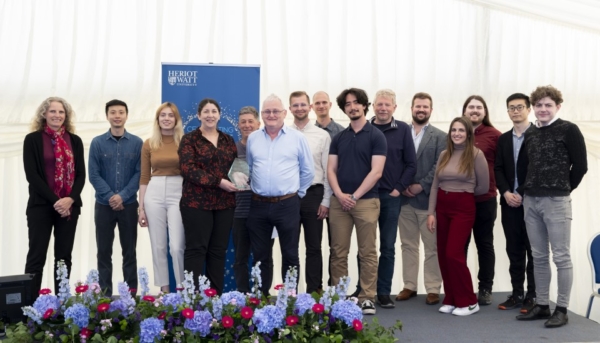
The ORCA hub wins Research Team of the Year at the 2022 Heriot-Watt University ‘Celebrating our People’ Awards
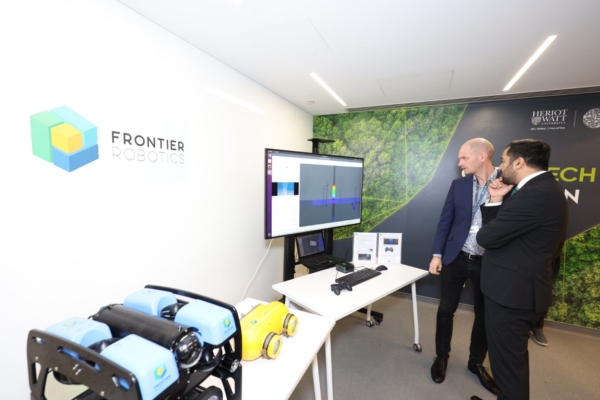
The in-house Business Development team at Heriot-Watt have also been incredibly supportive throughout the year, offering advice, invites to events and networking opportunities. The team at GRID was instrumental in my participation in the Clean Tech exhibition, part of the Climate Hub programme running at Heriot-Watt’s Dubai campus during COP28. They approached me to showcase the business at an exhibition space visited by scientists, policymakers, schools, invited guests and VIPs throughout the global conference.
I was honoured to exhibit alongside nine other companies that are developing technologies and products for a more sustainable future. These included Crover, also based at the National Robotarium, who have created a burrowing robotic drone to test the environmental conditions of grain silos, feeding back data to help farmers reduce waste caused by moisture and pest infestations; and Smartrawl, headed by Professor Paul Fernandes from the University’s Lyell Centre for Earth and Marine Sciences, which has invented an AI-empowered fishing net to identify different species of fish and prevent bycatch of those not needed by trawlers.
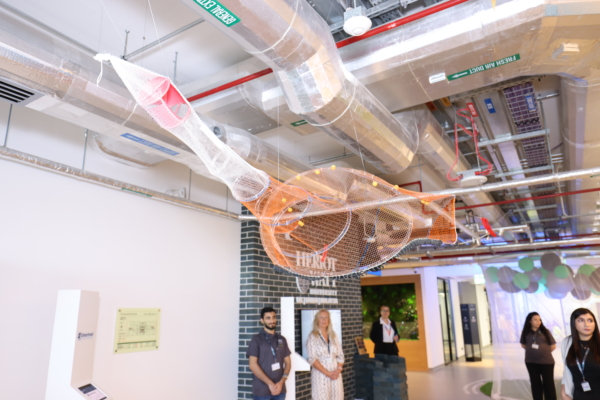
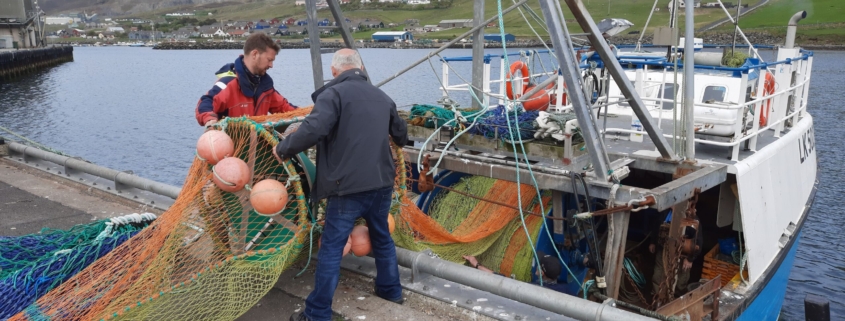
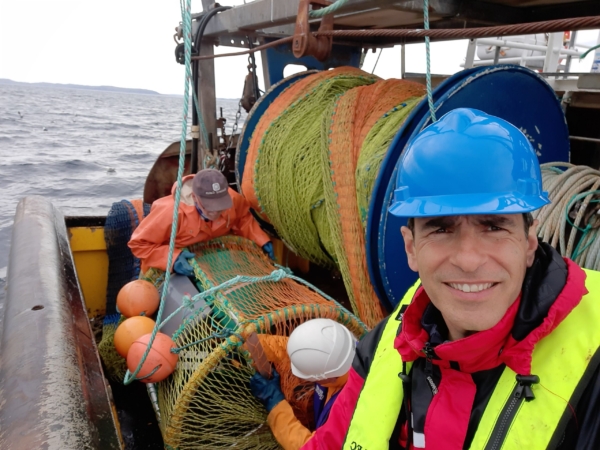
A prototype of the Smartrawl AI-empowered fishing net to prevent and reduce trawling bycatch
Meeting and sharing the space with these innovative businesses was one of the most beneficial aspects of the trip. We were able to share our experiences of running a startup and I got lots of valuable advice from those who have already navigated the potential and pitfalls of the Scottish funding and investment landscape. Being in an environment where we quickly connected and could share our successes and struggles bonded us immediately and it’s great to be part of a network of start-ups that can learn from each other’s mistakes and provide much-needed motivation.
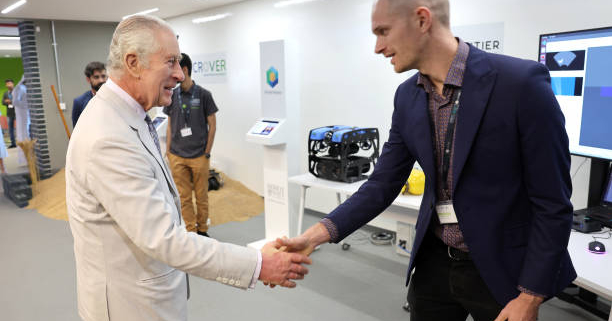
The first day in Dubai was an exciting one. We had been informed that His Royal Highness, King Charles III would be visiting to officially open the campus and tour around the CleanTech exhibition and we each had an opportunity to pitch. Despite being told there was only enough time to speak for a single sentence, the King was hugely generous with his time, showing genuine interest in our companies and asking lots of questions. I loved his down-to-earth nature and, as someone who’s been championing sustainable futures for decades, it was clear he was very knowledgeable about the challenges and opportunities for green businesses in the UK.
The First Minister of Scotland, Humza Yousaf, was also in attendance on the first day. I had met him before at Scottish EDGE and enjoyed speaking with him again about energy transition in Scotland.
Jonatan and Scottish First Minister Humza Yousaf
Over the week, the event brought in over 1000 visitors and it was lovely to meet so many interesting people. Our activity challenged willing participants to become an offshore operator in under 2 minutes using our shared autonomy system that guides and approves the actions in a simulated robotic inspection system.
I was particularly impressed with how quickly the school groups were not only able to grasp the importance for creating a greener future together, but also their ability to pick up the task, controlling the autonomy engine, robot, and 2-camera system (all developed at the National Robotarium) with ease. Our vision for the future is to see robots and humans seamlessly working together and it’s important that people feel empowered to use and control them effectively.
SLAM (simultaneous localisation and mapping) data
On our one day off, we were able to visit the COP28 exhibition arena and talk to some of the companies showcasing there. I was excited to see the latest inventions, learn what kinds of green tech we’re going to be using in the near-future and talk to potential investors.
What became really clear, really quickly, was that small start-ups and spinouts are leading the way for sustainable innovations, advancing new ideas and solutions to real-world problems quickly, and at scale. It’s an exciting time to be building a new business and heartening to see so many cool new companies coming through with a fresh vision, in comparison with bigger businesses who seem to be less transparent about what they’re doing to tackle climate change.
The week ended with some fruitful discussions with offshore industry representatives, and I’m excited that some have continued since I returned to Scotland.
In 2024, Frontier Robotics will be moving into our next phase of growing our industry portfolio and partnerships so it’s fantastic to have been able to connect with global companies and big industry names thanks to being part of Heriot-Watt University.
Jonatan, a Senior Robotics Engineer, and Frontier Robotics are based at the National Robotarium
https://thenationalrobotarium.com/wp-content/uploads/king1.jpg408612Louise Jackhttp://thenationalrobotarium.com/wp-content/uploads/Robotarium.pngLouise Jack2023-12-19 16:25:572025-04-25 12:16:42BLOG: A view from the Heriot-Watt Dubai Climate Hub – Jonatan Scharff-Willners, Frontier Robotics
Heriot-Watt University’s National Robotarium facility for robotics and AI took home the Project of the Year prize at this year’s Learning Places Scotland awards, held on 14 November in Glasgow. The awards, delivered in partnership with the Scottish Government as part of Scottish Learning Estates strategy, are an annual celebration of Scotland’s growing learning estate, recognising facilities that are making strides in sustainability, technology and student experience.
Supported by £21 million from the UK Government and £1.4m from the Scottish Government as part of the £1.3bn Edinburgh and South East Scotland City Region Deal, the National Robotarium officially opened in September 2022. Since then, the facility has been a catalyst for bridging knowledge between science and business, delivering sustainable economic benefit to Scotland and the UK through its expanding portfolio of industry partnerships that are developing new robotic technologies to address real-world and sectoral challenges.
Designed with sustainability at its heart, the 40,000ft² facility itself offers unrivalled learning spaces, allowing Heriot-Watt to maximise its AI and robotics strengths and lead the field in research. It boasts a variety of flexible spaces and test beds for specialist research, student projects, public engagement, and industry collaborations across three distinct themes; Robotics and Autonomous Systems (RAS), Human-Robot Interaction (HRI), and Precision Laser Applications (PLA).
The estates and projects team at Heriot-Watt, along with external consultants Michael Laird Architects and Atkins Realis, who collected the award on the night, were recognised for their collaborative efforts in creating a cutting-edge, sustainable centre for the advancement of research and learning in robotics and Artificial Intelligence.
The success of the project and its construction, enduring challenges such as the Covid pandemic and Brexit, was the result of extensive stakeholder engagement, ensuring the building met the requirements of individual teams and research areas, and accommodated emerging technologies through its flexible, fabric-first design.
More on the awards: https://www.learningplaces.scot/awards-dinner-information
https://thenationalrobotarium.com/wp-content/uploads/National-Robotarium-at-Heriot-Watt-University-36.jpg9981500Louise Jackhttp://thenationalrobotarium.com/wp-content/uploads/Robotarium.pngLouise Jack2023-11-23 16:34:552023-11-23 16:41:41The National Robotarium wins Project of the Year at Learning Places Scotland Awards
An underwater robotic sorting device which helps fishing trawlers prevent bycatch by identifying and sizing fish and other marine life in real-time is being developed by Heriot-Watt University scientists with support from experts in the National Robotarium’s Robotics and Autonomous Systems (RAS) laboratory.
Funded by the UK Seafood Innovation Fund and delivered in partnership with Fisheries Innovation & Sustainability (FIS), Smartrawl uses AI-technology to determine the individual size and species of marine life captured inside a trawl net using images taken by an underwater stereo camera. It then releases or retains each marine animal depending on whether it qualifies against a trawler’s intended catch using a computer-controlled robotic gate.
Trawling is a fishing practice that herds and captures target species, like fish or prawns, by towing a net along the ocean floor. This method of fishing is known to cause discarding and bycatch, where fish or other marine animals are accidentally caught and returned to the sea, most often dead. According to global marine fisheries data, it is estimated that 46% of all marine fish that are discarded come from this method of fishing.
The brainchild of Professor Paul Fernandes based at Heriot-Watt’s Lyell Centre for Earth and Marine Sciences, the Smartrawl sorting device is being supported by experts in underwater autonomous systems at the National Robotarium and designed in collaboration with the UK fishing industry. It is able to fit into existing nets of all sizes of vessels and requires no additional cables due to the device’s patented gate system which works with the force of the water to rotate between open and closed states.
“Smartrawl has been developed to ensure that vessels only catch the fish they’re targeting, releasing other animals back into their natural environment quickly and without harm. As a result, we’re confident that discarding and bycatch could quickly become a thing of the past and our precious marine life preserved.”
Components of the project have already been tested at sea and further trials are scheduled for later this year [2023] in Shetland using the research vessel Atlantia, operated by the University of the Highlands and Islands.
Administered by the Centre for Environment, Fisheries and Aquaculture Science (Cefas), on behalf of Department for Environment, Food and Rural Affairs (Defra), the UK Seafood Innovation Fund supports innovative projects which aim to bring new ideas and technology to the UK seafood sector and is part of the wider UK Seafood Fund.
Paul Fernandes (pictured above), the inventor of Smartrawl, is scientific lead for the project. He is a professor of fisheries science and technology at the Lyell Centre at Heriot-Watt University. He said:
“More than 4 million tonnes of marine fish are unintentionally caught by trawlers around the world every year, as well as bycatch of sharks, rays, dolphins, critically endangered turtles and seabirds. The sad reality is that these creatures, more often than not, are returned to the sea dead or dying.
“Current methods used on trawlers are unable to distinguish between different species and animals or give skippers enough information to build an accurate understanding of the size of individual fish prior to capture.
“Smartrawl has been developed to ensure that vessels only catch the fish they’re targeting, releasing other animals back into their natural environment quickly and without harm. As a result, we’re confident that discarding and bycatch could quickly become a thing of the past and our precious marine life preserved.”
FIS Executive Director, Kara Brydson, said:
“The UK Seafood Innovation Fund supports bold and ambitious tech-driven projects that will enable a step-change in the productivity and sustainability of the UK seafood sector. That perfectly describes Smartrawl, and this grant will take us nearer to our goal of enabling UK fishers to select and retain their high-quality catch while releasing non-target species back into our seas.”
https://thenationalrobotarium.com/wp-content/uploads/AI-empowered-fishing-net-being-loaded-onto-trawler-scaled-1.jpg19202560Louise Jackhttp://thenationalrobotarium.com/wp-content/uploads/Robotarium.pngLouise Jack2023-06-28 09:16:522023-10-26 14:32:36AI-empowered fishing net to help prevent marine bycatch
A unique burrowing robot which ‘swims’ through grain bulks to ensure crops are stored more efficiently has been launched by agritech developer Crover, a new tenant of the world-leading centre for robotics and artificial intelligence the National Robotarium.
As part of its residency, the Edinburgh-based start-up will benefit from the National Robotarium’s incubation facilities, state-of-the-art labs and engineering expertise housed within its pioneering new £22.4 million research building, opened in September 2022.
Informed by sectoral needs, the facility works collaboratively with partners around the globe to define, develop and resolve industry challenges through the application of robotics and AI.
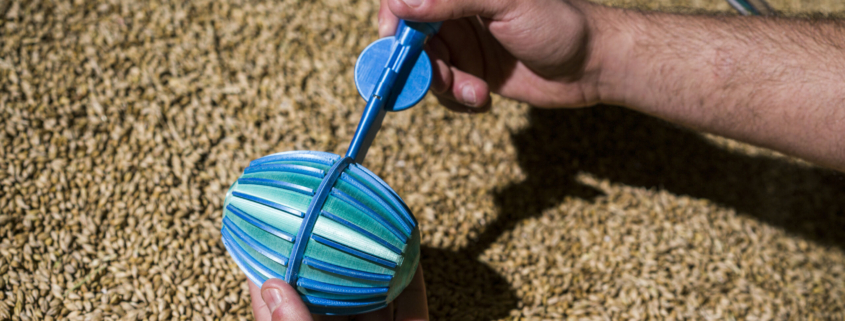
Crover’s t-shaped robot, which is being funded by Innovate UK, Scottish Enterprise and private funders, has been designed to offer grain aggregators, like farmers, better insight into the environmental conditions of grain crops, such as wheat and barley, when stored in sheds or silos.
The compact device has in-built moisture and temperature sensors and uses two domed-shaped wheels to propel itself through grain or other material in a bulk stack. It then feeds back analysis and data to a dashboard, giving users a more accurate understanding of the grain’s condition.
Temperature and humidity have a profound impact on grain storage and can contribute to the infestation of mould or insects which cause farmers to destroy significant portions of their stored crops. It is estimated that up to 30% of commodity grain is lost from the supply chain globally every year as a result.
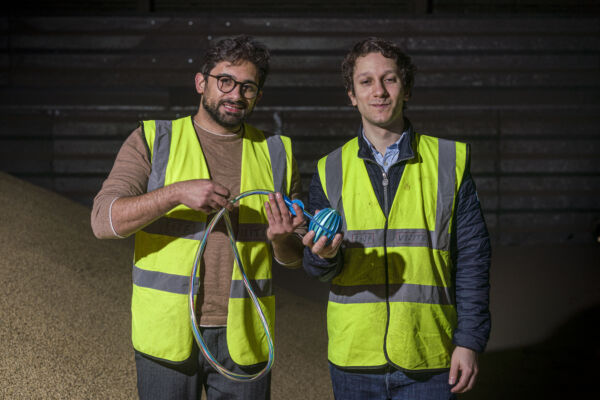
Gianlorenzo Di Santis (left) and Founding Director Lorenzo Conti (right) from Crover
Lorenzo Conti, founder and managing director of Crover, said:
“Working with the National Robotarium has significantly supported Crover’s development by providing us with access to state-of-the-art office and lab facilities and an extensive ecosystem of collaborators, industry experts and academic teams. It’s rare to be surrounded by a team who understand what it means to develop complex robots and we’re excited to continue sharing Crover’s journey with them.
“Traditional methods like spear sampling grain are time-consuming and laborious and quite often impractical and dangerous. In practice, grain storage operators are advised to sample bulk stacks at every 50 cm intervals. The reality is that, if done manually, someone could spend the best part of a week carrying out a single store check depending on the size of their crop load.
“Our device is designed to be controlled from one spot and saves whoever is operating it many hours of work as well as improving accuracy. The robot can ‘swim’ through the grain quickly generating a 3D map of temperature and moisture across the stack. This kind of insight can help people like farmers to better understand the condition of their grain and make informed decisions earlier like increasing ventilation or taking pest control measures.”
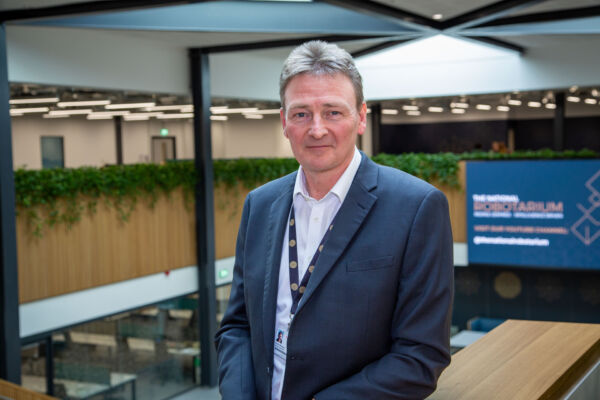
National Robotarium Chief Operating Officer, Steve Maclaren
Steve Maclaren is Chief Operating Officer at the National Robotarium. He said:
“The National Robotarium was launched with a mandate to assist all types of partners to accelerate research from laboratory to market, reduce cost and risk, increase opportunity and, ultimately, pave the way for the UK to take a global leadership role in AI and robotics technology.
“Innovations like Crover’s grain storage device – which could help solve a global problem for the world’s agriculture sector – are a great example of this mandate in action.
“The National Robotarium continues to be a leading collaborative hub, bringing together academics and global companies. Working with tenant companies like Crover, we want to provide a catalyst for entrepreneurship, and deliver sustainable economic benefit to the whole of the UK, its industries and society.”
UK Government Minister for Scotland, Malcolm Offord, said:
“It’s fantastic to see that farming and food and drink-boosting innovations like Crover’s new ‘grain-surfing’ robot will benefit from being part of the National Robotarium.
“Projects like this demonstrate the collaborative benefits the hub is providing, with resulting economic and environmental advances delivered to the UK.
“The UK Government is supporting the National Robotorium facilities at Heriot-Watt University with £21 million as part of more than £2.2 billion investment to level up communities across Scotland.”
Scottish Government Wellbeing Economy Secretary, Neil Gray, said:
“I welcome the development of this technology to help grain storage operators better understand the condition of grain and make informed decisions earlier.
“Technological advances like this show why the Scottish Government has supported the Robotarium through the Edinburgh and South East Scotland City Region Deal.”
LISTEN: Lorenzo Conti and National Robotarium Business Development Manager, Lisa Farrell, discuss how the National Robotarium is supporting Crover on BBC Radio Four’s Farming Today (broadcast 26 April 2023).
https://thenationalrobotarium.com/wp-content/uploads/Crover-grain-surfing-robot-scaled-e1695837394700.jpg6661000Louise Jackhttp://thenationalrobotarium.com/wp-content/uploads/Robotarium.pngLouise Jack2023-04-26 10:04:232023-09-13 17:35:42Grain-surfing robot the latest innovation to set up home at the National Robotarium
We may request cookies to be set on your device. We use cookies to let us know when you visit our websites, how you interact with us, to enrich your user experience, and to customize your relationship with our website.
Click on the different category headings to find out more. You can also change some of your preferences. Note that blocking some types of cookies may impact your experience on our websites and the services we are able to offer.
Essential Website Cookies
These cookies are strictly necessary to provide you with services available through our website and to use some of its features.
Because these cookies are strictly necessary to deliver the website, refusing them will have impact how our site functions. You always can block or delete cookies by changing your browser settings and force blocking all cookies on this website. But this will always prompt you to accept/refuse cookies when revisiting our site.
We fully respect if you want to refuse cookies but to avoid asking you again and again kindly allow us to store a cookie for that. You are free to opt out any time or opt in for other cookies to get a better experience. If you refuse cookies we will remove all set cookies in our domain.
We provide you with a list of stored cookies on your computer in our domain so you can check what we stored. Due to security reasons we are not able to show or modify cookies from other domains. You can check these in your browser security settings.
Google Analytics Cookies
These cookies collect information that is used either in aggregate form to help us understand how our website is being used or how effective our marketing campaigns are, or to help us customize our website and application for you in order to enhance your experience.
If you do not want that we track your visit to our site you can disable tracking in your browser here:
Other external services
We also use different external services like Google Webfonts, Google Maps, and external Video providers. Since these providers may collect personal data like your IP address we allow you to block them here. Please be aware that this might heavily reduce the functionality and appearance of our site. Changes will take effect once you reload the page.
Google Webfont Settings:
Google Map Settings:
Google reCaptcha Settings:
Vimeo and Youtube video embeds:
Other cookies
The following cookies are also needed - You can choose if you want to allow them:
Privacy Policy
You can read about our cookies and privacy settings in detail on our Privacy Policy Page.