The Data-Driven Innovation (DDI) Programme, a strategic partnership led by the University of Edinburgh and Heriot-Watt University, from which The National Robotarium centre for robotics and Artificial Intelligence was created, has won the Collaborative Initiative of the Year award at the prestigious Institute of Economic Development (iED) Annual Awards 2025.
This year saw a record-breaking number of entries, with almost 60 submissions received for seven award categories, and shortlisted nominations were assessed by an expert judging panel in September.
The Collaborative Initiative of the Year award, which this year is sponsored by Recurve Solutions, recognises outstanding cross-sector economic development collaboration between two or more partners drawn from local authorities, private sector, third sector, business and academia.
The submission outlined how the £700 million Data-Driven Innovation Programme, supported by the £1.3 billion Edinburgh and South East Scotland City Region Deal, unites the University of Edinburgh and Heriot-Watt University with six regional councils and industry to transform South East Scotland into the data capital of Europe. Delivering new infrastructure, thousands of skilled graduates, and high-growth ventures, the DDI programme is driving both inclusive growth and global competitiveness.
iED Director and former Chair Bev Hurley CBE, who hosted the awards honouring achievements across the public and private sectors, said: “Our judges said the Data-Driven Innovation Programme exemplifies the power of strategic collaboration to drive inclusive economic growth. With over £200 million in investment, support for over 600 companies, and a robust skills pipeline, the initiative demonstrates both measurable impact and long-term sustainability. They reported the seamless integration of public, academic, and industry partners sets a new benchmark for regional innovation.
“Our judges also praised the programme’s scale, infrastructure, innovation capacity, skills development, and global relevance, noting that these combined strengths position it as a catalyst for widespread economic and social benefit. In addition, they described the DDI Programme as a flagship model of collaborative economic development, delivering innovation, skills, and infrastructure at scale, and said that it is a benchmark for data-led transformation.”
Reflecting on the award, Professor Kim Graham, Provost of the University of Edinburgh and Senior Responsible Officer for the Data Driven Innovation Programme, commented: “This award is fantastic recognition of the impact of the DDI programme. The partnership between the universities of Edinburgh and Heriot-Watt is a shining example of how place-based investment in innovation and skills can have a transformative effect on economic growth, jobs and productivity, benefiting people in the region and beyond.”
Stewart Miller, Chief Executive Officer of The National Robotarium, said: “The National Robotarium is proud to be a part of the Data-Driven Innovation programme, a shining example of how collaboration between academia and industry can drive technological progress and create opportunities that will benefit businesses and communities across the region, the UK and beyond.
“Congratulations to the DDI delivery team and to our partner hubs for this award success.”
To find out more about the Data-Driven Innovation initiative and its partner hubs, visit: https://ddi.ac.uk/
https://thenationalrobotarium.com/wp-content/uploads/IED-awards-1500x500-1.jpeg5001500Louise Jackhttp://thenationalrobotarium.com/wp-content/uploads/Robotarium.pngLouise Jack2025-11-27 12:53:082025-11-27 13:00:32Data-Driven Innovation Programme wins Collaborative Initiative of the Year award at iED Annual Awards 2025
Two projects recently delivered by The National Robotarium, the UK’s centre for robotics and Artificial Intelligence at Heriot-Watt University, have been shortlisted for The Engineer C2i (Collaborate to Innovate) Awards 2025.
The awards, now in their tenth year, were launched to uncover and celebrate great examples of engineering collaboration and to recognise the role that engineers are playing in addressing some of the world’s biggest challenges.
The 5G Future Farming: Robotics project worked with agricultural and telecommunications specialists to test autonomous robots for precision farming tasks in remote or rural environments
The National Robotarium is shortlisted in the Information, Data & Connectivity and Wild Card categories for the projects:
5G Future Farming: Robotics (in partnership with James Hutton Institute, Scotland 5G Centre, Boston Dynamics and Freshwave)
A collaboration between technology and agricultural research, this project developed 5G-connected robotics applications to enable farmers to implement precision agriculture techniques while addressing rural connectivity challenges.
UNITE (with Heriot-Watt University in partnership with Imperial College London, Fugro, and Frontier Robotics)
This 3-year project, supported by Engineering and Physical Sciences Research Council (EPSRC), is developing autonomous, electric remotely-operated vehicles (eROVs) to conduct maintenance and repair of offshore wind turbines.
Now a prestigious panel of leading UK engineers will judge the shortlisted submissions with the winners being announced at a special event, taking place on Thursday 26 February 2026 in London.
Frontier Robotics, a spinout from Heriot-Watt University, support the UNITE project’s aims to develop smart, AI-enabled autonomous ROVs for wind turbine maintenance
Chief Executive Officer at The National Robotarium, Stewart Miller said: “Being shortlisted in not one, but two, categories is a fantastic result for the teams involved in delivering these complex, visionary projects.
“At The National Robotarium our robotics engineers and research teams are pushing the boundaries of innovation, and advancing the rapid adoption of smart and autonomous robotics that can help improve productivity, sustainability and safety in different industries.”
Editor of The Engineer Jon Excell said:
“Once again, the Collaborate to Innovate awards has uncovered a remarkable crop of innovative projects and initiatives from across the world of engineering. Between them, this year’s shortlisted finalists, provide a compelling illustration of the technologies and trends that are shaping our future and the role that UK engineers are playing at the forefront of some of the most critical technology developments of our times.”
https://thenationalrobotarium.com/wp-content/uploads/C2i_Awards_25-29-Facebook_1350x1350Shortlisted.png13501350Louise Jackhttp://thenationalrobotarium.com/wp-content/uploads/Robotarium.pngLouise Jack2025-11-20 10:27:422025-11-20 11:25:57The National Robotarium makes the shortlist in The Engineer C2I Awards 2025
The project team, which includes global geo-data specialists Fugro and Heriot-Watt spinout technology company Frontier Robotics, is developing advanced AI and autonomous systems for undertaking remote inspections of offshore wind farms to offer a safe, efficient and sustainable solution for global energy providers.
The Scottish KE awards, now in their 10th year, highlight the exceptional collaborations that deliver economic, environmental and social benefits for Scotland. UNITE has been nominated within the Multi-party Collaboration category, in recognition of the consortium’s innovative knowledge exchange, bringing together a legacy of science, industry expertise and emerging technologies to tackle a real-world challenge.
UNITE aims to develop autonomous, electric remotely-operated vehicles (eROVs) to conduct maintenance and repair on offshore wind turbines
Professor Yvan Petillot is academic co-lead at The National Robotarium and leads the UNITE project at Heriot-Watt.
He said: “It’s an honour to be shortlisted for a Scottish KE Award. By harnessing advanced robotics, artificial intelligence, and subsea engineering with the aim of transforming offshore maintenance and directly supporting Scotland’s net-zero ambitions, we think the UNITE project is an excellent example of truly impactful Knowledge Exchange.”
Amelia Whitelaw, Director of Interface, which organises the Awards, said: “At Interface, we are proud to deliver the Scottish Knowledge Exchange Awards on behalf of Scotland’s vibrant innovation ecosystem.
“These awards are more than just a celebration of achievements—they showcase the transformative power of collaboration between academia and industry. Each finalist represents the spirit of partnership, driving solutions that create lasting economic, environmental, and social impact.”
The Interface Scottish KE Awards will take place at Edinburgh Futures Institute on 19th March.
https://thenationalrobotarium.com/wp-content/uploads/KE-awards.png499706Louise Jackhttp://thenationalrobotarium.com/wp-content/uploads/Robotarium.pngLouise Jack2025-02-12 12:34:512025-02-12 12:40:25UNITE consortium shortlisted for Scottish Knowledge Exchange Award
I knew when it began that 2023 was going to be an interesting year. I had secured a Royal Academy of Engineering Enterprise Fellowship to pursue Frontier Robotics, a new spin-out created to advance software for underwater robotic autonomy, exploration and inspection and had one year to make the company a reality. Little did I know that, by the year’s close, I would be exhibiting our technology in Dubai during COP28, the world’s largest climate change conference, and meeting VIPs, including royalty!
The support included in the Fellowship provided a great grounding to this whirlwind year. As well as a year’s salary, it offered new Fellows a business support programme, consisting of several days intensive business training from St John’s Innovation Centre with expert advice encompassing pitching, branding and marketing, finance, and legal – all the foundational elements of a fledgling business – as well as access network of ~600 other startup companies. The Fellowship also provided a £15k business support grant that I put towards early-stage financing, webservers, and integrating our core produce AUIP (Autonomous Underwater Inspection Payload) with an ROV manufacturer for a potential future partnership in Norway.
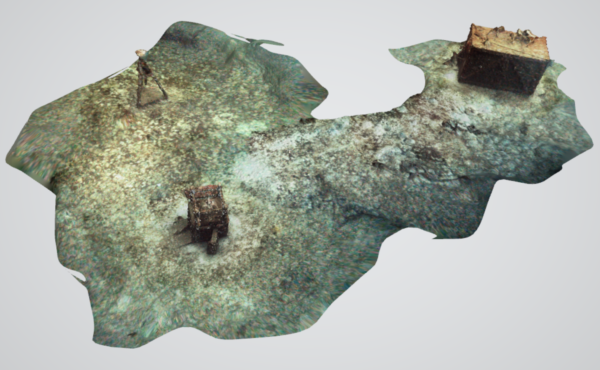
3D reconstruction from testing in a harbour in Norway
The advice and insight from the Fellowship proved invaluable. In May, Frontier Robotics won £100k grant at the Scottish EDGE Awards, the highest possible funding, including a special EDGE prize for Net Zero. This was only our first attempt (I’d heard anecdotally that most successful companies take at least two), so it really proves the effectiveness of the business support I’d had to that point. Particularly learning how to effectively pitch our business in less than 3 minutes.
The Scottish EDGE win changed everything. The investment allowed me to expand the team – I now employ 1 full-time and 2 part-time engineers, as well as a PhD student one day per week – and establish a base for developing Frontier’s technology from theoretical research developed during ORCA Hub(the offshore robotics research project that was a precursor to the National Robotarium’s autonomous underwater robotics research theme), to practical commercial applications that can be adopted by industry.
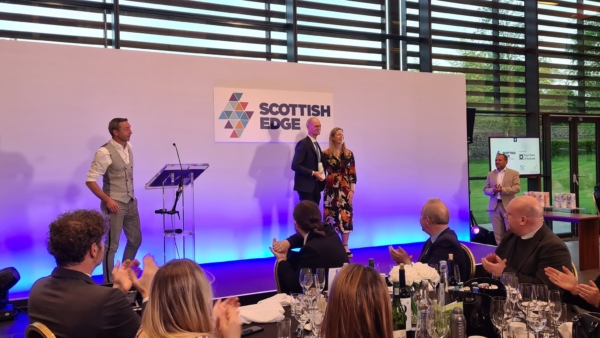
Jonatan Scharff-Willners winning the top prize of £100k at Scottish EDGE 2023
The win also led to an invite to join the Scottish Enterprise High-Growth Venture Programme, matching me with a mentor to support entrepreneurial skills development, develoeping my business models and helping me engage with investors to raise additional funding. I look forward to working with them over the next few months to accelerate the growth of the company.
Being part of the Heriot-Watt University ecosystem has reaped its rewards. In 2022, ORCA won ‘Research team of the year’ at the Heriot-Watt people celebration awards, and we were a finalist in the Times Higher Education Awards, two significant achievements that felt like the peak of success. Little did I know it was just the beginning of a much larger adventure, preceding a year when I gained more knowledge and experience than I could have imagined!
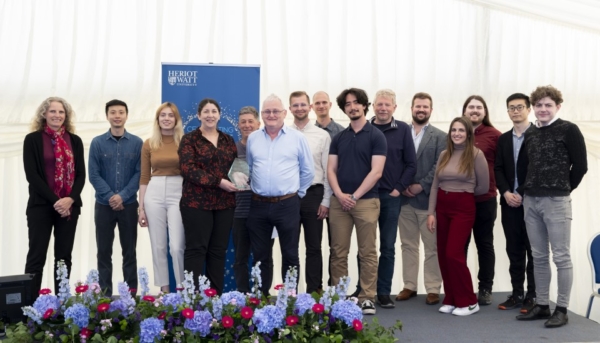
The ORCA hub wins Research Team of the Year at the 2022 Heriot-Watt University ‘Celebrating our People’ Awards
The in-house Business Development team at Heriot-Watt have also been incredibly supportive throughout the year, offering advice, invites to events and networking opportunities. The team at GRID was instrumental in my participation in the Clean Tech exhibition, part of the Climate Hub programme running at Heriot-Watt’s Dubai campus during COP28. They approached me to showcase the business at an exhibition space visited by scientists, policymakers, schools, invited guests and VIPs throughout the global conference.
I was honoured to exhibit alongside nine other companies that are developing technologies and products for a more sustainable future. These included Crover, also based at the National Robotarium, who have created a burrowing robotic drone to test the environmental conditions of grain silos, feeding back data to help farmers reduce waste caused by moisture and pest infestations; and Smartrawl, headed by Professor Paul Fernandes from the University’s Lyell Centre for Earth and Marine Sciences, which has invented an AI-empowered fishing net to identify different species of fish and prevent bycatch of those not needed by trawlers.
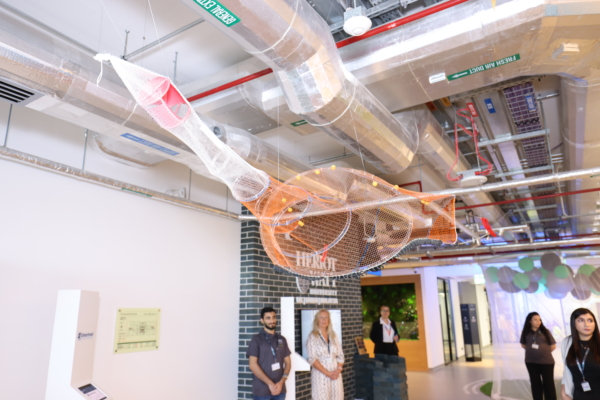
A prototype of the Smartrawl AI-empowered fishing net to prevent and reduce trawling bycatch
Meeting and sharing the space with these innovative businesses was one of the most beneficial aspects of the trip. We were able to share our experiences of running a startup and I got lots of valuable advice from those who have already navigated the potential and pitfalls of the Scottish funding and investment landscape. Being in an environment where we quickly connected and could share our successes and struggles bonded us immediately and it’s great to be part of a network of start-ups that can learn from each other’s mistakes and provide much-needed motivation.
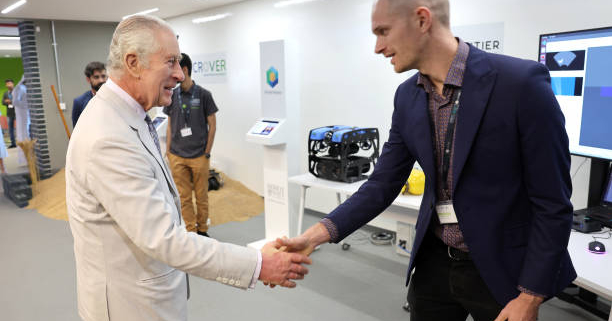
The first day in Dubai was an exciting one. We had been informed that His Royal Highness, King Charles III would be visiting to officially open the campus and tour around the CleanTech exhibition and we each had an opportunity to pitch. Despite being told there was only enough time to speak for a single sentence, the King was hugely generous with his time, showing genuine interest in our companies and asking lots of questions. I loved his down-to-earth nature and, as someone who’s been championing sustainable futures for decades, it was clear he was very knowledgeable about the challenges and opportunities for green businesses in the UK.
The First Minister of Scotland, Humza Yousaf, was also in attendance on the first day. I had met him before at Scottish EDGE and enjoyed speaking with him again about energy transition in Scotland.
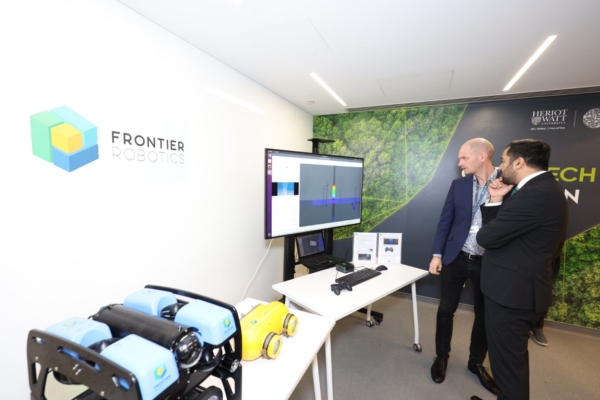
Jonatan and Scottish First Minister Humza Yousaf
Over the week, the event brought in over 1000 visitors and it was lovely to meet so many interesting people. Our activity challenged willing participants to become an offshore operator in under 2 minutes using our shared autonomy system that guides and approves the actions in a simulated robotic inspection system.
I was particularly impressed with how quickly the school groups were not only able to grasp the importance for creating a greener future together, but also their ability to pick up the task, controlling the autonomy engine, robot, and 2-camera system (all developed at the National Robotarium) with ease. Our vision for the future is to see robots and humans seamlessly working together and it’s important that people feel empowered to use and control them effectively.
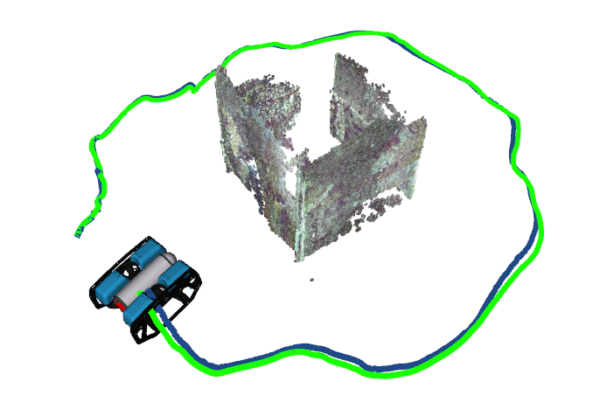
SLAM (simultaneous localisation and mapping) data
On our one day off, we were able to visit the COP28 exhibition arena and talk to some of the companies showcasing there. I was excited to see the latest inventions, learn what kinds of green tech we’re going to be using in the near-future and talk to potential investors.
What became really clear, really quickly, was that small start-ups and spinouts are leading the way for sustainable innovations, advancing new ideas and solutions to real-world problems quickly, and at scale. It’s an exciting time to be building a new business and heartening to see so many cool new companies coming through with a fresh vision, in comparison with bigger businesses who seem to be less transparent about what they’re doing to tackle climate change.
The week ended with some fruitful discussions with offshore industry representatives, and I’m excited that some have continued since I returned to Scotland.
In 2024, Frontier Robotics will be moving into our next phase of growing our industry portfolio and partnerships so it’s fantastic to have been able to connect with global companies and big industry names thanks to being part of Heriot-Watt University.
Jonatan, a Senior Robotics Engineer, and Frontier Robotics are based at the National Robotarium

https://thenationalrobotarium.com/wp-content/uploads/king1.jpg408612Louise Jackhttp://thenationalrobotarium.com/wp-content/uploads/Robotarium.pngLouise Jack2023-12-19 16:25:572025-04-25 12:16:42BLOG: A view from the Heriot-Watt Dubai Climate Hub – Jonatan Scharff-Willners, Frontier Robotics
Heriot-Watt University’s National Robotarium facility for robotics and AI took home the Project of the Year prize at this year’s Learning Places Scotland awards, held on 14 November in Glasgow. The awards, delivered in partnership with the Scottish Government as part of Scottish Learning Estates strategy, are an annual celebration of Scotland’s growing learning estate, recognising facilities that are making strides in sustainability, technology and student experience.
Supported by £21 million from the UK Government and £1.4m from the Scottish Government as part of the £1.3bn Edinburgh and South East Scotland City Region Deal, the National Robotarium officially opened in September 2022. Since then, the facility has been a catalyst for bridging knowledge between science and business, delivering sustainable economic benefit to Scotland and the UK through its expanding portfolio of industry partnerships that are developing new robotic technologies to address real-world and sectoral challenges.
Designed with sustainability at its heart, the 40,000ft² facility itself offers unrivalled learning spaces, allowing Heriot-Watt to maximise its AI and robotics strengths and lead the field in research. It boasts a variety of flexible spaces and test beds for specialist research, student projects, public engagement, and industry collaborations across three distinct themes; Robotics and Autonomous Systems (RAS), Human-Robot Interaction (HRI), and Precision Laser Applications (PLA).
The estates and projects team at Heriot-Watt, along with external consultants Michael Laird Architects and Atkins Realis, who collected the award on the night, were recognised for their collaborative efforts in creating a cutting-edge, sustainable centre for the advancement of research and learning in robotics and Artificial Intelligence.
The success of the project and its construction, enduring challenges such as the Covid pandemic and Brexit, was the result of extensive stakeholder engagement, ensuring the building met the requirements of individual teams and research areas, and accommodated emerging technologies through its flexible, fabric-first design.
More on the awards: https://www.learningplaces.scot/awards-dinner-information
https://thenationalrobotarium.com/wp-content/uploads/National-Robotarium-at-Heriot-Watt-University-36.jpg9981500Louise Jackhttp://thenationalrobotarium.com/wp-content/uploads/Robotarium.pngLouise Jack2023-11-23 16:34:552023-11-23 16:41:41The National Robotarium wins Project of the Year at Learning Places Scotland Awards
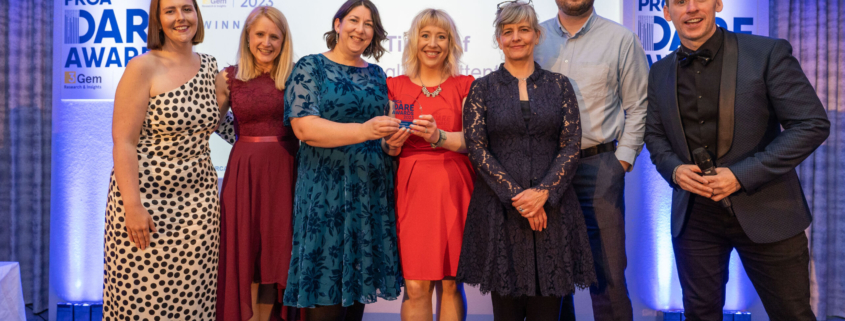
The National Robotarium was a winner at this year’s PRCA Scotland Dare Awards, an event which celebrates excellence in the public relations and communications industry.
The UK’s leading robotics and AI facility was presented with the award for ‘Event/Launch of the Year’ in recognition of its communications campaign to launch the opening of its new state-of-the-art £22.4m building in September 2022.
Other winners on the night were Scotland’s university innovation springboard competition, Converge, which received PRCA Scotland’s ‘B2B Campaign of the Year’ award for its works launching its 13th annual programme of competitions.
In May [2023], Converge unveiled the 100 start-ups and spinouts that will receive support to turn their ideas for products and services into reality as part of its 2023 programme, with a growing number of companies using robotics and AI to help tackle challenges including the climate emergency, health conditions, and childhood literacy.
Expressing delight at winning, Research Communications Manager at the National Robotarium, Louise Jack said:
“The National Robotarium and Converge share a common vision to transform the world through cutting-edge technology and innovation. These awards serve as a testament to our unwavering dedication to achieving that goal and, importantly, ensuring its story is told.
“We’re incredibly grateful to the PRCA Scotland for acknowledging our achievements and would like to thank our public relations partner Hot Tin Roof for its support and dedication throughout the delivery of this media campaign.”
We may request cookies to be set on your device. We use cookies to let us know when you visit our websites, how you interact with us, to enrich your user experience, and to customize your relationship with our website.
Click on the different category headings to find out more. You can also change some of your preferences. Note that blocking some types of cookies may impact your experience on our websites and the services we are able to offer.
Essential Website Cookies
These cookies are strictly necessary to provide you with services available through our website and to use some of its features.
Because these cookies are strictly necessary to deliver the website, refusing them will have impact how our site functions. You always can block or delete cookies by changing your browser settings and force blocking all cookies on this website. But this will always prompt you to accept/refuse cookies when revisiting our site.
We fully respect if you want to refuse cookies but to avoid asking you again and again kindly allow us to store a cookie for that. You are free to opt out any time or opt in for other cookies to get a better experience. If you refuse cookies we will remove all set cookies in our domain.
We provide you with a list of stored cookies on your computer in our domain so you can check what we stored. Due to security reasons we are not able to show or modify cookies from other domains. You can check these in your browser security settings.
Google Analytics Cookies
These cookies collect information that is used either in aggregate form to help us understand how our website is being used or how effective our marketing campaigns are, or to help us customize our website and application for you in order to enhance your experience.
If you do not want that we track your visit to our site you can disable tracking in your browser here:
Other external services
We also use different external services like Google Webfonts, Google Maps, and external Video providers. Since these providers may collect personal data like your IP address we allow you to block them here. Please be aware that this might heavily reduce the functionality and appearance of our site. Changes will take effect once you reload the page.
Google Webfont Settings:
Google Map Settings:
Google reCaptcha Settings:
Vimeo and Youtube video embeds:
Other cookies
The following cookies are also needed - You can choose if you want to allow them:
Privacy Policy
You can read about our cookies and privacy settings in detail on our Privacy Policy Page.