

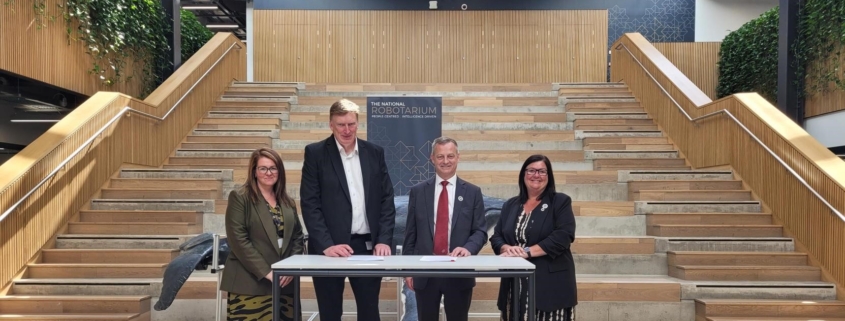
The National Robotarium has signed a new MOU (Memorandum of Understanding) with Corps Monitoring that will underpin the safe development of technologies for healthcare and other sectors.
The agreement, which was co-signed by Robotarium CEO Stewart Miller and CEO of Corps Monitoring Mike Bullock, during a visit to the National Robotarium on 3 June, kick-starts a collaboration that will focus on improving security and monitoring services for the social care sector.
Researchers in Human-Robot Interaction at Heriot-Watt University are developing applications, such as smart sensors and remote technologies, to enhance care provision in assisted-living environments. One current project involves the deployment of assistive robots within a real-use care organisation being led by Associate Professor Dr Mauro Dragone in partnership with Blackwood Homes and Care Services. Corps Monitoring, a division of Corps Security, will apply its extensive expertise in specialist security solutions to ensure these technologies are deployed safely, with enhanced cybersecurity to protect patient data and information.
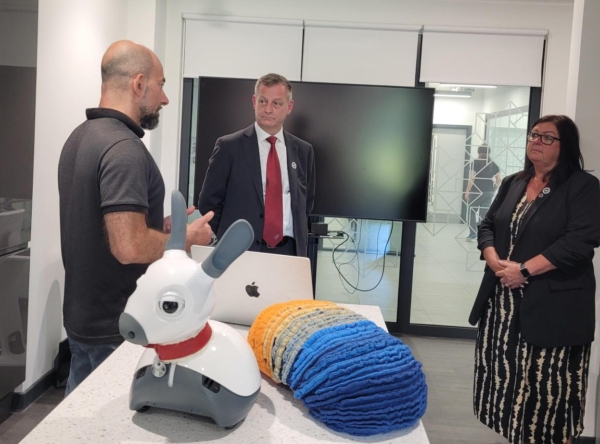
Dr Mauro Dragone (far-left), who leads the Laboratory for Assisted Robotic Living at the National Robotarium
“The aim of our partnership with the National Robotarium, is to improve the quality of life for many whilst striving forward with innovative technology advances.” Andrea Strong, MD of Corps Monitoring
National Robotarium Business Development Manager Lisa Farrell, who spearheaded the partnership, led the visit. She said:
“We were delighted to welcome Andrea and Mike to the National Robotarium to co-sign our new partnership agreement with Corps Monitoring.
“Our researchers are making huge advancements into the use of smart sensors, data analysis and machine vision to support greater independent living, however their security is a must if they are to be adopted by care providers on a wider scale.
“The expertise of Corps Monitoring will help underpin the safe development of these technologies, ensuring patient data remains private and protected and maintaining confidence within the sector.”
Andrea Strong, Managing Director of Corps Monitoring, also attended the signing. She said:
“The advancement of technology is moving at such a rapid pace. This partnership won’t just allow us to ‘keep up’ but to be ahead of the curve. By focusing on innovations that not only enhances independent living within the varying care sectors but aids the security and other sectors in general.
“The aim of our partnership with the National Robotarium, is to improve the quality of life for many whilst striving forward with innovative technology advances.”
The National Robotarium hosted the newly appointed Deputy First Minister and Cabinet Secretary for the Economy, Kate Forbes MSP, on Monday 20 May.
The Cabinet Secretary chose the UK’s centre for robotics and AI as the venue to announce a new £5 million funding package, created by the Scottish Government to boost the economy and attract international investment.
Targeted at start-up businesses, spinouts and female entrepreneurs, the scheme will help deliver end-to-end support as part of the government’s ongoing commitment to developing a world-class technology sector in Scotland.
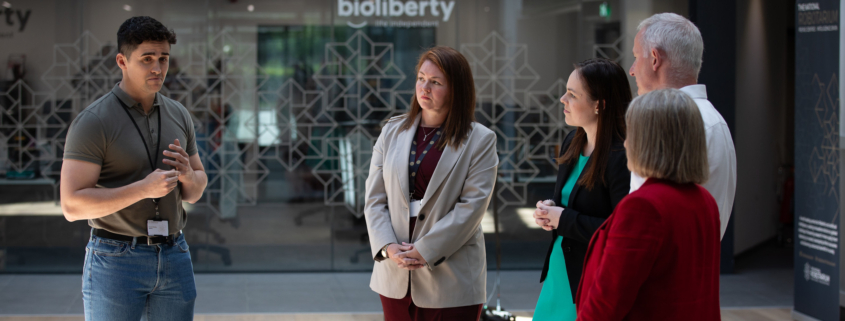
As part of the visit, led by National Robotarium Business Development Manager, Lisa Farrell, and Chief Operating Officer, Steve Maclaren, alongside Heriot-Watt University’s Vice-Principal and Provost, Professor Steve McLaughlin, the Deputy First Minister met a number of start-up tech companies, who are advancing their business and technology through access to the centre’s high-spec laboratories, office space and robotics expertise.
“Facilities like the National Robotarium are proven to attract a range of talented and dynamic companies in their infancy. However, we need to ensure that we have a supportive infrastructure that allows them to remain in Scotland while they grow their business and scale-up production.”
Lisa Farrell, The National Robotarium
Companies benefitting from the National Robotarium’s business acceleration support include Frontier Robotics, BioLiberty, Crover, Touchlab Ltd., and newest residents, Danu Robotics, all of whom spoke to the Economy Secretary about how crucial centres like the National Robotarium are for growing Scotland’s start-up business community and retaining its tech talent and skills base.
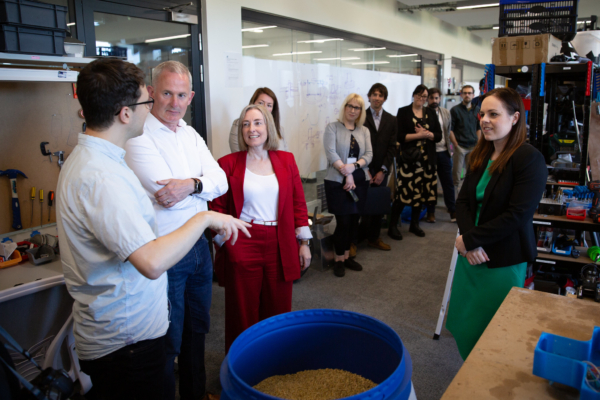
Agritech start-up Crover shared how they’ve developed their technology since joining the National Robotarium
Deputy First Minister Kate Forbes said:
“Innovation is at the very heart of our economy. We have the talent, the skills and the facilities to make Scotland one of Europe’s fastest-growing start-up economies: an economy that is strong, successful and dynamic.
“This package of measures, which builds on the multi-million investment the Scottish Government is already making into our start-up business community, forms the next step in providing one of the most comprehensive government-backed support networks in Europe.”
Business Development Manager, Lisa Farrell said:
“It was an honour to host the Deputy First Minister and showcase some of the start-ups that are getting a head-start through our business incubation and acceleration support.
“Facilities like the National Robotarium are proven to attract a range of talented and dynamic companies in their infancy. However, we need to ensure that we have a supportive infrastructure that allows them to remain in Scotland while they grow their business and scale-up production.
“I welcome the announcement that the Scottish Government are committed to delivering additional resource that will foster real economic growth through its start-up community and grow its roster of female entrepreneurs.”
Also in attendance were Mark Logan, Chief Entrepreneurial Advisor to the Scottish Government, and Ana Stewart, a tech entrepreneur and investment partner, who produced a Pathways report last year that highlighted recommendations for improving under-representation of women in entrepreneurship.
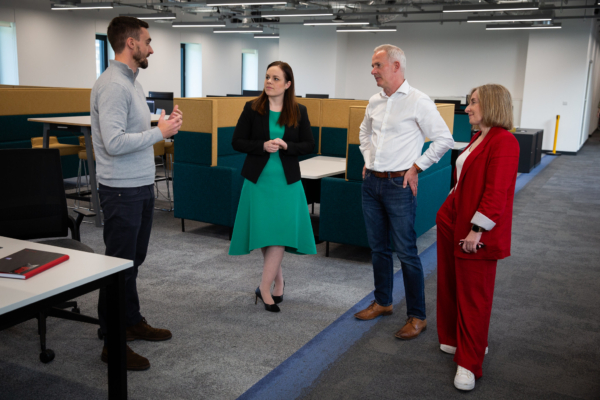
New resident company Danu Robotics spoke to the Economy Secretary about their automated waste sorting technology
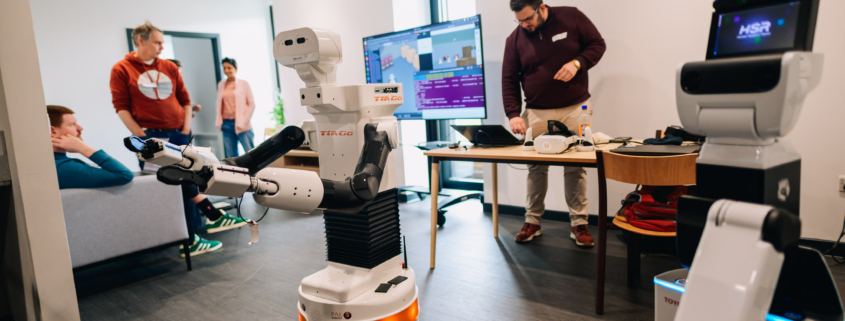
Industry representatives from health technology and telecare are invited to attend the next Emergence Healthcare Technologies Network event, taking place at the National Robotarium.
An interactive workshop, participants will explore the use of intelligent and robotic systems for the elderly or frail. Insights into the challenges facing healthcare professionals will be shared, along with hands-on exploration of new technologies, including robots and smart sensors, in the facility’s living lab.
📌 Tackling Frailty: Facilitating the Emergence of Healthcare Robots from Labs into Services
📅 Tuesday 4 June
🕙 1000-1600
📍 The National Robotarium, Heriot-Watt University, Edinburgh
More information and booking: https://www.emergencerobotics.net/events-and-network-activities/intelligent-systems-for-frailty-edinburgh

The National Robotarium is hosting the second Edinburgh Tourism Action Group (ETAG) ‘Tech Tuesday’ event, taking place from 12-3pm on Tuesday 14 May.
Industry professionals from the hospitality, tourism and travel sectors are invited along for an afternoon of networking, talks and discussion exploring how robotics can support the sector.
📣 Robotics in Hospitality & Tourism: Practical Solutions for your Business
📅 Tuesday 14 May
🕛 12-3pm
🗺 The National Robotarium, Heriot-Watt University, Edinburgh
FREE 🎟 via ETAG Eventbrite

A robot that can wink, laugh, and shrug is about to turn the National Robotarium in Edinburgh into its first home in the UK.
Ameca, which is made by British company Engineered Arts, will be used as part of the facility’s outreach work with school pupils and the general public to study humans’ reactions to robots.
The National Robotarium, the UK’s centre for robotics and artificial intelligence (AI) based at Heriot-Watt University in partnership with The University of Edinburgh, has purchased Ameca, making it the first place in the UK to have this state-of-the-art humanoid robot.
Described by Engineered Arts as the ‘world’s most advanced’ humanoid robot, Ameca’s sophisticated features include embedded microphones, cameras, facial recognition software, and articulated motorised components which enable it to interact with people in a natural and engaging way. By showcasing Ameca’s capabilities through its public outreach and education programmes, the National Robotarium will seek to break down barriers and build trust between humans and robots.
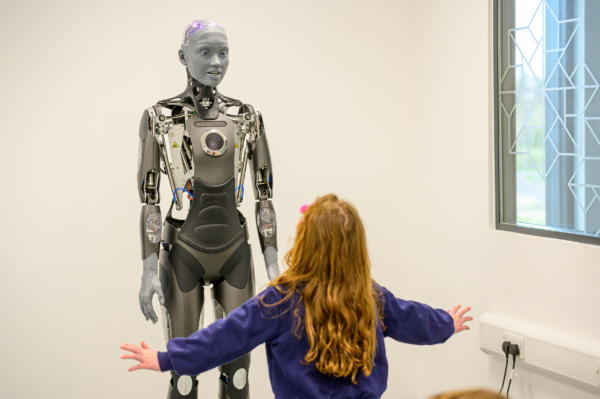
Ameca will be utilised as part of the National Robotarium’s outreach and engagement programme, helping to build trust in robotics and improve adoption.
The facility’s dedicated public engagement team will feature Ameca at various events, school visits, and workshops across Scotland and beyond, providing opportunities for people of all ages and backgrounds to interact directly with the robot and learn about the latest advancements in robotics and AI.
Researchers will also utilise Ameca to study public perceptions and attitudes towards humanoid robots, gathering valuable insights to inform the development of future technologies that prioritise trust, transparency, and user-friendliness.
Steve Maclaren is Chief Operating Officer at the National Robotarium. He said:
“The arrival of Ameca at the National Robotarium marks a significant step forward in our mission to make robotics more accessible and relatable to the people of Scotland, the UK and beyond. Since opening our doors in September 2022, we’ve successfully hosted more than 50 in-person and virtual events and engaged with 1000s of school-aged children.
“Ameca represents an exciting opportunity to build on that success and take public engagement to the next level. By giving people the chance to interact with this state-of-the-art humanoid robot firsthand, we aim to demystify robotics, foster trust in human-robot interaction, and showcase the remarkable potential of these technologies to improve our daily lives and benefit society as a whole.”
Will Jackson is the founder and CEO of Engineered Arts Ltd. He said:
“We are incredibly proud to have Ameca join the many preeminent robots at the National Robotarium. Meeting an AI-embodied humanoid robot is a unique experience that very few people have witnessed and we are very excited to be able to share what can be a profound moment with a wider audience.”
The National Robotarium is part of the Data-Driven Innovation initiative, supported by £21 million from the UK Government and £1.4 million from the Scottish Government. The initiative aims to turn Edinburgh into the data capital of Europe and is part of the wider £1.5 billion Edinburgh and South-East Scotland City Region Deal.
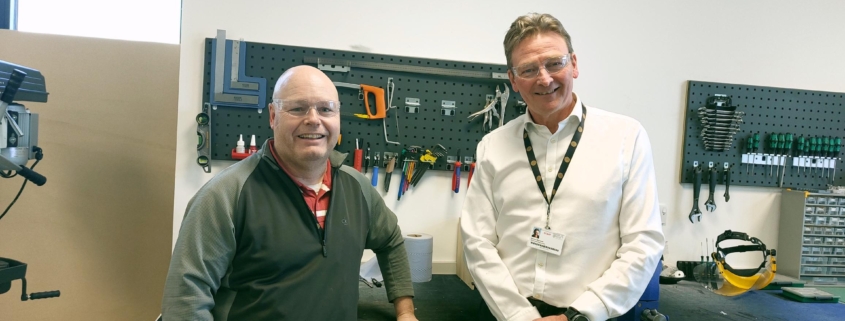
The National Robotarium has been announced as a partner in the UK Robotics and Autonomous Systems Strategic Technical Platform (UKRAS-STEP), a new 3-year project to support and enhance training and development for technical research staff.
With the backing of funding from the Engineering and Physical Sciences Research Council (EPSRC), UKRAS-STEP will strengthen the UK’s Robotics and Autonomous Systems capabilities, improve the long-term career prospects of Research Technical Professionals (RTPs) and create stronger links between academia, industry and government.
Through a consortium of 37 universities within the existing UKRAS network, the project, led by University of Leeds Professor of Robotics, Robert Richardson, will deliver a programme of education across eight themes, designed to support the diverse range of technical expertise that currently supports world-class robotics research.
“Research technicians are the backbone of world-leading research into Robotics and Autonomous Systems, providing a wealth of technical expertise and operational support…”
– Steve Maclaren, Chief Operating Officer at the National Robotarium
Professor Richardson said: “Research Technicians in Robotics and Autonomous Systems play a pivotal role in advancing robotics research across various industry sectors in the UK, spanning from transport and healthcare to manufacturing and unmanned systems.
“Despite their amazing contribution, career growth opportunities are limited and as a result, some areas experience high staff turnover. UKRAS STEPS will establish a dedicated platform to address these challenges by facilitating the development of secondments, training programmes and mentorship schemes.
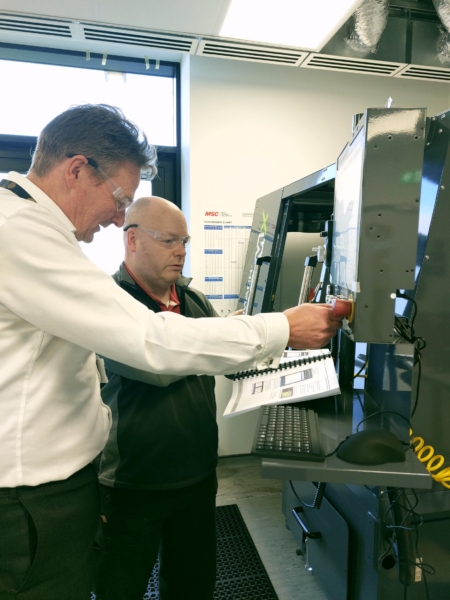
COO Steve Maclaren and Senior Technician Thomas McGravie
The National Robotarium will lead in formation of a number of task groups, each focused on addressing a particular challenge within the technical research sector. Through an open call, HEIs from the UK-RAS network will work together to deliver tasks ranging from small projects and producing training materials to holding national workshops and influencing policy through white papers.
“The UKRAS-STEP initiative will enable me and other technical research colleagues working in robotics across the UK to connect, share knowledge and best practice.”
– Thomas McGravie, Senior Technician at the National Robotarium
Chief Operating Officer at the National Robotarium Steve Maclaren will lead on the Task Groups work package. He said: “We are thrilled to be a part of the UKRAS-STEP programme and work with the RAS community to help advance training and opportunities for technical research staff.
“Research technicians are the backbone of world-leading research into Robotics and Autonomous Systems, providing a wealth of technical expertise and operational support that enable scientists to conduct research safely and effectively in an optimum research environment.
“Without them, we would be unable to maintain and manage essential research components such as robotic equipment, lab space, computer systems and software, so it is vital that our community of technical research professionals feel valued with opportunities to develop and grow.”
Thomas McGravie has been Senior Technician for Heriot-Watt University at the National Robotarium since it opened in September 2022. He said: “The UKRAS-STEP initiative will enable me and other technical research colleagues working in robotics across the UK to connect, share knowledge and best practice, and build upon our individual and collective skills.
“I’m excited to see the proposal come to life and look forward working more closely with the wider RTP community.”
About UKRAS-STEP
The UK Robotics and Autonomous Systems Strategic Technical Platform (UKRAS-STEP), led by University of Leeds, is one of 11 new projects benefitting from a share of a new £16 million investment by EPSRC and UKRI Digital Research Infrastructure (DRI) to improve the long-term career prospects of Research Technical Professionals (RTPs).
UKRAS-STEP will create a community-driven strategic technology platform that empowers individuals to develop, while building an inclusive community to enhance the UK research environment and support the delivery of world-class research in the UK.
Its three main objectives are:
i) To enhance individual technical knowledge, skills and career development amongst research technicians;
ii) Provide opportunities for networking, knowledge-sharing, community-driven activities, celebrating and promotion success, international collaboration and national advocacy;
iii) Deliver a flagship programme that is inclusive, ethical and sustainable.


Next-generation socially assistive robots have been successfully tested in a healthcare setting to assist patients, alleviate their anxiety, and relieve pressure on nursing staff as part of a hospital trial co-conducted by researchers from the National Robotarium in Paris, France.
The SPRING (Socially Assistive Robots in Gerontological healthcare) trial developed robots equipped with advanced artificial intelligence to enable natural conversations, understand patient needs, and assist hospital staff with routine tasks across three waves of experiments with elderly volunteers at Assistance Publique Hôpitaux de Paris.
Results show that robots were able to smoothly engage in social interactions like greeting patients, answering questions, and providing directions. Critically, robots are quickly demonstrating an ability to comprehend multi-party conversations – following dialogue between several individuals simultaneously.
By undertaking simple but repetitive duties, robots also reduced potential physical contact between clinicians and patients as part of the trial, with early feedback suggesting the use of socially assistive robots may lower infection transmission risk, while boosting productivity of nurses and doctors.
Anxiety and uncertainty can often precede a hospital visit and it is understood that this behaviour can be more pronounced in senior patients, with up to 20% of older adults suffering from the illness1. It is hoped that the availability of helpful and socially intelligent robots that can converse and answer initial screening questions whilst alleviating busy hospital staff could prove extremely beneficial in clinical settings.
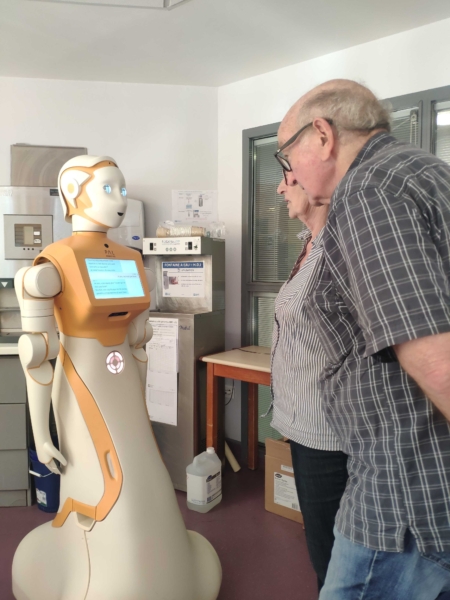
Patients and companions make their enquiries with the ARI robot
Professor Anne-Sophie Rigaud, Head of Department at Assistance Publique Hôpitaux de Paris, said:
“Our patients are increasingly interested in robotics and the evolution of hospital services, which they see as the logical evolution of our society. We believe that the ARI robot could in future become an essential element of patient care in hospitals, thanks to its capacity for social interaction and guidance.
“Older adults have also expressed that they’re pleased with the design of the robot and thought that it would be useful to provide information and companionship to patients with cognitive disorders.”
The feasibility of implementing the SPRING project has been made possible by academics at the National Robotarium who have made major advances in developing large language models (LLM) that enable robots to be capable of natural and fluent conversations with groups of people.
The Paris trials have provided key insights into how this emerging technology can enhance care delivery and safety whilst simultaneously advancing innovations in areas like computer vision, audio processing and human-robot interaction which have potential for further global applications.
The €8.4 million collaborative SPRING project includes researchers from Heriot Watt University, the National Robotarium, the Czech Technical University, Bar Ilan University Israel, University of Trento Italy, Assistance Publique Hôpitaux de Paris, PAL Robotics Spain, ERM AUtomatismes France, and is coordinated by Inria France. SPRING received support from Horizon 2020, a programme funded by the European Union.
The National Robotarium is part of the Data-Driven Innovation initiative, supported by £21 million from the UK Government and £1.4 million from the Scottish Government. The initiative aims to turn Edinburgh into the data capital of Europe and is part of the wider £1.3 billion Edinburgh and South-East Scotland City Region Deal.

Professor Oliver Lemon, academic co-lead at the National Robotarium
Oliver Lemon is a professor of AI and academic co-lead at the National Robotarium. He said:
“Today’s rapid advances in AI are truly inspiring and open up a world of possibilities for its positive impact on various sectors, including healthcare. One of the most significant contributions of robotics and AI is its ability to conserve resources and alleviate human workload, therefore providing valuable new tools for enhancing healthcare delivery.
“The prospect of robots seamlessly collaborating with hospital staff to enhance the patient experience is now closer to reality. Promising initial trials at Assistance Publique Hôpitaux de Paris have demonstrated our robot’s ability to converse effectively with patients and their companions simultaneously.
“We believe that the SPRING project marks a significant milestone in the development of interactive robotics, and we are proud of its achievements, while recognising the exciting challenges that lie ahead.”
UK Government Minister for Scotland, Malcolm Offord, said:
“The early trials into helper robots successfully demonstrates the great potential such advanced technology has to deliver vital support to health staff, improve patient care and prevent the spread of infections and diseases.
“The UK Government has invested £21 million in the National Robotarium helping foster world-leading research and support high quality jobs, investment and growth, as part of our more than £2.9 billion investment to level up across Scotland.”
Scottish Government Wellbeing Economy, Fair Work and Energy Secretary, Neil Gray, said:
“I welcome this progress using artificial intelligence to help ease the pressure on health service staff.
“With Scottish Government support, the National Robotarium is using cutting edge research to help drive innovation and artificial intelligence to deliver creative solutions to real world challenges.”

Robotics and automation are already helping to reduce risk to humans and increase productivity on building sites, writes Pete Felton, Business Development Executive at the National Robotarium.
FROM its early use on films such as Rocky, Marathon Man, and The Shining through to its modern appearances at the side of football matches and other sporting clashes, the Steadicam has revolutionised the life of camera operators, removing much of the strain of manoeuvring heavy equipment from their shoulders and arms. Soon, construction workers should be benefiting from similar assisted technology too.
In the same way that the Steadicam rig helps camera operators by spreading the weight of cameras, batteries, and monitors throughout their core, engineers are developing systems to aid construction workers in handling heavy tools. Rather than putting the pressure on workers’ shoulders or arms, these robotic structures should help to spread the load, cutting down on the number of potential workplace injuries.
Other robotic systems are already making a difference on construction sites. Hilti’s Jaibot semi-autonomous drilling robot is harnessing data from building information modelling (BIM) systems to carry out mechanical, electrical, and plumbing (MEP) installation tasks such as overhead drilling, both improving productivity and reducing the strain on human workers.
That focus on health and safety is one of the key areas in which robotics and automation can help to take people away from dangerous and dirty jobs, helping to improve the quality of life for everyone. Robots and people can work side by side in safety.
This isn’t about robots taking people’s jobs – there’s a massive skills shortage in the construction industry and so if we can take workers away from mundane and repetitive jobs and use robots instead then those workers can be retrained to carry out more skilled tasks, adding greater value to projects and giving them more job satisfaction.
Brick-laying machines don’t work well because people are better suited to that type of skilled work. But, in the pre-construction phase, robots could be assembling panels and other prefabricated materials, freeing up people to do tasks on site that require finer skills – such as sealing, plumbing, or installing electrics – which are much harder for robots.

Pete Felton, Business Development Executive at the National Robotarium
Here at The National Robotarium, we know that it’s no good talking the talk if we don’t walk the walk as well. That’s why we used a Spot robot – built by Boston Dynamics and kitted out with sensors by our team – to inspect our building site at night when construction was underway on our flagship facility.
This type of simultaneous localisation and mapping work is going to become even more important when stricter building regulations are introduced throughout the UK. Robots can help to gather the data that will be needed to prove that construction projects comply with environmental regulations – if robots don’t carry out this type of work then construction companies will need to employ people, at significant expense, to carry out mundane tasks such as checking sealant and auditing insulation.
Ultimately, using robots to gather data will enable the creation of digital twins while office blocks and industrial projects are being constructed, creating an accurate record of where each wire, cable, pipe, and duct is situated. Those digital twins can then be passed on by the builder to the facilities manager, making the maintenance of properties much easier and creating a digital link all the way through from the architect to the maintenance staff.
As well as improving conditions for workers and increasing productivity in the UK, the greater use of robotics and automation could also generate an economic boost for Britain through exports too. If British construction companies harness the power of robots then the technologies they create and the expertise they develop could be exported to markets throughout the world.
The building boom across the Gulf States and the wider Middle East is set to be eclipsed by the growth of the affluent middle classes in India, with the ensuing need for buildings that rapid urbanisation will bring. Such growth can only be achieved in an environmentally sustainable way if robotics and automation are harnessed throughout the construction process, from prefabrication through to retrofitting of existing buildings to make sure they keep dwellers cool in the summer and warm in the winter.
BIM and automation go hand-in-hand when it comes to energy efficiency, both for cooling systems and heating systems, making sure that buildings consume as little power as possible. If we get these factors correct in the UK then we can export that expertise around the world.
Health and safety and digital twinning are just two of the exciting areas in which robots can make a difference to building projects, but our engineers are always looking to work with staff at the sharp end of the construction industry to come up with new ideas – that’s why the doors at The National Robotarium are always open for collaborations.
This article was originally published in BIM Plus magazine on 11 January 2024.

Heriot-Watt University
Edinburgh, Scotland
UK EH14 4AS
Scottish registered charity number SC000278

The University of Edinburgh
Edinburgh, Scotland
EH8 9YL
Scottish registered charity number SC005336
 Scottish Government Flickr