

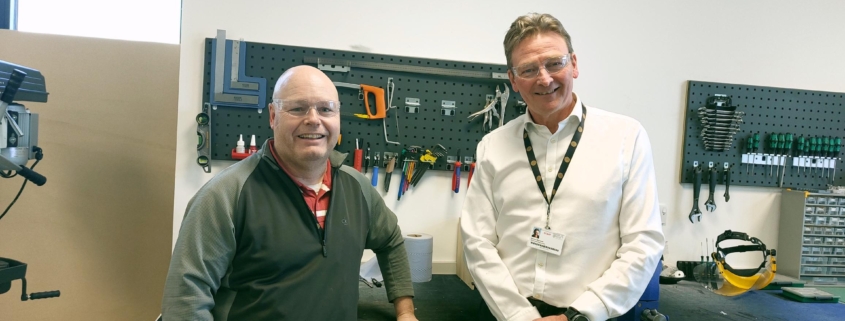
Technical experts at The National Robotarium have developed a sustainable system for recycling and repurposing plastic waste from 3D printers.
The UK’s centre for robotics and Artificial Intelligence at Heriot-Watt University is home to multiple 3D printers within its three distinct workshop spaces. The printers and other specialist machines are used daily by the facility’s engineering team, researchers and resident robotics companies.
With the price of printers and common materials, such as PLA (polylactic acid) filament, coming down in recent years, 3D printing is more accessible than ever. However, ease of production has created larger volumes of test and modular printing, increasing the amount of plastic discard.
Growing concerned about the large volumes of plastic offcuts being created in the workshops, Senior Technician for Robotics and Autonomous Systems, Thomas McGravie, and Senior Engineer Dr Alix Partridge were keen to explore ways to reuse the materials and reduce waste.
Thomas McGravie, Senior Technician at The National Robotarium
Compounding the issue further, leftovers from 3D printing cannot be easily recycled together, with different preparatory methods, such as drying or cleaning, required for different kinds of plastic.
Thomas, who oversees the workshops and technical spaces, said: “It was back in 2023, Alix and myself noticed that we were creating an astonishing amount of plastic waste through 3D printing; 54kg in two years!
“At the same time, I was talking to colleagues in other services and schools and found out that the Heriot-Watt is recycling 3 tonnes of plastic bottles a year. So, I wanted to come up with a way that we could repurpose the different types of plastic waste being produced on-campus.”
3D printing at The National Robotarium alone has created 54kg of plastic waste in two years
As part of his quest, Thomas looked online for inspiration, but found most solutions were either too costly or so time and labour-intensive that the benefits were negligible.
“I continued to browse online and stumbled upon someone in Australia who used a t-shirt press to flatten and melt down plastic shreds, reconstituting the 3d printed waste into sheets. Just by chance, one of our academics, Dr Alistair McConnell, had procured a shredder and injection moulding machine for a project, and he let us use these to recreate the first step of this process.”
A simple t-shirt press can melt plastic shreds into smooth sheets
However, despite now having the process knowledge and access to some of the required machinery, there was another factor getting in the way; time.
As Thomas explains: “Whilst we were keen to be more sustainable and reduce our carbon footprint, the demands our day-to-day jobs didn’t allow much time for experimentation.”
Fortunately, the discovery coincided with the centre hosting Fabio Tatti (Imperial College London) and Rob Woolley (University of York), two technicians from the UKRAS STEPS (UK Robotics and Autonomous Systems Strategic Technical Platform) network, who were interested in working on the filament recycling project as part of a week-long secondment.
The National Robotarium is a key delivery partner in the 3-year project, led by the University of Leeds and funded by the UKRI Engineering and Physical Sciences Research Council (EPSRC), that aims to strengthen the UK’s Robotics and Autonomous Systems capabilities and improve the long-term career prospects of Research Technical Professionals (RTPs).
Thomas and visiting technicians were awarded a Highly Commended prize at the UK RAS STEPS Technical Showcase event in June 2025 [l-r: Graham Brown (winner), Fabio Tatti, Rob Wooley,Thomas, Charles Richards]
Thomas said: “The visiting technicians were a fantastic support. Having four pairs of hands allowed us to fine-tune the system and produce more consistent heats and temperatures.”
The team presented on the project at the UK RAS STEPS Technical Showcase event, held at the London Science Museum in June, taking away the Highly Commended prize in the ‘Innovative Teamwork in Robotics’ category.
As well as facilitating the secondments, UKRAS-STEPS also provided financial support for the purchase of additional equipment, enabling Thomas and Alix to formalise the process and produce a template, which can be shared by other participating institutions across the UK.
“The support from UKRAS-STEPS has been vital to finessing the process. We are now able to recycle 3d printer waste into other items, such as badges and keyrings, which could be given to visiting school groups and work experience students. In time, we’re hoping to create items that are more commonly used in labs and workshops, greatly reducing the need to purchase these plastics as new.
“This has the potential to create a massive reduction in 3D printed plastic waste, not just at The National Robotarium but in RAS labs up and down the country.
Whilst the recycling system promises a sustainable and circular solution to plastic waste, Thomas thinks behavioural change is also needed to tackle the problem.
“We need to consider the reasons why we’re producing so much waste in the first place. Low costs and speedy turnaround times make it too easy to run off multiple prototypes in bulk – we need to be more mindful during the design process to not be wasteful and only print what we need.”
https://thenationalrobotarium.com/wp-content/uploads/Plastic-recycling-machine-1000px.jpg6661000Louise Jackhttp://thenationalrobotarium.com/wp-content/uploads/Robotarium.pngLouise Jack2025-07-30 12:52:022025-07-30 12:52:02National Robotarium technical team tackles 3D printing plastic problem
The National Robotarium is proud to support International Women’s Day, celebrated annually on March 8 to honour the achievements of women across all aspects of life – social, economic, cultural, and political – while also advocating for gender equality.
Every year, we celebrate the achievements of our incredible female colleagues who are helping to drive advancements in robotics and Artificial Intelligence, and shaping the future by empowering more women and girls to embrace robotic technologies in their education, lives and careers, for generations to come.
Accelerating Action
To mark this year’s theme ‘Accelerate Action’, we asked some of the team what steps are being taken to improve gender equality in robotics, and what else can be done to encourage more pioneering women to pursue a career in robots, AI, computer science, engineering, technology and other STEM subjects.
Women in Robotics at The National Robotarium
Find out more about how female members of The National Robotarium team have navigated their careers, and the advice they’d give to women, girls and anyone else who’s interested in joining the Robotics Revolution.
Rowanne Miller, Project Manager
Dr Hsing-Yu Chen, Senior Robotics Engineer
Lisa Farrell, Business Development Manager
Dr Maria Koskinopoulou, Assistant Professor of Engineering
https://thenationalrobotarium.com/wp-content/uploads/InternationalWomensDay_Icon_WhiteOnPurple.jpg10001000Louise Jackhttp://thenationalrobotarium.com/wp-content/uploads/Robotarium.pngLouise Jack2025-03-07 15:49:172025-03-07 15:49:17International Women’s Day 2025 – Celebrating Women in Robotics
Originally published in The Manufacturer on 9 December 2024, Stewart Miller, CEO of the National Robotarium, explains why the recently announced Industrial Strategy will be pivotal in supporting the UK’s potential to lead the global robotics revolution.
Imagine a near future where autonomous robots maintain vast offshore wind farms, where precision manufacturing systems collaborate seamlessly with skilled technicians, and where British-made robotics lead global innovation in healthcare, energy, and industrial automation. This future isn’t decades away – it’s within our grasp. But seizing it requires urgent action.
As the government sets out its vision for Britain’s industrial future, the stakes for manufacturing could not be higher. The sector currently accounts for 10% of GDP – increasing this to 15% would add £142bn to the economy. Achieving this transformation, however, requires modernising our manufacturing capabilities, particularly in robotics and automation where Britain lags dangerously behind global competitors.
With just 119 robots per 10,000 manufacturing employees, the UK has recorded the lowest robotics adoption in the G7, trailing not only traditional competitors but emerging economies like Mexico and Turkey. While Asia installs 73% of new industrial robots and the EU maintains steady growth, the UK’s modest 3% growth rate signals concerning trends for our future competitiveness.
A missed opportunity
The economic stakes are enormous. The global robotics technology market is projected to surge to £283bn by 2032, representing a transformative opportunity that the UK must seize to remain competitive. Goldman Sachs forecasts humanoid robots becoming economically viable for factories by 2027, while countries like Australia and China are already racing ahead with ambitious national robotics strategies. Without decisive action now, Britain risks missing this opportunity entirely.
The implications for UK manufacturing are profound. Currently facing 70,000 sector vacancies, manufacturers are struggling not just with labour shortages but with reshoring opportunities that could strengthen domestic supply chains. Advanced robotics could enable this reshoring while creating thousands of high-skilled jobs across development, integration, maintenance, and manufacturing support roles.
Yet a critical mistake in current policy is subsuming robotics under artificial intelligence initiatives. While AI is crucial, robotics requires distinct strategic focus and investment. The technology’s physical nature demands specialised facilities for development, testing, and manufacturing – infrastructure that can’t be created through software alone. A standalone robotics strategy would help unlock the full potential of this transformative technology.
Accelerating innovation
The solution lies in developing comprehensive robotics clusters that integrate research, manufacturing, and skills development. Examples like the National Robotarium in Edinburgh demonstrate how dedicated facilities can accelerate innovation, with such centres becoming home to hundreds of robotics professionals, housing successful startups, supporting industry-funded projects, and engaging thousands in robotics education.
The vision for expansion includes ten new regional centres, each supporting specific industrial clusters and manufacturing capabilities. In the Northeast, a specialised centre could further develop offshore robotics capabilities, supporting both renewable energy and the oil and gas sector’s transition. The Northwest could leverage its medical technology strengths to pioneer healthcare robotics, from surgical systems to sterile manufacturing processes.
In the Midlands, a specialised centre could leverage the region’s automotive heritage to pioneer advanced manufacturing robotics, building on decades of expertise in production line automation. The South could build on its strengths in aerospace and defence, developing robotics for precision manufacturing and testing. Each centre would combine research facilities, testing capabilities, and training programmes to create innovation ecosystems serving the specific needs of their local industrial bases.
A network of this size and depth requires comprehensive support. A coordinated skills strategy must ensure the UK develops expertise to design, programme, maintain, and operate advanced robotics systems. This includes embedding robotics in education from primary school onwards, creating new vocational qualifications in robotics manufacturing, and integrating robotics modules into existing qualifications across health and social care, construction, agriculture, energy, and engineering.
The Industrial Strategy must also address procurement barriers, particularly within large state-funded organisations like the NHS, where complex pathways slow adoption of innovative solutions. Reform should include specific provisions for robotics adoption, similar to environmental impact assessments in public tenders. Additionally, cybersecurity frameworks must be established to ensure robust protection as robotics systems become more interconnected and integral to critical infrastructure.
As the Tony Blair Institute’s recent report on ‘next-wave robotics’ emphasises: “The challenge of responding is so urgent, the risk of falling behind other countries so great, and the opportunities so exciting, that nothing less will do.” The UK, with our track record in innovation and engineering excellence, has the potential to lead the global robotics revolution – but scaling these capabilities and realising our collective ambition requires bold policy vision and decisive government action.
We must choose: become an active producer of robotics technology, creating high-skilled jobs and driving economic growth across our regions, or remain a passive consumer as other nations seize the opportunities ahead. The evidence and urgency are clear. The Industrial Strategy must provide the framework for Britain to become a true robotics nation, turning our world-class innovation into world-leading industrial capability.
https://thenationalrobotarium.com/wp-content/uploads/AdobeStock_804546185-scaled.jpeg18742560Louise Jackhttp://thenationalrobotarium.com/wp-content/uploads/Robotarium.pngLouise Jack2024-12-09 10:46:232025-05-06 16:43:45Why 2025’s Industrial Strategy must close Britain’s manufacturing robotics gap
To mark National Engineering Day (13 November 2024), we have been speaking to our Robotics Engineers about their career paths, engineering role models and what a typical day is like at the National Robotarium…
Hsing-Yu Chen
Who’s your engineering role model?
One of my key role models in engineering is Morris Chang, the founder of Taiwan Semiconductor Manufacturing Company (TSMC). His technical expertise, leadership and vision have revolutionised the semiconductor industry and made a huge impact on global technology innovation. His emphasis on long-term thinking, collaboration, and focus on excellence in manufacturing processes continues to inspire me in my own work.
What in your mind is an example of good engineering?
An example of engineering that truly inspires me is the development of reusable rockets. This breakthrough in space technology shows us the power of dreaming big and pushing the boundaries of what’s possible. The ability to reuse rockets—once thought to be impossible—has the potential to completely reshape the aerospace industry, opening up new possibilities for space travel and exploration.”
What is typical day like as a Robotics Engineer?
A typical day for a robotics engineer begins with problem-solving, addressing challenges and issues related to the robots they are developing. This entails brainstorming innovative solutions to optimize robot performance, troubleshooting both hardware and software components, conducting experiments to validate the robots’ functionality, and delving into data analysis. Given the collaborative nature of their work, engineers often engage in ongoing communication with team members and clients.
What skills are required to be a good engineer?
Beyond technical proficiency, being a good engineer relies on essential problem-solving and critical thinking skills, enabling the identification and resolution of intricate engineering challenges. Equally critical is a commitment to continuous learning and stay attuned with this rapidly evolving field, ensuring that engineers can adapt to new technologies and innovate effectively.
How does engineering improve people’s lives?
Robotics engineering plays a pivotal role in enhancing people’s lives in numerous ways. For instance, the creation of surgical robots and prosthetic limbs improves the quality of medical treatments and enhances the lives of patients. Autonomous vehicles not only increase transportation efficiency but also enhance road safety. Assistive robots simplify daily tasks, making life more convenient and accessible for individuals. These advancements underscore the transformative impact of robotics engineering on our daily existence and overall well-being.
How can engineering help us live and/or work more sustainably?
Robotic engineering offers substantial potential to enhance sustainable living and working in various domains. This can be achieved by automating industrial processes to boost efficiency, optimising resource utilisation to reduce consumption and lower carbon emissions, improving recycling rates through precise sorting, and monitoring environmental changes. These technologies have the potential to create a more environmentally friendly and resilient world.
Hari Lakshman
Who are your engineering role models?
The reason I pursued an engineering career was after watching an animated video about Nikola Tesla’s life. Reading about his work, dedication, and passion to keep inventing things inspired me to follow in his footsteps. Another inspiration in my life is Henry Ford, who taught me so much about tech business, optimisation, and efficiency.”
Can you give an example of good engineering that inspires you?
The pyramids are the first engineering marvel that blew my mind; it’s exhausting even to imagine the methods ancient people might have used to build such a magnificent structure. Another marvel is the Chandra X-ray Observatory, which enables scientists to collect data and images for space research. This incredible piece of engineering has revolutionised space science research.”
What does the role of Robotics Engineer involve?
Robotics engineers involve themselves in various fields of engineering. It is always a big learning curve, sometimes building robots feels like creating a human child. We have knowledge in coding, software development, and designing prototypes, which involves an extensive understanding of mechanical engineering, electrical engineering, and control systems. We try and implement cutting-edge machine learning and AI algorithms to make the robot more intelligent and more efficient. For me, I’m still learning lots and lots to become a fine-tuned robotics engineer.
What skills are required to be a good engineer?
Robotics engineers should have skills such as critical thinking and design thinking, programming, active learning, teamwork, safety skills and leadership qualities.
How does engineering improve people’s lives?
Engineering helps to improve people’s lives in every possible way: economically, and ethically, it helps to improve quality of life, solve societal problems, fight against climate change and more. At the National Robotarium, we use our engineering skills to build robots that can help people with physically or mentally challenging tasks, and improve efficiency and cost-effectiveness.
Ronnie Smith
What is typical day like as a Robotics Engineer?
What you spend most of your time on day to day depends on your own role within the team. Some engineers can spend most of their day at a computer doing design or programming, while others might do largely hands on work building, extending, debugging, and maintaining robots. Since we tend to work on multiple projects at once, most days start by figuring out what to prioritise. For me, a typical day might involve some proposal writing, development work, project team meetings, and monitoring/debugging some of the robots we are testing as part of ongoing projects.
What skills are required to be a good engineer?
Since robotics is such an inter-disciplinary field, I think there is no fixed set of skills to be a robotics engineer. I think a good robotics isn’t necessarily someone who is an expert in all aspects of robotics, but rather someone who has their own strengths in a few core areas and who is interested in learning about the whole robotic system to the point where they can understand how everything fits together. This applies to myself, as I come from mainly a software background, but am keen to use my time at the National Robotarium to learn and become a more “rounded” robotics engineer.
How does engineering improve people’s lives?
Most of the time, when engineers are working on a problem it is in the name of improving our comfort, efficiency, safety, or our general quality of life. Robotics is a field which has the potential to touch on all of these aspects. In my previous role as a PhD student, we worked on assistive robotics and technology for older adults. Through user engagement we worked to understand the ways in which collaborative robotics can enable individuals to live in their own home for longer by automating aspects of daily tasks that might otherwise be impossible to complete alone.
How can engineering help us live and/or work more sustainably?
One of the main ways that robots can aid with sustainability is by being more efficient than the solutions that came before. What is meant by efficiency will of course differ across domains, but for example in manufacturing this might mean process efficiency which increases hourly output for the same or less energy. On the other hand, in agriculture it could be that increased precision in turn leads to increased efficiency, e.g., more accurate and targeted spraying of crops conserves resources.
Can you give an example of good engineering that inspires you?
I would look to the semiconductor industry and the advancement of the transistor-based processor over the past several decades as an example of inspiring engineering. Computers today are using billions of tiny transistors, manufactured at nanometre scale, to perform trillions of mathematical operations every second. This achievement has relied on back-to-back advancements and innovation across materials science, lithography, quantum physics, and of course computer and electronics engineers. To me, this is a shining example of human ingenuity and our ability to work together on a large scale to create technology that is so pervasive and seamless that we are able to take it for granted.
Rahul Ramachandran
Who are your engineering role models?
The Wright brothers and Dr. A.P.J. Abdul Kalam are two of my biggest role models. The Wright brothers’ achievement in creating the first successful powered airplane inspires me with their relentless pursuit of innovation and their ability to overcome doubt and failure. Similarly, Dr. Kalam’s perseverance and contributions to ISRO, especially his leadership in missions like India’s Mars Orbiter Mission, remind me of the importance of vision and hard work in achieving groundbreaking results. Both have shown me that with determination and passion, it’s possible to change the course of history.
Can you give an example of good engineering that inspires you?
One piece of engineering that really inspires me is the Moog synthesizer. What I love about it is how it simplified the complex technology of earlier electronic instruments, making it easier for musicians to use. The design is so elegant, and the way it combines innovation with simplicity was groundbreaking at the time. The Moog didn’t just change the way music was made; it made a complex tool feel accessible, showing how thoughtful design can open up new possibilities and spark creativity in unexpected ways.
What does the role of Robotics Engineer involve?
Robotics is an interdisciplinary field and because of that robotics engineer’s role depends on one’s engineering background, be it mechanical, electrical, computer science, sociology or applied physics. For example, a robotics engineer with a degree in Mechanical Engineering would work on the design and modelling of robot mechanics, whereas one with a background in electrical and electronics engineering would develop the robot’s battery management system and its sensors and actuators.
What skills are required to be a good engineer?
I believe that to be a good engineer, you must be able to understand the need for an engineering solution to any given problem. It’s not the “what” and “how” but the “why” that comes first.
Be curious, take inspiration from nature and question EVERYTHING! Analytical thinking is very important as is the ability to communicate effectively in a collaborative environment. It is helpful to have an engineering degree, but it is not always necessary if you have the proper knowledge and practical skills.”
How does engineering improve people’s lives?
We live in a world where everything we see has been engineered for us to live a better life, especially in today’s modern digital world, where everything is data-driven. We now have self-driving cars and text-to-speech solutions such as Okay Google, Alexa and Siri which enable us to make calls and play songs using voice commands.
At the National Robotarium, we are developing solutions such as unmanned underwater robots to undertake the inspection of offshore turbines, which is currently being done by deep-sea scuba divers. We are also improving the quality of life for many people doing repetitive tasks in factories by developing solutions for factory automation, which will enable people to safely undertake less repetitive and more skilled tasks side-by-side with robots.
The National Robotarium is supporting the development of new artificial intelligence and control systems that could enable underwater robots to operate autonomously in turbulent seas, potentially revolutionising maintenance and repair tasks for offshore wind turbines.
The UNITE project, an EPSRC Prosperity Partnership programme led by Heriot-Watt University in collaboration with Imperial College London, is creating new artificial intelligence and control systems in partnership with geo-data specialist Fugro and Heriot-Watt University spinout Frontier Robotics, supported by the National Robotarium, the UK’s centre for robotics and AI.
“The UNITE project was co-created with Fugro to develop the next generation of autonomy-enabled robotics solutions for offshore inspection and maintenance. We are especially interested in subsea inspection and manipulation in dynamic environments where existing solutions cannot be used.”
– Yvan Petillot, Professor of Robotics at Heriot Watt University and National Robotarium academic lead
“Our trials are showing promising results in enabling underwater robots to maintain stable contact with offshore structures in challenging conditions,” said David Morrison, Project Manager at the National Robotarium. “If successful, the technology could transform offshore wind maintenance, reducing fuel consumption of maintenance missions by up to 97% – from 7,000 litres per day to just 200 litres. This could significantly lower both operational costs and the carbon footprint of maintenance.”
The project demonstrates the National Robotarium’s role in bringing together established companies and emerging innovators. Through its laboratories and testing infrastructure, the facility enables rapid development and validation of commercial solutions. The technology being developed could reduce standard data collection time from three weeks to just three hours.
“With the exponential growth of offshore infrastructure, we need to look towards deploying more AI, robots and autonomy to enable the industry to take advantage of new technologies to work even more efficiently and to scale with the global demand,” said Jonatan Scharff Willners, CEO of Frontier Robotics. “It is great to work closely with Heriot-Watt University, the National Robotarium and Fugro to tackle these highly important problems, which are key components if we want to transition to renewable energy using a greener and more sustainable supply-chain.”
Mark Bruce, Global Product Manager of Next Generation ROV Systems at Fugro, said: “Our USVs and eROV’s deliver unmatched efficiency, hugely reduced environmental impact, and most importantly they eliminate human risk offshore by removing people from harm’s way. Our remote operations centres have been operating for ten years, during which time we have refined and improved our solutions.”
The National Robotarium provides companies with access to laboratories, testing facilities, and specialised equipment, alongside support for commercialisation. Companies working at the facility can connect with researchers, access funding opportunities, and engage with the UK’s broader robotics ecosystem.
The £1.4 million Underwater Intervention for Offshore Renewable Energies (UNITE) project is led by Professor Yvan Petillot from Heriot-Watt University, with Dr. Sen Wang leading Imperial College London’s contributions, and is funded through an EPSRC Prosperity Partnership, part of UK Research and Innovation.
The National Robotarium welcomes contact from energy companies and technology providers interested in exploring the commercial applications of this technology. Email nationalrobotarium@hw.ac.uk or contact our Business Development team.
https://thenationalrobotarium.com/wp-content/uploads/Surface-vessel-and-autonomous-underwater-robot-undergoing-trials-in-Heriot-Watt-Universitys-wave-tank-facility-GoPro-stills.jpg15362048Louise Jackhttp://thenationalrobotarium.com/wp-content/uploads/Robotarium.pngLouise Jack2024-10-24 00:01:272024-10-24 09:54:06National Robotarium accelerates industry development of wind farm robotics
With the backing of funding from the Engineering and Physical Sciences Research Council (EPSRC), UKRAS-STEP will strengthen the UK’s Robotics and Autonomous Systems capabilities, improve the long-term career prospects of Research Technical Professionals (RTPs) and create stronger links between academia, industry and government.
Through a consortium of 37 universities within the existing UKRAS network, the project, led by University of Leeds Professor of Robotics, Robert Richardson, will deliver a programme of education across eight themes, designed to support the diverse range of technical expertise that currently supports world-class robotics research.
“Research technicians are the backbone of world-leading research into Robotics and Autonomous Systems, providing a wealth of technical expertise and operational support…”
– Steve Maclaren, Chief Operating Officer at the National Robotarium
Professor Richardson said: “Research Technicians in Robotics and Autonomous Systems play a pivotal role in advancing robotics research across various industry sectors in the UK, spanning from transport and healthcare to manufacturing and unmanned systems.
“Despite their amazing contribution, career growth opportunities are limited and as a result, some areas experience high staff turnover. UKRAS STEPS will establish a dedicated platform to address these challenges by facilitating the development of secondments, training programmes and mentorship schemes.
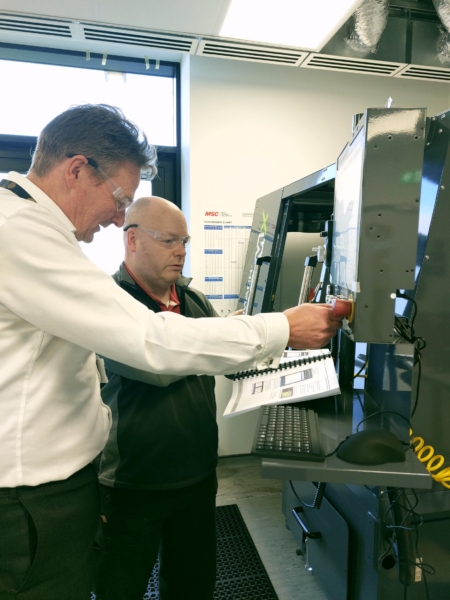
COO Steve Maclaren and Senior Technician Thomas McGravie
The National Robotarium will lead in formation of a number of task groups, each focused on addressing a particular challenge within the technical research sector. Through an open call, HEIs from the UK-RAS network will work together to deliver tasks ranging from small projects and producing training materials to holding national workshops and influencing policy through white papers.
“The UKRAS-STEP initiative will enable me and other technical research colleagues working in robotics across the UK to connect, share knowledge and best practice.”
– Thomas McGravie, Senior Technician at the National Robotarium
Chief Operating Officer at the National Robotarium Steve Maclaren will lead on the Task Groups work package. He said: “We are thrilled to be a part of the UKRAS-STEP programme and work with the RAS community to help advance training and opportunities for technical research staff.
“Research technicians are the backbone of world-leading research into Robotics and Autonomous Systems, providing a wealth of technical expertise and operational support that enable scientists to conduct research safely and effectively in an optimum research environment.
“Without them, we would be unable to maintain and manage essential research components such as robotic equipment, lab space, computer systems and software, so it is vital that our community of technical research professionals feel valued with opportunities to develop and grow.”
Thomas McGravie has been Senior Technician for Heriot-Watt University at the National Robotarium since it opened in September 2022. He said: “The UKRAS-STEP initiative will enable me and other technical research colleagues working in robotics across the UK to connect, share knowledge and best practice, and build upon our individual and collective skills.
“I’m excited to see the proposal come to life and look forward working more closely with the wider RTP community.”
About UKRAS-STEP
The UK Robotics and Autonomous Systems Strategic Technical Platform (UKRAS-STEP), led by University of Leeds, is one of 11 new projects benefitting from a share of a new £16 million investment by EPSRC and UKRI Digital Research Infrastructure (DRI) to improve the long-term career prospects of Research Technical Professionals (RTPs).
UKRAS-STEP will create a community-driven strategic technology platform that empowers individuals to develop, while building an inclusive community to enhance the UK research environment and support the delivery of world-class research in the UK.
Its three main objectives are:
i) To enhance individual technical knowledge, skills and career development amongst research technicians;
ii) Provide opportunities for networking, knowledge-sharing, community-driven activities, celebrating and promotion success, international collaboration and national advocacy;
iii) Deliver a flagship programme that is inclusive, ethical and sustainable.

https://thenationalrobotarium.com/wp-content/uploads/1000002836.jpg17342312Louise Jackhttp://thenationalrobotarium.com/wp-content/uploads/Robotarium.pngLouise Jack2024-03-18 11:04:362024-08-23 10:51:06The National Robotarium to support robotics technician development across UK
Robotics and automation are already helping to reduce risk to humans and increase productivity on building sites, writes Pete Felton, Business Development Executive at the National Robotarium.
FROM its early use on films such as Rocky, Marathon Man, and The Shining through to its modern appearances at the side of football matches and other sporting clashes, the Steadicam has revolutionised the life of camera operators, removing much of the strain of manoeuvring heavy equipment from their shoulders and arms. Soon, construction workers should be benefiting from similar assisted technology too.
In the same way that the Steadicam rig helps camera operators by spreading the weight of cameras, batteries, and monitors throughout their core, engineers are developing systems to aid construction workers in handling heavy tools. Rather than putting the pressure on workers’ shoulders or arms, these robotic structures should help to spread the load, cutting down on the number of potential workplace injuries.
Other robotic systems are already making a difference on construction sites. Hilti’s Jaibot semi-autonomous drilling robot is harnessing data from building information modelling (BIM) systems to carry out mechanical, electrical, and plumbing (MEP) installation tasks such as overhead drilling, both improving productivity and reducing the strain on human workers.
Helping to narrow the skills gap
That focus on health and safety is one of the key areas in which robotics and automation can help to take people away from dangerous and dirty jobs, helping to improve the quality of life for everyone. Robots and people can work side by side in safety.
This isn’t about robots taking people’s jobs – there’s a massive skills shortage in the construction industry and so if we can take workers away from mundane and repetitive jobs and use robots instead then those workers can be retrained to carry out more skilled tasks, adding greater value to projects and giving them more job satisfaction.
Brick-laying machines don’t work well because people are better suited to that type of skilled work. But, in the pre-construction phase, robots could be assembling panels and other prefabricated materials, freeing up people to do tasks on site that require finer skills – such as sealing, plumbing, or installing electrics – which are much harder for robots.

Pete Felton, Business Development Executive at the National Robotarium
Harnessing the power of digital twins
Here at The National Robotarium, we know that it’s no good talking the talk if we don’t walk the walk as well. That’s why we used a Spot robot – built by Boston Dynamics and kitted out with sensors by our team – to inspect our building site at night when construction was underway on our flagship facility.
This type of simultaneous localisation and mapping work is going to become even more important when stricter building regulations are introduced throughout the UK. Robots can help to gather the data that will be needed to prove that construction projects comply with environmental regulations – if robots don’t carry out this type of work then construction companies will need to employ people, at significant expense, to carry out mundane tasks such as checking sealant and auditing insulation.
Ultimately, using robots to gather data will enable the creation of digital twins while office blocks and industrial projects are being constructed, creating an accurate record of where each wire, cable, pipe, and duct is situated. Those digital twins can then be passed on by the builder to the facilities manager, making the maintenance of properties much easier and creating a digital link all the way through from the architect to the maintenance staff.
Widening opportunities for export success
As well as improving conditions for workers and increasing productivity in the UK, the greater use of robotics and automation could also generate an economic boost for Britain through exports too. If British construction companies harness the power of robots then the technologies they create and the expertise they develop could be exported to markets throughout the world.
The building boom across the Gulf States and the wider Middle East is set to be eclipsed by the growth of the affluent middle classes in India, with the ensuing need for buildings that rapid urbanisation will bring. Such growth can only be achieved in an environmentally sustainable way if robotics and automation are harnessed throughout the construction process, from prefabrication through to retrofitting of existing buildings to make sure they keep dwellers cool in the summer and warm in the winter.
BIM and automation go hand-in-hand when it comes to energy efficiency, both for cooling systems and heating systems, making sure that buildings consume as little power as possible. If we get these factors correct in the UK then we can export that expertise around the world.
Health and safety and digital twinning are just two of the exciting areas in which robots can make a difference to building projects, but our engineers are always looking to work with staff at the sharp end of the construction industry to come up with new ideas – that’s why the doors at The National Robotarium are always open for collaborations.
This article was originally published in BIM Plus magazine on 11 January 2024.
https://thenationalrobotarium.com/wp-content/uploads/AdobeStock_220539261-scaled.jpeg17072560Louise Jackhttp://thenationalrobotarium.com/wp-content/uploads/Robotarium.pngLouise Jack2024-01-22 16:23:192024-01-22 16:24:25How robots are taking BIM to the next level
I knew when it began that 2023 was going to be an interesting year. I had secured a Royal Academy of Engineering Enterprise Fellowship to pursue Frontier Robotics, a new spin-out created to advance software for underwater robotic autonomy, exploration and inspection and had one year to make the company a reality. Little did I know that, by the year’s close, I would be exhibiting our technology in Dubai during COP28, the world’s largest climate change conference, and meeting VIPs, including royalty!
The support included in the Fellowship provided a great grounding to this whirlwind year. As well as a year’s salary, it offered new Fellows a business support programme, consisting of several days intensive business training from St John’s Innovation Centre with expert advice encompassing pitching, branding and marketing, finance, and legal – all the foundational elements of a fledgling business – as well as access network of ~600 other startup companies. The Fellowship also provided a £15k business support grant that I put towards early-stage financing, webservers, and integrating our core produce AUIP (Autonomous Underwater Inspection Payload) with an ROV manufacturer for a potential future partnership in Norway.

3D reconstruction from testing in a harbour in Norway
The advice and insight from the Fellowship proved invaluable. In May, Frontier Robotics won £100k grant at the Scottish EDGE Awards, the highest possible funding, including a special EDGE prize for Net Zero. This was only our first attempt (I’d heard anecdotally that most successful companies take at least two), so it really proves the effectiveness of the business support I’d had to that point. Particularly learning how to effectively pitch our business in less than 3 minutes.
The Scottish EDGE win changed everything. The investment allowed me to expand the team – I now employ 1 full-time and 2 part-time engineers, as well as a PhD student one day per week – and establish a base for developing Frontier’s technology from theoretical research developed during ORCA Hub(the offshore robotics research project that was a precursor to the National Robotarium’s autonomous underwater robotics research theme), to practical commercial applications that can be adopted by industry.

Jonatan Scharff-Willners winning the top prize of £100k at Scottish EDGE 2023
The win also led to an invite to join the Scottish Enterprise High-Growth Venture Programme, matching me with a mentor to support entrepreneurial skills development, develoeping my business models and helping me engage with investors to raise additional funding. I look forward to working with them over the next few months to accelerate the growth of the company.
Being part of the Heriot-Watt University ecosystem has reaped its rewards. In 2022, ORCA won ‘Research team of the year’ at the Heriot-Watt people celebration awards, and we were a finalist in the Times Higher Education Awards, two significant achievements that felt like the peak of success. Little did I know it was just the beginning of a much larger adventure, preceding a year when I gained more knowledge and experience than I could have imagined!
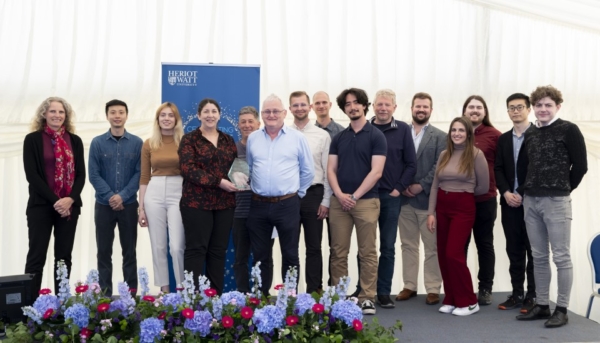
The ORCA hub wins Research Team of the Year at the 2022 Heriot-Watt University ‘Celebrating our People’ Awards
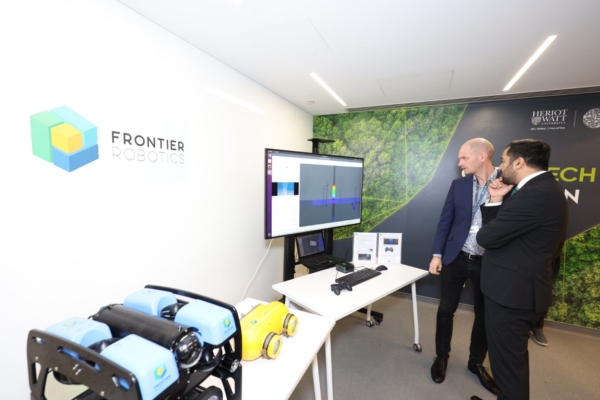
The in-house Business Development team at Heriot-Watt have also been incredibly supportive throughout the year, offering advice, invites to events and networking opportunities. The team at GRID was instrumental in my participation in the Clean Tech exhibition, part of the Climate Hub programme running at Heriot-Watt’s Dubai campus during COP28. They approached me to showcase the business at an exhibition space visited by scientists, policymakers, schools, invited guests and VIPs throughout the global conference.
I was honoured to exhibit alongside nine other companies that are developing technologies and products for a more sustainable future. These included Crover, also based at the National Robotarium, who have created a burrowing robotic drone to test the environmental conditions of grain silos, feeding back data to help farmers reduce waste caused by moisture and pest infestations; and Smartrawl, headed by Professor Paul Fernandes from the University’s Lyell Centre for Earth and Marine Sciences, which has invented an AI-empowered fishing net to identify different species of fish and prevent bycatch of those not needed by trawlers.
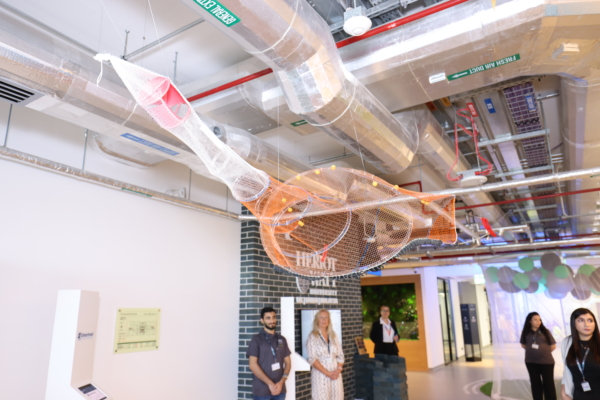
A prototype of the Smartrawl AI-empowered fishing net to prevent and reduce trawling bycatch
Meeting and sharing the space with these innovative businesses was one of the most beneficial aspects of the trip. We were able to share our experiences of running a startup and I got lots of valuable advice from those who have already navigated the potential and pitfalls of the Scottish funding and investment landscape. Being in an environment where we quickly connected and could share our successes and struggles bonded us immediately and it’s great to be part of a network of start-ups that can learn from each other’s mistakes and provide much-needed motivation.
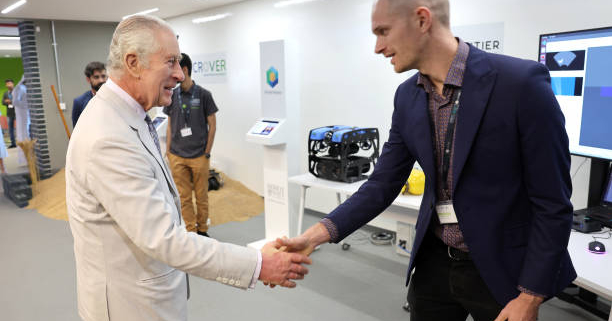
The first day in Dubai was an exciting one. We had been informed that His Royal Highness, King Charles III would be visiting to officially open the campus and tour around the CleanTech exhibition and we each had an opportunity to pitch. Despite being told there was only enough time to speak for a single sentence, the King was hugely generous with his time, showing genuine interest in our companies and asking lots of questions. I loved his down-to-earth nature and, as someone who’s been championing sustainable futures for decades, it was clear he was very knowledgeable about the challenges and opportunities for green businesses in the UK.
The First Minister of Scotland, Humza Yousaf, was also in attendance on the first day. I had met him before at Scottish EDGE and enjoyed speaking with him again about energy transition in Scotland.
Jonatan and Scottish First Minister Humza Yousaf
Over the week, the event brought in over 1000 visitors and it was lovely to meet so many interesting people. Our activity challenged willing participants to become an offshore operator in under 2 minutes using our shared autonomy system that guides and approves the actions in a simulated robotic inspection system.
I was particularly impressed with how quickly the school groups were not only able to grasp the importance for creating a greener future together, but also their ability to pick up the task, controlling the autonomy engine, robot, and 2-camera system (all developed at the National Robotarium) with ease. Our vision for the future is to see robots and humans seamlessly working together and it’s important that people feel empowered to use and control them effectively.
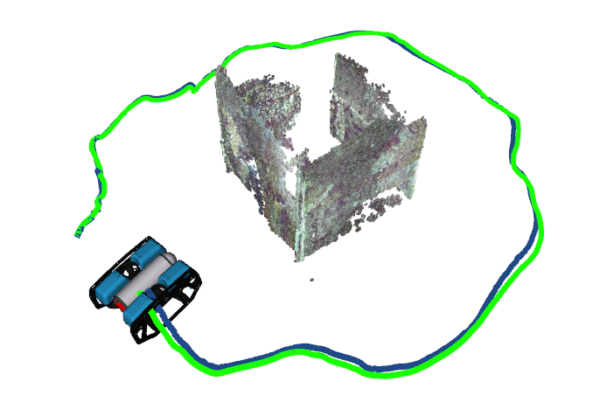
SLAM (simultaneous localisation and mapping) data
On our one day off, we were able to visit the COP28 exhibition arena and talk to some of the companies showcasing there. I was excited to see the latest inventions, learn what kinds of green tech we’re going to be using in the near-future and talk to potential investors.
What became really clear, really quickly, was that small start-ups and spinouts are leading the way for sustainable innovations, advancing new ideas and solutions to real-world problems quickly, and at scale. It’s an exciting time to be building a new business and heartening to see so many cool new companies coming through with a fresh vision, in comparison with bigger businesses who seem to be less transparent about what they’re doing to tackle climate change.
The week ended with some fruitful discussions with offshore industry representatives, and I’m excited that some have continued since I returned to Scotland.
In 2024, Frontier Robotics will be moving into our next phase of growing our industry portfolio and partnerships so it’s fantastic to have been able to connect with global companies and big industry names thanks to being part of Heriot-Watt University.
Jonatan, a Senior Robotics Engineer, and Frontier Robotics are based at the National Robotarium
https://thenationalrobotarium.com/wp-content/uploads/king1.jpg408612Louise Jackhttp://thenationalrobotarium.com/wp-content/uploads/Robotarium.pngLouise Jack2023-12-19 16:25:572025-04-25 12:16:42BLOG: A view from the Heriot-Watt Dubai Climate Hub – Jonatan Scharff-Willners, Frontier Robotics
Dr Ingo Keller has been appointed as the first Head of Robotics at the National Robotarium, the UK’s centre for Robotics and Artificial Intelligence.
A software, AI and robotics engineer with over 20 years of experience in science and industry, Ingo will lead the facility’s growing team of robotics engineers as they test and develop new technologies and systems to address real-world challenges. Current projects include robotics for sectors including agriculture, construction, manufacturing, aerospace and fisheries.
Ingo has in-depth, hands-on experience with a multitude of robotic systems, including all phases of software development, life-cycle management and DevOps tooling. He has co-founded a number of start-up technology companies in software architecture and database management systems, developing a keen understanding of the potential of applied emerging technologies for addressing industry challenges.
Prior to his new role, he was Chief Technology Officer at Xihelm, a London-based robotic harvesting solutions company, where he worked while completing a PhD in Data Augmentation for Human-Robot Interaction at Heriot-Watt University, where the National Robotarium is based.
On his new appointment, Ingo said: “I’m delighted to join the National Robotarium team at this exciting stage of its development and lead on the creation of robotics, AI and engineering systems that can truly transform people’s lives and work. My goal is to get more robots out of the lab and into the wild, and being able to talk directly to industry leaders about their challenges means we can develop safe, practical, and effective robotic technologies that can be seamlessly integrated into society.
“I’m also passionate about sharing the knowledge and expertise of our talented team to build robotics skills in different sectors, ensuring people are equipped with the tools they need to operate and manage robotics and AI, and promoting the positive benefits of these technologies to all.”
Stewart Miller, Chief Executive Officer, said: “The appointment of Ingo as our first Head of Robotics is an important and exciting milestone for the National Robotarium. He is passionate about applying his extensive expertise to new and interdisciplinary problem spaces and will be a great ambassador, working with experts in all fields of science and industry to advance state-of-the-art robotics systems.”

https://thenationalrobotarium.com/wp-content/uploads/WebsitePic-400x400-1.png400400Louise Jackhttp://thenationalrobotarium.com/wp-content/uploads/Robotarium.pngLouise Jack2023-08-29 09:50:122023-10-24 12:06:29The National Robotarium appoints first Head of Robotics
We may request cookies to be set on your device. We use cookies to let us know when you visit our websites, how you interact with us, to enrich your user experience, and to customize your relationship with our website.
Click on the different category headings to find out more. You can also change some of your preferences. Note that blocking some types of cookies may impact your experience on our websites and the services we are able to offer.
Essential Website Cookies
These cookies are strictly necessary to provide you with services available through our website and to use some of its features.
Because these cookies are strictly necessary to deliver the website, refusing them will have impact how our site functions. You always can block or delete cookies by changing your browser settings and force blocking all cookies on this website. But this will always prompt you to accept/refuse cookies when revisiting our site.
We fully respect if you want to refuse cookies but to avoid asking you again and again kindly allow us to store a cookie for that. You are free to opt out any time or opt in for other cookies to get a better experience. If you refuse cookies we will remove all set cookies in our domain.
We provide you with a list of stored cookies on your computer in our domain so you can check what we stored. Due to security reasons we are not able to show or modify cookies from other domains. You can check these in your browser security settings.
Google Analytics Cookies
These cookies collect information that is used either in aggregate form to help us understand how our website is being used or how effective our marketing campaigns are, or to help us customize our website and application for you in order to enhance your experience.
If you do not want that we track your visit to our site you can disable tracking in your browser here:
Other external services
We also use different external services like Google Webfonts, Google Maps, and external Video providers. Since these providers may collect personal data like your IP address we allow you to block them here. Please be aware that this might heavily reduce the functionality and appearance of our site. Changes will take effect once you reload the page.
Google Webfont Settings:
Google Map Settings:
Google reCaptcha Settings:
Vimeo and Youtube video embeds:
Other cookies
The following cookies are also needed - You can choose if you want to allow them:
Privacy Policy
You can read about our cookies and privacy settings in detail on our Privacy Policy Page.