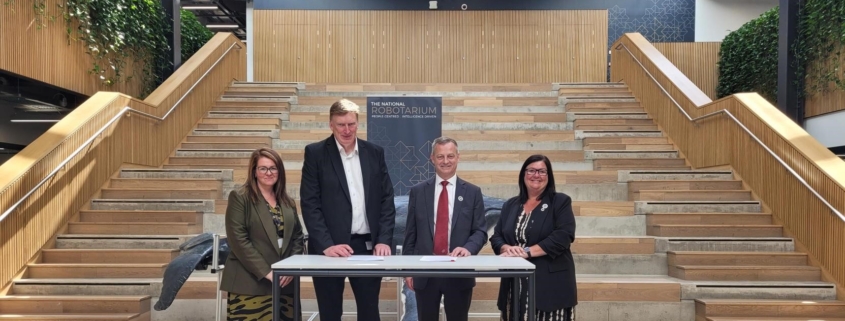
The National Robotarium entered into an international partner agreement with Robotics Australia Group (RAG), a non-profit national association that brings together companies, educational institutions, and public stakeholders to build a strong and sustainable interconnected robotics and autonomation ecosystem.
In a Letter of Intent signed by CEO of The National Robotarium, Stewart Miller and RAG CEO Nicci Rossouw in a virtual meeting on 2 December 2025, the two partners aim to develop joint initiatives and foster cooperation in areas including research and technology transfer, bilateral events and visits, and vocational and educational opportunities.
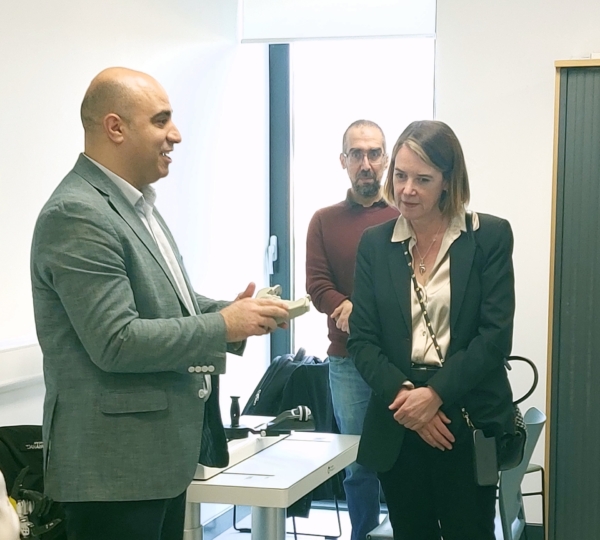
[clockwise from bottom: Stewart Miller, CEO and Steve Maclaren, COO of The National Robotarium, Nicci Rossouw, CEO of Robotics Australia Group]
This marks The National Robotarium’s second major international collaboration in 2025, following a Memorandum of Understanding signed in June with Robotekin, the Basque Association for Robotics and Automation. Together, these partnerships reinforce the centre’s commitment to building a globally connected robotics ecosystem that supports innovation, aligns regulatory frameworks, and accelerates technological progress.
Stewart Miller said: “Partnering with Robotics Australia Group marks an important step in our mission to build a globally interconnected robotics ecosystem. By combining our strengths, we can accelerate innovation, support emerging talent, and ensure that advances in robotics benefit industry and society worldwide.
“This agreement brings us closer to realising our ambition of becoming a truly globally significant centre for robotics.”
Nicci Rossouw said: “We are delighted to formalise our partnership with The National Robotarium. Together, we can build powerful pathways for collaboration that elevate research, talent development and industry capability across both nations.
“This relationship strengthens our shared vision for a thriving, sustainable robotics ecosystem.”
https://thenationalrobotarium.com/wp-content/uploads/Robotics-Australia-Group-e1765284080591.jpg12811813Louise Jackhttp://thenationalrobotarium.com/wp-content/uploads/Robotarium.pngLouise Jack2025-12-10 14:04:182025-12-10 14:04:18The National Robotarium signs strategic agreement with Robotics Australia Group to accelerate robotics innovation
The Data-Driven Innovation (DDI) Programme, a strategic partnership led by the University of Edinburgh and Heriot-Watt University, from which The National Robotarium centre for robotics and Artificial Intelligence was created, has won the Collaborative Initiative of the Year award at the prestigious Institute of Economic Development (iED) Annual Awards 2025.
This year saw a record-breaking number of entries, with almost 60 submissions received for seven award categories, and shortlisted nominations were assessed by an expert judging panel in September.
The Collaborative Initiative of the Year award, which this year is sponsored by Recurve Solutions, recognises outstanding cross-sector economic development collaboration between two or more partners drawn from local authorities, private sector, third sector, business and academia.
The submission outlined how the £700 million Data-Driven Innovation Programme, supported by the £1.3 billion Edinburgh and South East Scotland City Region Deal, unites the University of Edinburgh and Heriot-Watt University with six regional councils and industry to transform South East Scotland into the data capital of Europe. Delivering new infrastructure, thousands of skilled graduates, and high-growth ventures, the DDI programme is driving both inclusive growth and global competitiveness.
iED Director and former Chair Bev Hurley CBE, who hosted the awards honouring achievements across the public and private sectors, said: “Our judges said the Data-Driven Innovation Programme exemplifies the power of strategic collaboration to drive inclusive economic growth. With over £200 million in investment, support for over 600 companies, and a robust skills pipeline, the initiative demonstrates both measurable impact and long-term sustainability. They reported the seamless integration of public, academic, and industry partners sets a new benchmark for regional innovation.
“Our judges also praised the programme’s scale, infrastructure, innovation capacity, skills development, and global relevance, noting that these combined strengths position it as a catalyst for widespread economic and social benefit. In addition, they described the DDI Programme as a flagship model of collaborative economic development, delivering innovation, skills, and infrastructure at scale, and said that it is a benchmark for data-led transformation.”
Reflecting on the award, Professor Kim Graham, Provost of the University of Edinburgh and Senior Responsible Officer for the Data Driven Innovation Programme, commented: “This award is fantastic recognition of the impact of the DDI programme. The partnership between the universities of Edinburgh and Heriot-Watt is a shining example of how place-based investment in innovation and skills can have a transformative effect on economic growth, jobs and productivity, benefiting people in the region and beyond.”
Stewart Miller, Chief Executive Officer of The National Robotarium, said: “The National Robotarium is proud to be a part of the Data-Driven Innovation programme, a shining example of how collaboration between academia and industry can drive technological progress and create opportunities that will benefit businesses and communities across the region, the UK and beyond.
“Congratulations to the DDI delivery team and to our partner hubs for this award success.”
To find out more about the Data-Driven Innovation initiative and its partner hubs, visit: https://ddi.ac.uk/
https://thenationalrobotarium.com/wp-content/uploads/IED-awards-1500x500-1.jpeg5001500Louise Jackhttp://thenationalrobotarium.com/wp-content/uploads/Robotarium.pngLouise Jack2025-11-27 12:53:082025-11-27 13:00:32Data-Driven Innovation Programme wins Collaborative Initiative of the Year award at iED Annual Awards 2025
As the UK sets out its ambitious plans to rapidly expand its AI capabilities, The National Robotarium, the UK’s centre for robotics and Artificial Intelligence, is powering the ambitions for the ‘arms and legs of AI’: robots.
Now, as part of the centre’s ongoing commitment to drive the national adoption of robotics and AI, The National Robotarium is working closely with NVIDIA to leverage cutting-edge robotics and AI frameworks and create a robotics and AI ecosystem to enable growth and leadership in the UK.
The UK’s hub for robotics innovation
From its home at Heriot-Watt University in Edinburgh, The National Robotarium is widely recognised as the UK’s hub for robotics innovation; supporting cutting-edge, practical research, helping early-stage businesses grow, and fast-tracking new technologies that can transform people’s work, health and lives.
The model has attracted significant recognition within the UK and Scottish Governments, whose support via the Edinburgh and South-East Scotland City Region Deal was instrumental to launching the facility – as a partnership between Heriot-Watt and The University of Edinburgh – in September 2022. Building on this momentum, the Scottish Government recently backed a new initiative to help deep tech companies in Scotland anchor and scale – and fast-track robotics adoption within their operations – marking an encouraging step-change in policy that positions emerging technologies, including robotics and AI, as a key driver for economic growth.
A new era of AI sovereignty
This comes at a pivotal moment as the UK lays the groundwork for a new era of AI sovereignty, with an unprecedented £2 billion recently committed by the UK Government to build the robust, sustainable and secure infrastructure required to physically deploy advanced AI across the country. The opportunity for industry experts at the cutting-edge of digital technologies is substantial. Working with NVIDIA and other leading technology companies can help fully realise the UK’s potential for digital transformation through AI.
Celebrating the UK’s AI ecosystem
At a special UK ecosystem event this week, the National Robotarium Head of Robotics Dr Ingo Keller will lend an expert voice on AI-powered robotics, which are transforming healthcare delivery, supporting offshore energy maintenance, and driving manufacturing innovation, all crucial for delivering the UK Government’s vision.
Dr Ingo Keller is Head of Robotics at The National Robotarium
Coinciding with the event, TechUK, the UK’s technology trade association and champion of The National Robotarium, has announced the launch of a dedicated robotics programme within its Tech and Innovation portfolio. By acting as convenor between industry, government and academia, it will provide a platform to advance the UK’s global leadership in robotics, and help towards realising The National Robotarium’s ongoing mission to create a national robotics strategy.
Dr Ingo Keller said: “This is a pivotal time for technological advancement in the UK and the rapid pace in which government are working in collaboration with the private sector, trade associations and other industry experts is driving real progress in delivering a digital infrastructure that can support the UK’s economic and productivity goals.
“However, to fully realise the UK’s ambitions in AI and innovation, it is essential to include robotics – the physical embodiment of AI – as a core component of the national strategy.
“In just three years, The National Robotarium has emerged as a leading force in UK robotics, championing the economic and societal value of building a strong robotics ecosystem. By harnessing AI and supercomputing to power intelligent machines, our work is helping to transform manufacturing, create high-value jobs, and deliver smarter public services.
“As the UK continues to invest in AI and digital transformation, robotics will play a vital role in shaping a future that is not only more efficient and productive, but one that drives growth and global competitiveness.”
The National Robotarium is working with NVIDIA to leverage cutting-edge robotics and AI frameworks to create a robotics and AI ecosystem in the UK
Examples of AI-powered robotics at The National Robotarium include:
Crover, an agritech company who have created a range of smart portable robot drones that can ‘swim’ through industrial grain silos. Crover utilise AI to gather and transmit data on the integrity of the grain and, when needed, deploying the robot’s burrowing function to optimise the grain’s storage, reducing waste and improving staff safety.
Frontier Robotics, a spinout from Heriot-Watt based at The National Robotarium, Frontier Robotics have developed advanced visual sensing and autonomy technology for subsea robots. Their unique, state-of-the-art camera, which can be mounted onto remotely-operated vehicles (ROVs), uses NVIDIA AI technology to take true-to-life imagery of offshore assets, such as wind turbines and floating offshore wind platforms, and simulate virtually ‘real’ assets.
Smartrawl, an intelligent fishing system that utilises NVIDIA technologies to detect and reduce bycatch. The brainchild of Professor Paul Fernandes, Bicentennial Research Leader at The Lyell Centre, Heriot-Watt University’s global research institute for Earth and marine sciences, Smartrawl’s underwater stereo camera system rapidly processes a fish species AI algorithm to identify and safely release unintended catch using an automated gate system developed with Robotics Engineers at The National Robotarium.
Touchlab Limited. Creators of the world’s thinnest synthetic e-skin, Touchlabuses cutting-edge haptic technologies to allow robots to ‘feel’ texture and perform challenging tasks such as grasping fragile objects or using tools. In collaboration with The National Robotarium’s engineering team, they have further developed their robotic touch systems embedding tactile sensors through HaptX gloves. Using the revolutionary technology, remote operators can gain real-time feedback, helping them to undertake a wide range of tasks, such as safe healthcare delivery in infection-control areas.
https://thenationalrobotarium.com/wp-content/uploads/Ameca-and-child-scaled.jpg17032560Louise Jackhttp://thenationalrobotarium.com/wp-content/uploads/Robotarium.pngLouise Jack2025-09-16 22:35:372025-09-16 15:43:17AI-driven robotics: powering the UK
A new programme to help companies manufacture deep tech products as they take them from prototype to market has been launched by Scottish Enterprise and The National Robotarium.
Deputy First Minister Kate Forbes today (11 September) officially launched the Deep Tech Growth Programme at a showcase event at the Bayes Centre, University of Edinburgh.
Deputy First Minister of Scotland, Kate Forbes MSP with MD, Innovation and Investment at Scottish Enterprise, Jane Martin at the programme launch event, held at The Bayes Centre on 11 Sept 2025
The pilot programme is part of the wider Deep Tech Supercluster and was hailed as a major milestone in Scotland’s innovation journey.
Companies signing up will benefit from wrap-around support from Scottish Enterprise, the National Manufacturing Institute Scotland (NMIS), The National Robotarium, Smart Things Accelerator Centre (STAC), Highlands and Islands Enterprise, universities and the private sector.
According to the Royal Academy of Engineering’s State of UK Deep Tech report, the UK deep tech sector now attracts more than £5 billion in annual venture capital. Deep tech industries are defined as those with substantial scientific or engineering foundations — covering fields such as quantum technologies, photonics, advanced sensors, biotechnology, robotics, satellites and advanced materials.
Business Development Manager (The National Robotarium) Lisa Farrell will lead the pilot of the Deep Tech Growth programme
In Scotland, these capabilities underpin high-growth global markets such as subsea systems, medical technologies, and space.
Deputy First Minister Kate Forbes said: “Deeptech is a fundamental building block of many of the technologies we use in our everyday life – as well as many others that underpin the success of future industries. It represents a high-growth economic opportunity and, as such, it is vital that we harness the huge talent and innovation lying across Scotland’s technology sector.
“We want to see more companies forming, growing and manufacturing here in Scotland. By providing access to public and private support, this supercluster presents a step-change in how we foster deeptech companies and help them to succeed. I look forward to the pilot proving a real game-changer for a number of our most exciting companies, providing them with the right support and expertise at the right time to ensure that they succeed, grow and flourish.”
Managing Director of Innovation and Investment at Scottish Enterprise Jane Martin said: “This exciting collaboration will help companies to manufacture scalable products ultimately anchoring more high-growth firms in Scotland, creating jobs, boosting exports, and attracting investment.
“We want to work with some of Scotland’s most exciting growth prospects intensively to determine the most effective approaches to ensure they can scale here in Scotland, working with public and private partners along the way to create a really joined up system for growth.”
CEO of The National Robotarium Stewart Miller said: “The National Robotarium is proud to be a key delivery partner of the Deep Tech Supercluster Programme. This is a very exciting time for tech companies in Scotland; we have the talent, the skills and the entrepreneurial spirit to rapidly make truly innovative technologies that can improve people’s lives.
“Scotland has a long legacy of technological firsts and programmes like the Deep Tech Supercluster initiative will help to harness the wide range of expert support available to help these fledgling companies scale-up and, crucially, help Scotland retain their valued skills and innovative creations.”
Among the companies showcasing today was Novosound, which is developing thin-film ultrasound sensors for healthcare, subsea inspection, and industrial markets.
Director of Research and Development at Novosound Daniel Irving said: “Having gone through the journey of prototyping and productising deep tech concepts, with the invaluable support of Scottish Enterprise, it’s fantastic to see a dedicated programme now in place to back the next generation of Scottish deep tech start-ups. This kind of targeted support is exactly what’s needed to help innovation thrive.”
The Deep Tech Supercluster Programme is supported by partners including enterprise agencies, Scottish Government, The National Robotarium, Smart Things Accelerator Centre and the National Manufacturing Institute Scotland.
The pilot begins in November 2025 as a manufacturing pathway and will provide tailored support, investment readiness, access to manufacturing facilities, and partner expertise.
Get involved
There are two ways to get involved in the Deep Tech Growth Programme;
As a deep tech company looking to scale: If you’re building a deep tech product with global potential – whether validating feasibility, preparing to scale manufacturing, or expanding into new markets – the programme will help you access the right partners, investment, and support to accelerate growth. Apply as a deep tech company.
As a strategic partner: If you’re a technical, manufacturing, design or investment organisation, you can connect early with high-potential companies, shape projects, and unlock new commercial opportunities via the Partner Pool. Apply as a strategic partner.
Expressions of interest must be submitted to enquiries@scotent.co.uk by midday on 24 October 2025.
https://thenationalrobotarium.com/wp-content/uploads/SE-and-Kate-Forbes-DTSC.jpg545968Louise Jackhttp://thenationalrobotarium.com/wp-content/uploads/Robotarium.pngLouise Jack2025-09-11 15:59:062025-09-15 10:10:34Deep Tech Supercluster Programme takes technologies from prototype to market
On 2-3 September, The National Robotarium at Heriot-Watt University hosted The Scotland Forum, an initiative aimed at enhancing Scotland’s international engagement across economic development, intercultural relations and academic collaborations.
Led by Tasmina Ahmed-Sheikh OBE, former Member of UK Parliament for Ochil and South Perthshire, and facilitated with the Institute for Cultural Diplomacy, the event welcomed dignitaries and political leaders from across UK and European parliaments to explore how deeper engagement between Scotland and Europe could address pressing global challenges and generate strategic proposals and policy recommendations with the potential for national and global impact.
Keynote speakers at the forum, themed ‘Scotland’s Place in Europe: Promoting International Cooperation and Understanding’, included Former First Minister of Scotland, The Rt. Hon. Henry McLeish, Minister for Development Cooperation and Foreign Trade of Finland, Ville Skinnari, Former Prime Minister of Ireland, Bertie Ahern, Chair of the Lithuanian Green Party, Ieva Budraite, and Secretary of State for Exiting the European Union, Sir David Davis.
Speaking on behalf of the University were Associate Executive Dean for International and Partnerships, Professor Amos Haniff and Chief Operating Officer of The National Robotarium, Steve Maclaren, who welcomed guests to the global research institute for robotics and Artificial Intelligence on the first morning of the event, and spoke at that evening’s VIP dinner at Dynamic Earth.
Chief Operating Officer, Steve Maclaren (second left) and Professor Amos Haniff (furthest right) with Mark C. Donfried and representatives from The Institute for Cultural Diplomacy
Steve said: “It was honour to host so many great leaders and parliamentarians for The Scotland Forum and to contribute to discussions that could shape how Scotland and Europe work together on advancing innovation for years to come.
“As the UK’s National Robotarium, we are passionate about expanding our global networks and collaborating with a diverse range of partners that can support our mission to transform people’s lives, work and health through science, technology and robotics.”
As well as talks, panel discussions and workshops, the event included a gala dinner at Edinburgh Castle with a special lecture from lead singer and lyricist of Deep Purple, Ian Gillan.
https://thenationalrobotarium.com/wp-content/uploads/Scotland-Forum-group-pic-1000px.jpg6371000Louise Jackhttp://thenationalrobotarium.com/wp-content/uploads/Robotarium.pngLouise Jack2025-09-08 13:51:132025-09-08 14:54:56World leaders gather at The National Robotarium for international convention
A new tentacle-like underwater robot that can safely interact with offshore structures could help revolutionise how millions of kilometres of subsea infrastructure is inspected and maintained around the world.
Developed through a collaboration between the UK’s National Robotarium and Senai Cimatec in Brazil, the 1-metre-long flexible manipulator features a soft, bendy design that conforms to structures during contact. This offers significant advantages over conventional rigid manipulators when working near delicate or complex subsea equipment.
The soft robotic tentacle – pictured on display at the 2025 Goodwood Festival of Speed – will be showcased at the UK Robotics Expo on 18 September
The breakthrough addresses key challenges in offshore inspection, where subsea pipelines and equipment at depths reaching nearly 3000m must be regularly checked to ensure safety and prevent costly failures. With offshore infrastructure decommissioning costs estimated at over $100 billion by 2030, extending the safe operational life of existing pipelines and equipment delivers both significant economic savings and reduces environmental impact.
The robot, which has been designed and developed by engineers at the National Robotarium, the UK’s centre for robotics and AI at Heriot-Watt University, works by combining a flexible backbone with a system of tendon-like cables that control its movement. Special sensors help it understand its position and shape underwater, allowing the robot to make precise movements even in turbulent conditions. This makes it ideal for deploying from underwater vehicles to inspect offshore wind farms, as well as other offshore energy and marine infrastructure.
Tests conducted at the National Robotarium’s wave tank facility show the robot can position its tentacle-like arm with remarkable accuracy and maintain stability when subjected to external forces of up to 300g. Even when intentionally disturbed, it can correct its position and return to the desired state within seconds – a crucial capability for operation in unpredictable ocean environments.
Rowanne Miller, Project Manager at The National Robotarium
Rowanne Miller, Project Manager at the National Robotarium, said: “This breakthrough represents a significant milestone for the National Robotarium, showcasing our comprehensive end-to-end project delivery capabilities. Our team has taken this innovative underwater robot from initial concept through design and development to successful testing in real-world conditions. What makes this particularly exciting is that we’ve created a solution that doesn’t just incrementally improve existing technology – it fundamentally changes how we can approach underwater inspection tasks, opening up new possibilities for safer, more precise interaction with critical subsea infrastructure and potentially transforming how we maintain and protect our offshore assets for decades to come.”
Lucas Silva, Lead Researcher at SENAI CIMATEC, said: “We worked together with the National Robotarium to conceive an innovative take on underwater manipulation, opening up new use cases for the industry. This new branch of development represents an important and disruptive upgrade to our robotics development roadmap, and the seamless cooperation with The National Robotarium played a key role in this new achievement, setting new standards for future international partnerships”.
The technology is primarily aimed at offshore energy companies, underwater inspection service providers, and operators of subsea infrastructure who conduct regular safety assessments. Traditional inspection methods often require large vessels and human divers, creating both safety hazards and significant carbon footprints. It is hoped the ground-breaking innovation could enable smaller underwater vehicles to perform sophisticated inspection tasks, substantially reducing operational costs while improving personnel safety and environmental sustainability.
The project demonstrates how soft robotics – typically developed at small scales for delicate tasks – can be successfully scaled up to solve real-world engineering challenges in demanding environments.
The soft robotic tentacle will be on display at the inaugural UK Robotics Expo, taking place at The National Robotarium on Thursday 18 September.
https://thenationalrobotarium.com/wp-content/uploads/Cimatech-tentacle-at-Goodwood-FoS-e1756892780287.jpg10541000Louise Jackhttp://thenationalrobotarium.com/wp-content/uploads/Robotarium.pngLouise Jack2025-09-03 11:00:412025-09-03 11:00:41Tentacle-like underwater robot to make offshore inspections safer and more precise
The National Robotarium and Robotekin – Basque Association for Robotics and Automation have forged a new global partnership to advance innovation, research and skills development in Robotics and Autonomous Systems (RAS).
In July, the UK’s centre for robotics and AI at Heriot-Watt University welcomed a delegation from Robotekin, a not-for-profit consortium in the Basque Country, during which a Letter of Intent was signed by CEO of The National Robotarium, Stewart Miller, and Robotekin Director, Daniel Ruiz Corres. The letter outlines each organisation’s commitment to sharing knowledge and developing joint initiatives in areas including applied research and technology transfer, international projects, outreach and events.
[l-r] Daniel Ruiz Corres, Robotekin Director, and Stewart Miller, CEO of The National Robotarium sign the letter of intent (July 2025)
The delegation – which included Robotekin industry members Smartlog Group, Seaquenz, BIC Araba, Ikaslan, IKERLAN and DACO Ingeniería – followed a visit by National Robotarium Chief Operating Officer, Steve Maclaren, to Robotekin’s headquarters in Álava, Spain in December. During the visit, Steve presented on the National Robotarium’s holistic enterprise model that is advancing science in robotics and automation, and supporting early-stage technology companies. It was agreed that a reciprocal visit be arranged, paving the way towards a more formalised partnership.
Steve said: “Following my insightful visit to Robotekin’s headquarters last year, it was an honour to welcome the team and their associates to The National Robotarium. As well as getting a tour our state-of-the-art labs, the visit was hugely valuable in learning more about each other’s delivery models, and exploring opportunities to drive forward new collaborations.”
Steve Maclaren (centre) visited Robotekin in Spain in Dec 2025
Robotekin operates as a ‘cooperative ecosystem’, creating a link between R&D, education, manufacturing and user testing, rapidly driving new technological and business projects that address genuine industry and customer needs. The success of the Robotekin model could provide a blueprint for other nations looking to create a circular robotics supply chain that harnesses scientific excellence, private and government investment, and entrepreneurial spirit, manufacturing and production. Building a similar robotics ecosystem for Scotland is a key recommendation in The National Robotarium’s recent policy paper ‘Making Scotland a World Leader in Robotics’.
Stewart Miller said: “Scotland stands to gain significantly from a hub-and-spoke model like Robotekin. By acting as a physical hub for industry, government and science to work closely together on fast-tracking new robotic innovations, we not only benefit people’s lives but also create a driver for economic prosperity and talent retention.
“This partnership offers a valuable opportunity to explore alternative delivery models that could be key to securing long-term success for robotics in Scotland.”
https://thenationalrobotarium.com/wp-content/uploads/Robotekin-group-dinner-1000px.jpg7501000Louise Jackhttp://thenationalrobotarium.com/wp-content/uploads/Robotarium.pngLouise Jack2025-07-31 17:19:342025-07-31 17:21:20The National Robotarium forges new partnership with Robotekin
Technical experts at The National Robotarium have developed a sustainable system for recycling and repurposing plastic waste from 3D printers.
The UK’s centre for robotics and Artificial Intelligence at Heriot-Watt University is home to multiple 3D printers within its three distinct workshop spaces. The printers and other specialist machines are used daily by the facility’s engineering team, researchers and resident robotics companies.
With the price of printers and common materials, such as PLA (polylactic acid) filament, coming down in recent years, 3D printing is more accessible than ever. However, ease of production has created larger volumes of test and modular printing, increasing the amount of plastic discard.
Growing concerned about the large volumes of plastic offcuts being created in the workshops, Senior Technician for Robotics and Autonomous Systems, Thomas McGravie, and Senior Engineer Dr Alix Partridge were keen to explore ways to reuse the materials and reduce waste.
Thomas McGravie, Senior Technician at The National Robotarium
Compounding the issue further, leftovers from 3D printing cannot be easily recycled together, with different preparatory methods, such as drying or cleaning, required for different kinds of plastic.
Thomas, who oversees the workshops and technical spaces, said: “It was back in 2023, Alix and myself noticed that we were creating an astonishing amount of plastic waste through 3D printing; 54kg in two years!
“At the same time, I was talking to colleagues in other services and schools and found out that the Heriot-Watt is recycling 3 tonnes of plastic bottles a year. So, I wanted to come up with a way that we could repurpose the different types of plastic waste being produced on-campus.”
3D printing at The National Robotarium alone has created 54kg of plastic waste in two years
As part of his quest, Thomas looked online for inspiration, but found most solutions were either too costly or so time and labour-intensive that the benefits were negligible.
“I continued to browse online and stumbled upon someone in Australia who used a t-shirt press to flatten and melt down plastic shreds, reconstituting the 3d printed waste into sheets. Just by chance, one of our academics, Dr Alistair McConnell, had procured a shredder and injection moulding machine for a project, and he let us use these to recreate the first step of this process.”
A simple t-shirt press can melt plastic shreds into smooth sheets
However, despite now having the process knowledge and access to some of the required machinery, there was another factor getting in the way; time.
As Thomas explains: “Whilst we were keen to be more sustainable and reduce our carbon footprint, the demands our day-to-day jobs didn’t allow much time for experimentation.”
Fortunately, the discovery coincided with the centre hosting Fabio Tatti (Imperial College London) and Rob Woolley (University of York), two technicians from the UKRAS STEPS (UK Robotics and Autonomous Systems Strategic Technical Platform) network, who were interested in working on the filament recycling project as part of a week-long secondment.
The National Robotarium is a key delivery partner in the 3-year project, led by the University of Leeds and funded by the UKRI Engineering and Physical Sciences Research Council (EPSRC), that aims to strengthen the UK’s Robotics and Autonomous Systems capabilities and improve the long-term career prospects of Research Technical Professionals (RTPs).
Thomas and visiting technicians were awarded a Highly Commended prize at the UK RAS STEPS Technical Showcase event in June 2025 [l-r: Graham Brown (winner), Fabio Tatti, Rob Wooley,Thomas, Charles Richards]
Thomas said: “The visiting technicians were a fantastic support. Having four pairs of hands allowed us to fine-tune the system and produce more consistent heats and temperatures.”
The team presented on the project at the UK RAS STEPS Technical Showcase event, held at the London Science Museum in June, taking away the Highly Commended prize in the ‘Innovative Teamwork in Robotics’ category.
As well as facilitating the secondments, UKRAS-STEPS also provided financial support for the purchase of additional equipment, enabling Thomas and Alix to formalise the process and produce a template, which can be shared by other participating institutions across the UK.
“The support from UKRAS-STEPS has been vital to finessing the process. We are now able to recycle 3d printer waste into other items, such as badges and keyrings, which could be given to visiting school groups and work experience students. In time, we’re hoping to create items that are more commonly used in labs and workshops, greatly reducing the need to purchase these plastics as new.
“This has the potential to create a massive reduction in 3D printed plastic waste, not just at The National Robotarium but in RAS labs up and down the country.
Whilst the recycling system promises a sustainable and circular solution to plastic waste, Thomas thinks behavioural change is also needed to tackle the problem.
“We need to consider the reasons why we’re producing so much waste in the first place. Low costs and speedy turnaround times make it too easy to run off multiple prototypes in bulk – we need to be more mindful during the design process to not be wasteful and only print what we need.”
https://thenationalrobotarium.com/wp-content/uploads/Plastic-recycling-machine-1000px.jpg6661000Louise Jackhttp://thenationalrobotarium.com/wp-content/uploads/Robotarium.pngLouise Jack2025-07-30 12:52:022025-07-30 12:52:02National Robotarium technical team tackles 3D printing plastic problem
The National Robotarium, the UK’s leading centre for robotics and Artificial Intelligence at Heriot-Watt University, is to be involved in the development of new products and services that help to advance the safe adoption of robotics in the public sector.
As part of round 11 of the CivTech Challenge, a Scottish Government programme that brings the public, private and third sectors together to create new innovations that can make people’s lives better, The National Robotarium and the Directorate for Digital aims to support the development of pioneering ideas that can enable greater adoption of new robotic and smart technologies in public organisations.
Any organisation, team or individual can respond to Challenge 11.8, ‘How can the public sector ensure a safe, secure and transparent adoption of robotics’, with the most promising solutions given the chance to access up to £1.2m in public contracts.
Full Challenge Information
Challenge Title:
How can the public sector ensure a safe, secure and transparent adoption of robotics?
Sponsored by:
The National Robotarium and Scottish Government, Directorate for Digital
Challenge Summary
Robotics is rapidly advancing and with ever-increasing capabilities there are massive opportunities to improve public services and so make people’s lives better. Unlike traditional IT systems robots interact with the physical world. This means that cyber-attacks can potentially result in not just data breaches, but also operational disruption, safety hazards and other harms. So, unless clear standards, assurance requirements and robust testing are established and in place, there are risks to robotics adoption at scale in the public sector supply chain.
So how can we ensure that robotic systems are resilient, trustworthy and capable of withstanding evolving cyber threats?
https://thenationalrobotarium.com/wp-content/uploads/Round-11-Hero-Landscape.png7201280Louise Jackhttp://thenationalrobotarium.com/wp-content/uploads/Robotarium.pngLouise Jack2025-07-25 09:14:022025-09-08 10:59:37Submissions open for CivTech challenge into safe adoption of robotics – closes 2 Sept 2025
The National Robotarium, the UK’s leading centre for robotics and Artificial Intelligence at Heriot-Watt University, is to be involved in the development of new products and services that help to advance the safe adoption of robotics in the public sector.
As part of round 11 of the CivTech Challenge, a Scottish Government programme that brings the public, private and third sectors together to create new innovations that can make people’s lives better, The National Robotarium and the Directorate for Digital aims to support the development of pioneering ideas that can enable greater adoption of new robotic and smart technologies in public organisations.
Any organisation, team or individual can respond to Challenge 11.8, ‘How can the public sector ensure a safe, secure and transparent adoption of robotics’, with the most promising solutions given the chance to access up to £1.2m in public contracts.
CEO Stewart Miller with Robotics Engineer Coena Das
Chief Executive Officer of The National Robotarium, Stewart Miller, said: “Our mission at The National Robotarium is to build the UK’s presence in the robotics sector, support new technology companies in getting their robotic products to market, and encourage businesses to increase the use of robotic technologies in their day-to-day operations.
“A major part of this involves ensuring that companies feel confident in having more robots working side-by-side with humans, customers or other users, and that requires robust cybersecurity that protects their programming and automation.
“Through the CivTech Challenge, we have the opportunity to support the rapid advancement of new products or services that can protect robots – and businesses – from even the most sophisticated cyber-attacks, enabling a smoother transition to robotics adoption.”
Innovators, entrepreneurs, startups, SMEs and established businesses interested in taking on the CivTech Challenge have until 2 September to submit their initial proposal via Public Contracts Scotland.
Hear Stewart discuss the challenge in more detail at: https://youtu.be/SrJM_IONP6E
We may request cookies to be set on your device. We use cookies to let us know when you visit our websites, how you interact with us, to enrich your user experience, and to customize your relationship with our website.
Click on the different category headings to find out more. You can also change some of your preferences. Note that blocking some types of cookies may impact your experience on our websites and the services we are able to offer.
Essential Website Cookies
These cookies are strictly necessary to provide you with services available through our website and to use some of its features.
Because these cookies are strictly necessary to deliver the website, refusing them will have impact how our site functions. You always can block or delete cookies by changing your browser settings and force blocking all cookies on this website. But this will always prompt you to accept/refuse cookies when revisiting our site.
We fully respect if you want to refuse cookies but to avoid asking you again and again kindly allow us to store a cookie for that. You are free to opt out any time or opt in for other cookies to get a better experience. If you refuse cookies we will remove all set cookies in our domain.
We provide you with a list of stored cookies on your computer in our domain so you can check what we stored. Due to security reasons we are not able to show or modify cookies from other domains. You can check these in your browser security settings.
Google Analytics Cookies
These cookies collect information that is used either in aggregate form to help us understand how our website is being used or how effective our marketing campaigns are, or to help us customize our website and application for you in order to enhance your experience.
If you do not want that we track your visit to our site you can disable tracking in your browser here:
Other external services
We also use different external services like Google Webfonts, Google Maps, and external Video providers. Since these providers may collect personal data like your IP address we allow you to block them here. Please be aware that this might heavily reduce the functionality and appearance of our site. Changes will take effect once you reload the page.
Google Webfont Settings:
Google Map Settings:
Google reCaptcha Settings:
Vimeo and Youtube video embeds:
Other cookies
The following cookies are also needed - You can choose if you want to allow them:
Privacy Policy
You can read about our cookies and privacy settings in detail on our Privacy Policy Page.