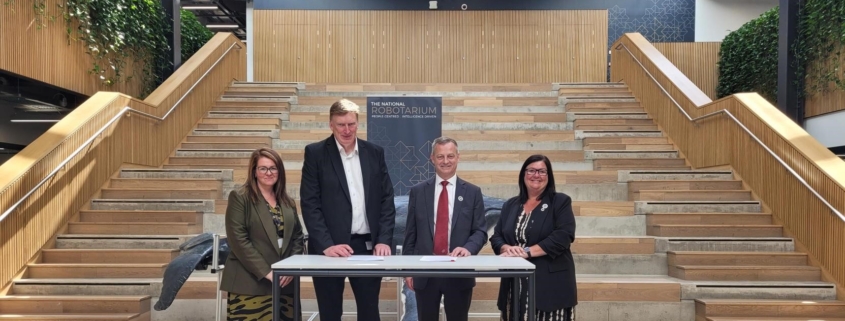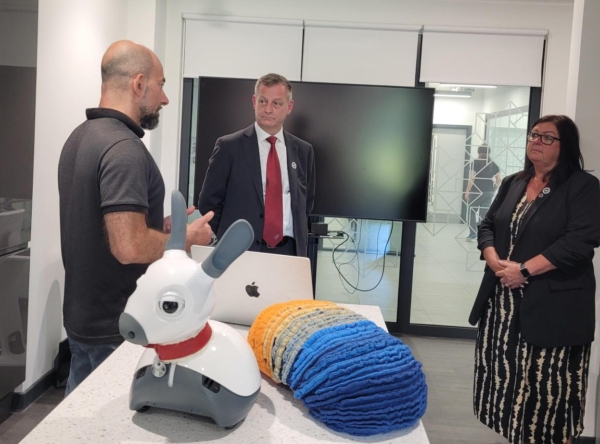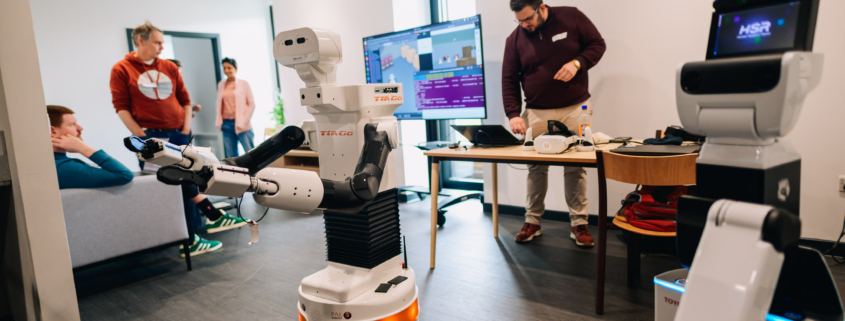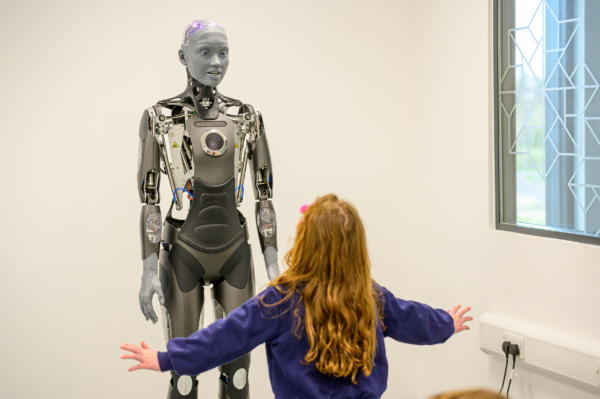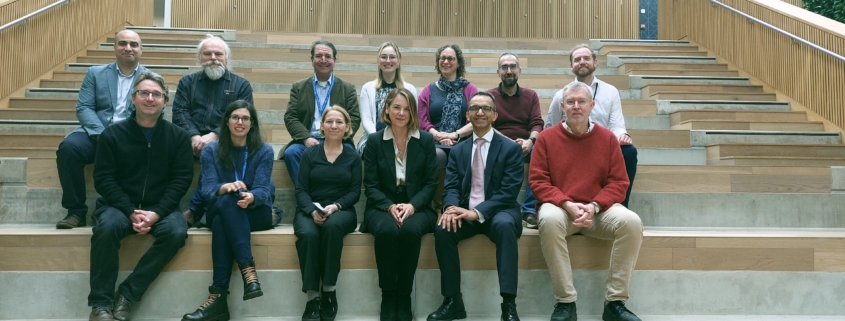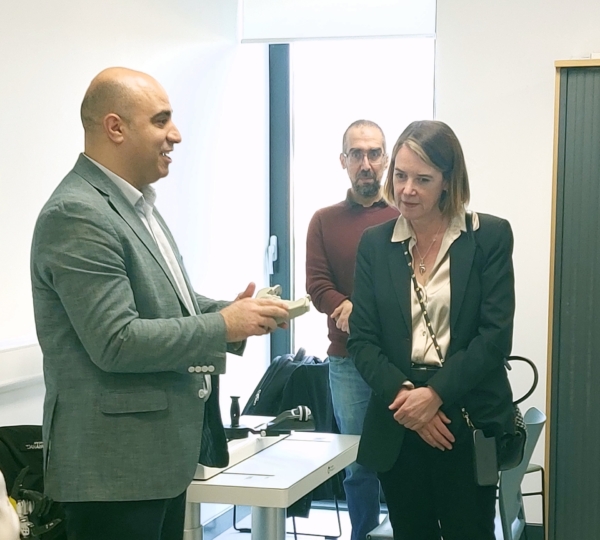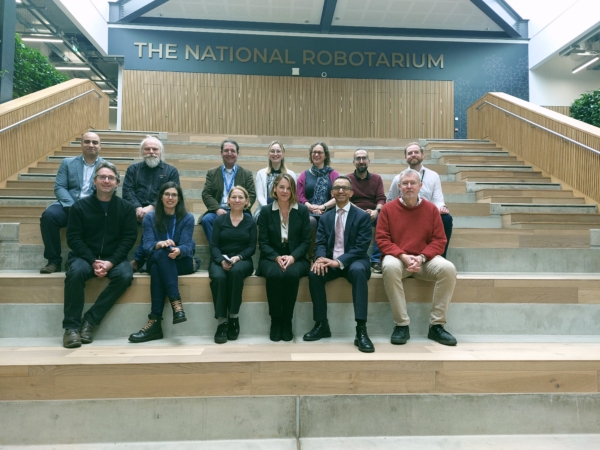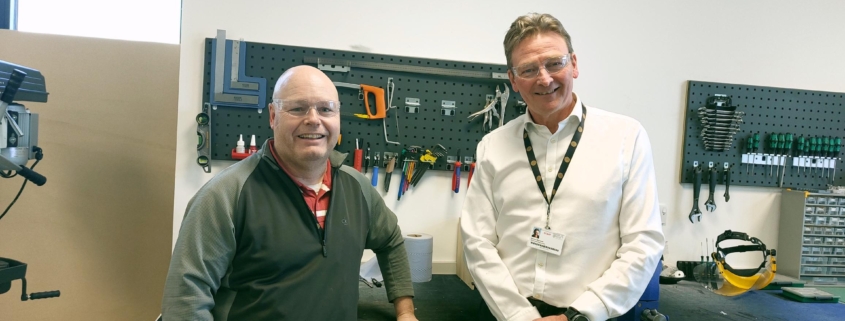

The National Robotarium is hosting the 2026 UK Robotics Summer School, taking place from 22-26 June 2026.
The Summer School, organised by the Edinburgh Centre for Robotics – a joint initiative between the University of Edinburgh and Heriot-Watt University and supported by the UK-RAS Network CDT D2AIR, will feature a week of expert-led lectures, tutorials, and industry talks covering some of the most important and fast-growing areas in robotics and artificial intelligence. Participants will also gain hands-on experience working with state-of-the-art robotics technology and platforms.
Key topics for 2026 include:
Bioinspired robotics
Generative AI for robotics
Healthcare robotics
Safe AI for robotics
The programme will also include an Industry Application Day, where industry partners will present current projects, real-world challenges, and emerging opportunities in robotics and autonomous systems.
In addition to the academic and technical programme, the Summer School provides excellent networking opportunities, bringing together students, researchers, and industry professionals from across the UK robotics and AI community. Registration includes refreshments, lunch, and the Summer School dinner, kindly sponsored by the UK-RAS Network.
Participants can register for the full week or choose to attend specific days depending on their availability and interests. The registration deadline is 29 May 2026.
A PhD researcher in Artificial Intelligence at Heriot-Watt University has been recognised in the 2026 OpenUK New Year’s Honours List.
OpenUK’s annual Honours List, now in its sixth year, celebrates individuals who have made exceptional contributions to open source software, open hardware, open data, open standards, and AI governance. The list highlights innovators and leaders advancing the UK’s position in the global open technology landscape.
Godfrey Inyama, whose PhD is focused on conversational AI and dialogue systems within the National Robotarium’s Laboratory for Assistive Living (LARA), was included in the prestigious list for his research in ‘AI Openness’ within the UK’s technology ecosystem. Godfrey’s work on agentic AI and mixed-initiative dialogue systems to advance Human-Robot Interaction (HRI) and collaboration between humans and AI agents was also recognised in the AI category of the OpenUK Awards, where he was named runner-up at a special event held in the House of Commons in London.
Godfrey Inyama, PhD student in conversational AI and dialogue systems within the National Robotarium’s Human-Robot Interaction group
Godfrey said: “It is a massive honour to be included in the OpenUK New Year’s Honours List alongside an impressive array of great minds that are pushing the boundaries of Open Technology in the UK. I’m excited to see what the year ahead will bring, especially within the scope of Agentic AI for Mixed Initiative Dialogue.”
Godfrey works with the HRI research group, located in the Laboratory for Assistive Living (LARA), a unique test lab for developing assistive robots
Dr Mauro Dragone, a leading expert in HRI at The National Robotarium, is Godfrey’s researcher supervisor.
He said: “Godfrey is an excellent example of the talent nurtured at Heriot-Watt University.
“Having previously graduated from our MSc Robotics programme, he has consistently demonstrated outstanding work ethic, intellectual curiosity, and ambition. He is now pursuing a PhD focused on conversational Artificial Intelligence to support effective human–robot cooperation, an area of growing national importance.
“His work is strongly aligned with the strategic vision of the UK’s National Robotarium, which serves as a key advanced testbed for translating these technologies into real-world impact across multiple application domains. This research area will play an important role in strengthening the UK’s digital economy over the coming decade.”
Dr Mauro Dragone, pictured here with health and social care practitioners in LARA, is a leading expert in HRI and Godfrey’s research supervisor
Amanda Brock, CEO of OpenUK, said of this year’s honourees: “The individuals recognised in the 2026 New Year’s Honours represent the cutting edge of open technology innovation and community engagement in the UK. Their work exemplifies the commitment required to build an open, collaborative digital future.”
The full OpenUK 2026 Honours List underscores the breadth of talent across the UK, featuring individuals from academia, startups, industry leaders, and community contributors. It reinforces the UK’s role as a global hub for open technology advancement and thought leadership.
For more details on the full 2026 Honours List and category recognitions, visit the OpenUK website.
https://thenationalrobotarium.com/wp-content/uploads/WhatsApp-Image-2026-01-03-at-21.07.11-3.jpeg20401530Louise Jackhttp://thenationalrobotarium.com/wp-content/uploads/Robotarium.pngLouise Jack2026-01-13 11:35:022026-01-13 11:45:28PhD student recognised in 6th OpenUK New Year Honours List
From 15-17 September, robotics scientists, engineers, technicians, industry experts and robot enthusiasts joined together in Edinburgh for the first ever ROSCon UK.
The 3-day event – themed around ROS (Robotics Operating Systems) – included talks, tutorials, workshops and robot demonstrations, as well as tours of The National Robotarium and partner Data-Driven Innovation hub the Bayes Centre at The University of Edinburgh.
Attendees at the first ROSConUK (photo credit: Tartan Robotics Collective)
Over 150 attendees travelled to Scotland’s capital, where they heard talks from some of the world’s leading voices in robotics, including Dr Steve Cousins, Executive Director of the Stanford University Robotics Centre, Julien Enoch, Senior Solutions Architect at ZettaScale Technology, and Seamus McGinley, a Robotics Software Engineer at the National Oceanography Centre.
Robotics Engineer at The National Robotarium, Rahul Ramachandran, also delivered a talk at the conference, during which he gave an overview of an ongoing project that is integrating ROS2 with NVIDIA Isaac Sim technology to develop a digital twin of the centre’s co-bot station.
RosCon UK was created and delivered by the Tartan Robotics Collective, a charitable organisation that aims to promote scientific research and advance educational opportunities in robotics. Organisers included Head of Robotics at The National Robotarium, Dr Ingo Keller, Dr Alejandro Bordallo (The University of Edinburgh), Dr Bence Magyar and Tom Moore (both Locus Robotics), Dr Vladimir Ivan (Touchlab Ltd), Prof. Dr Sabine Hauert (University of Bristol), and Dr Hugo Sardinha (Launchpad Build).
Head of Robotics, Dr Ingo Keller (second from right) with the ROSConUK organising committee (photo credit: Tartan Robotics Collective)
Dr Keller said: “The team and I were thrilled to deliver the UK’s first ever ROSCon event, which attracted so many robot experts and enthusiasts from across the globe. The positive response to the conference from attendees, host institutions, and sponsors, has highlighted the level of interest and demand for strategic and informed discussions on robotic systems, which are primed to transform every aspect of our future lives.
“I’d like to thank everyone who attended and contributed to the success of the event, particularly my fellow organisers, our wonderful sponsors, and OSRF (Open Source Robotics Foundation) for their support.
“We are already looking forward to planning and organising next year’s event!”
Edinburgh was host of the first ever ROSCon UK event (photo credit: Tartan Robotics Collective)
The event coincided with a significant announcement by NVIDIA to play a leading role in advancing the UK’s AI infrastructure, for which the UK Government has committed an unprecedented £2 billion to physically deploy advanced AI across the country. The National Robotarium, along with other leading UK innovation centres, was namechecked in the global press release, ahead of an exclusive AI ecosystem event attended by Ingo in London, which was introduced by NVIDIA CEO and President Jensen Huang and Prime Minister Sir Keir Starmer MP.
https://thenationalrobotarium.com/wp-content/uploads/ROSCon_UK_2025-TIAGO-1000px.jpg6571000Louise Jackhttp://thenationalrobotarium.com/wp-content/uploads/Robotarium.pngLouise Jack2025-10-27 16:50:422025-10-27 16:52:15Highlights from the inaugural ROSConUK
The National Robotarium is supporting a pioneering new initiative to monitor greenhouse gases in Edinburgh.
As part of the GEMINI+ project, led by Professor Paul Palmer and team from The University of Edinburgh’s School of Geosciences, a network of monitoring sites has been set-up across the city, using specialist instrumentation to map measurements of greenhouse gases, including carbon dioxide (CO₂) and methane.
The testing compound area at The National Robotarium, located in Riccarton as part of Heriot-Watt University’s campus, is being used as one base for the Bruker equipment, which will link up with similar instruments across other locations in the monitoring network, including Port of Leith Distillery, Queen Margaret University and The University of Edinburgh to continuously collect data. The network also includes automatic weather stations to monitor wind patterns, which are crucial for interpreting the gas measurements.
The sophisticated Bruker equipment autonomously gathers real-time greenhouse gas data
Dr Will Morrison a research scientist at The University of Edinburgh led the roll-out of the monitoring sites and currently analyses the data collected from each of the locations to quantify city-wide emission estimates of CO2 and methane. This information aims to inform long-term climate strategies for the city, which has a net-zero target by 2030.
Chief Operating Officer at The National Robotarium, Steve Maclaren
Chief Operating Officer at The National Robotarium, Steve Maclaren, was integral to the facility being involved in the study. He said: “As the UK’s leading robotics centre, we’re committed to developing new technologies that promote sustainability and create a cleaner, safer planet for all.
“Our purpose-built facility is powered by solar energy and was designed with energy efficiency at its core. Hosting one of the GEMINI instruments allows us to actively support Edinburgh’s long-term carbon-neutral goals and contribute to climate science in a meaningful way.”
The National Robotarium is one of six Data-Driven Innovation hubs, funded in partnership with The University of Edinburgh, as part of the £1.5bn Edinburgh and South-East Scotland City Region Deal.
https://thenationalrobotarium.com/wp-content/uploads/ROBOTARIUM-ROOF-1000px.jpg7491000Louise Jackhttp://thenationalrobotarium.com/wp-content/uploads/Robotarium.pngLouise Jack2025-08-19 17:25:382025-09-01 09:43:14The National Robotarium supports groundbreaking greenhouse gas monitoring initiative
The National Robotarium and Robotekin – Basque Association for Robotics and Automation have forged a new global partnership to advance innovation, research and skills development in Robotics and Autonomous Systems (RAS).
In July, the UK’s centre for robotics and AI at Heriot-Watt University welcomed a delegation from Robotekin, a not-for-profit consortium in the Basque Country, during which a Letter of Intent was signed by CEO of The National Robotarium, Stewart Miller, and Robotekin Director, Daniel Ruiz Corres. The letter outlines each organisation’s commitment to sharing knowledge and developing joint initiatives in areas including applied research and technology transfer, international projects, outreach and events.
[l-r] Daniel Ruiz Corres, Robotekin Director, and Stewart Miller, CEO of The National Robotarium sign the letter of intent (July 2025)
The delegation – which included Robotekin industry members Smartlog Group, Seaquenz, BIC Araba, Ikaslan, IKERLAN and DACO Ingeniería – followed a visit by National Robotarium Chief Operating Officer, Steve Maclaren, to Robotekin’s headquarters in Álava, Spain in December. During the visit, Steve presented on the National Robotarium’s holistic enterprise model that is advancing science in robotics and automation, and supporting early-stage technology companies. It was agreed that a reciprocal visit be arranged, paving the way towards a more formalised partnership.
Steve said: “Following my insightful visit to Robotekin’s headquarters last year, it was an honour to welcome the team and their associates to The National Robotarium. As well as getting a tour our state-of-the-art labs, the visit was hugely valuable in learning more about each other’s delivery models, and exploring opportunities to drive forward new collaborations.”
Steve Maclaren (centre) visited Robotekin in Spain in Dec 2025
Robotekin operates as a ‘cooperative ecosystem’, creating a link between R&D, education, manufacturing and user testing, rapidly driving new technological and business projects that address genuine industry and customer needs. The success of the Robotekin model could provide a blueprint for other nations looking to create a circular robotics supply chain that harnesses scientific excellence, private and government investment, and entrepreneurial spirit, manufacturing and production. Building a similar robotics ecosystem for Scotland is a key recommendation in The National Robotarium’s recent policy paper ‘Making Scotland a World Leader in Robotics’.
Stewart Miller said: “Scotland stands to gain significantly from a hub-and-spoke model like Robotekin. By acting as a physical hub for industry, government and science to work closely together on fast-tracking new robotic innovations, we not only benefit people’s lives but also create a driver for economic prosperity and talent retention.
“This partnership offers a valuable opportunity to explore alternative delivery models that could be key to securing long-term success for robotics in Scotland.”
https://thenationalrobotarium.com/wp-content/uploads/Robotekin-group-dinner-1000px.jpg7501000Louise Jackhttp://thenationalrobotarium.com/wp-content/uploads/Robotarium.pngLouise Jack2025-07-31 17:19:342025-07-31 17:21:20The National Robotarium forges new partnership with Robotekin
Technical experts at The National Robotarium have developed a sustainable system for recycling and repurposing plastic waste from 3D printers.
The UK’s centre for robotics and Artificial Intelligence at Heriot-Watt University is home to multiple 3D printers within its three distinct workshop spaces. The printers and other specialist machines are used daily by the facility’s engineering team, researchers and resident robotics companies.
With the price of printers and common materials, such as PLA (polylactic acid) filament, coming down in recent years, 3D printing is more accessible than ever. However, ease of production has created larger volumes of test and modular printing, increasing the amount of plastic discard.
Growing concerned about the large volumes of plastic offcuts being created in the workshops, Senior Technician for Robotics and Autonomous Systems, Thomas McGravie, and Senior Engineer Dr Alix Partridge were keen to explore ways to reuse the materials and reduce waste.
Thomas McGravie, Senior Technician at The National Robotarium
Compounding the issue further, leftovers from 3D printing cannot be easily recycled together, with different preparatory methods, such as drying or cleaning, required for different kinds of plastic.
Thomas, who oversees the workshops and technical spaces, said: “It was back in 2023, Alix and myself noticed that we were creating an astonishing amount of plastic waste through 3D printing; 54kg in two years!
“At the same time, I was talking to colleagues in other services and schools and found out that the Heriot-Watt is recycling 3 tonnes of plastic bottles a year. So, I wanted to come up with a way that we could repurpose the different types of plastic waste being produced on-campus.”
3D printing at The National Robotarium alone has created 54kg of plastic waste in two years
As part of his quest, Thomas looked online for inspiration, but found most solutions were either too costly or so time and labour-intensive that the benefits were negligible.
“I continued to browse online and stumbled upon someone in Australia who used a t-shirt press to flatten and melt down plastic shreds, reconstituting the 3d printed waste into sheets. Just by chance, one of our academics, Dr Alistair McConnell, had procured a shredder and injection moulding machine for a project, and he let us use these to recreate the first step of this process.”
A simple t-shirt press can melt plastic shreds into smooth sheets
However, despite now having the process knowledge and access to some of the required machinery, there was another factor getting in the way; time.
As Thomas explains: “Whilst we were keen to be more sustainable and reduce our carbon footprint, the demands our day-to-day jobs didn’t allow much time for experimentation.”
Fortunately, the discovery coincided with the centre hosting Fabio Tatti (Imperial College London) and Rob Woolley (University of York), two technicians from the UKRAS STEPS (UK Robotics and Autonomous Systems Strategic Technical Platform) network, who were interested in working on the filament recycling project as part of a week-long secondment.
The National Robotarium is a key delivery partner in the 3-year project, led by the University of Leeds and funded by the UKRI Engineering and Physical Sciences Research Council (EPSRC), that aims to strengthen the UK’s Robotics and Autonomous Systems capabilities and improve the long-term career prospects of Research Technical Professionals (RTPs).
Thomas and visiting technicians were awarded a Highly Commended prize at the UK RAS STEPS Technical Showcase event in June 2025 [l-r: Graham Brown (winner), Fabio Tatti, Rob Wooley,Thomas, Charles Richards]
Thomas said: “The visiting technicians were a fantastic support. Having four pairs of hands allowed us to fine-tune the system and produce more consistent heats and temperatures.”
The team presented on the project at the UK RAS STEPS Technical Showcase event, held at the London Science Museum in June, taking away the Highly Commended prize in the ‘Innovative Teamwork in Robotics’ category.
As well as facilitating the secondments, UKRAS-STEPS also provided financial support for the purchase of additional equipment, enabling Thomas and Alix to formalise the process and produce a template, which can be shared by other participating institutions across the UK.
“The support from UKRAS-STEPS has been vital to finessing the process. We are now able to recycle 3d printer waste into other items, such as badges and keyrings, which could be given to visiting school groups and work experience students. In time, we’re hoping to create items that are more commonly used in labs and workshops, greatly reducing the need to purchase these plastics as new.
“This has the potential to create a massive reduction in 3D printed plastic waste, not just at The National Robotarium but in RAS labs up and down the country.
Whilst the recycling system promises a sustainable and circular solution to plastic waste, Thomas thinks behavioural change is also needed to tackle the problem.
“We need to consider the reasons why we’re producing so much waste in the first place. Low costs and speedy turnaround times make it too easy to run off multiple prototypes in bulk – we need to be more mindful during the design process to not be wasteful and only print what we need.”
https://thenationalrobotarium.com/wp-content/uploads/Plastic-recycling-machine-1000px.jpg6661000Louise Jackhttp://thenationalrobotarium.com/wp-content/uploads/Robotarium.pngLouise Jack2025-07-30 12:52:022025-07-30 12:52:02National Robotarium technical team tackles 3D printing plastic problem
As part of the 2025 UK Robotics Summer School, expert researchers at Heriot-Watt University are hosting a roundtable discussion on ‘Responsible Research, Innovation and EDI in Robotics and AI’.
Speakers include Associate Professor of Computer Science Dr Ioannis Konstas, Professor of Economics Cristina Tealdi and Professor of Psychology Thusha Rajendran.
This FREE session, taking place on 2 June, is open to ALL (sign-up required).
‼️ Roundtable discussion on responsible research and innovation, Equality, Diversity, and Inclusion in Robotics and AI
📅 Monday 2 June
🕓 1600-1700
📍 HeriotWatt Postgraduate Centre, PG01
🎫 https://lnkd.in/e8-zeaSu
https://thenationalrobotarium.com/wp-content/uploads/Ben-Glasgow-134.jpg13632048Louise Jackhttp://thenationalrobotarium.com/wp-content/uploads/Robotarium.pngLouise Jack2025-05-20 10:36:102025-06-09 13:53:45‘Responsible Research, Innovation and EDI in Robotics and AI’ – Monday 2 June
This article was originally published by Frankie Macpherson in healthandcare.scot on Monday 28 April
A new project has spotlighted the potential of robotic technical to support independent living and social engagement for people living in assisted residential accommodation, at the same time as ensuring a quick response when things go wrong.
Scottish researchers partnered with charity and specialist home care provider, Blackwood Homes and Care to explore how robotics might work alongside, and potentially improve, Blackwood’s existing care systems.
Lead researcher and expert in assistive robotics, Heriot-Watt University’s Dr Mauro Dragone said:
“Robotics offers a powerful solution for independent living, enabling remote monitoring, reducing staff pressures, and increasing personal choice and care flexibility. Projects like this help de-risk innovation by embedding technical expertise into care environments, ensuring reliability and user acceptance.
“To achieve lasting impact, partnerships — such as with the National Robotarium at Heriot-Watt — are essential.
“They provide the research, support and training needed to scale new technologies responsibly and effectively across Scotland’s health and care sector.”
Temi: robot first responders
The Temi is being used as a first responder for residents at Blackwood Homes and Care, providing 24/7 support.
At the heart of the project was the ‘Temi’ robot, which was integrated with the digital telecare systems already used across three buildings in Glasgow. Temi could reach people in their apartments to help Blackwood’s Homes and Care 24/7 emergency response team and carry out routine health and wellbeing check-ins.
Dr Dragone said that the robots have been developed with input from staff and residents. He said: “These robots acted as first responders, automatically travelling to residents’ flats during emergencies and enabling live video contact with care teams. Unlike traditional devices, they ensured support even when residents couldn’t access their phones or tablets.
“Beyond emergency response, the robots also carried out daily mental health and wellbeing check-ins.
“Developed through co-design with residents and staff, the robot could ask questions, play music, and facilitate contact with the care team — adding value to day-to-day life and increasing social interaction.
“One of the most successful aspects of the collaboration between the research team at Heriot-Watt University and the innovation team in Blackwood was these participatory design activities, to understand their concerns but also their aspiration, preferences and desires for the new technology.”
Participants in the trial reported increased satisfaction with the enhanced service, highlighting Temi’s contribution to both social engagement and accessibility of care services.
A care work team leader who attended one of the sessions demonstrating how the robotics work described themselves as “totally converted” from a non-believer in robotics to seeing it as something that can help “shape the future of care”.
The UK’s National Robotarium played a ‘pivotal role’ in advancing robotic and software solutions through this partnership, with Heriot-Watt researchers developing “custom software and user interfaces” for Temi.
The research team also trained staff, and integrated the system within Blackwood’s residences, and now hope to continue to advance robotic-assisted independent living and care.
One person involved in the trial said they had “immensely enjoyed” the process, adding:
“I initially got involved as I was curious about what robotics encompassed, and despite being unsure about technology, I kept an open mind. From the very first workshop, I saw how they could be of benefit. Contributing ideas from a service user point of view felt such a privilege and now that I have seen my ‘mental health check-in’ idea has been incorporated into the robot, is just mind blowing!
“It makes me feel not only proud of my idea, but more importantly, that it can be of benefit to others. That makes me happy to know that someone else might feel better because of it.”
Remote triage
One challenge the teams worked to address for remote care staff is that systems often rely on the person who is in trouble to trigger an emergency video call.
The researchers explain this can “difficult to manage”, as it may not be possible if someone has fallen out of sight of the device or is feeling ill or confused.
Dr Mauro Dragone showcases the Temi robot to health and social care practitioners with the National Robotarium Laboratory for Robotic Assistive living (LARA).
Dr Dragone explained Temi could respond to an emergency being trigged without residents using a phone or tablet. It travels from the ground floor, using the building’s lifts if needed, to reach and connect residents with a virtual care team through a live video feed. Once connected, the responder from the remote care team takes control of the robot, assesses the situation and can speak to the resident.
He said: “This allowed remote staff to assess the situation accurately and quickly enhanced emergency response and enabling care even during travel restrictions.
“Temi is a mobile robot with a tablet and camera for video calls, combined with obstacle detection, navigation software, and the ability to operate lifts and doors.
“While Temi doesn’t currently carry out physical tasks, Heriot-Watt is now developing smart home devices and modular robotic furniture to work alongside robots like Temi — extending their support potential in care settings.”
He added that this is particularly helpful during stations where there are travel or social distancing restrictions, as seen during the COVID crisis.
Dr Dragone emphasised that robotics is an increasing key component of independent living, not just for remote monitoring but also promoting social connections and self-management at times of self-isolation or travel restrictions.
Find out how our cutting-edge technology and expertise can help your business
https://thenationalrobotarium.com/wp-content/uploads/Mauro-Dragone-at-EMERGENCE.jpg6661000Louise Jackhttp://thenationalrobotarium.com/wp-content/uploads/Robotarium.pngLouise Jack2025-04-28 17:03:262025-04-28 18:05:13Enhancing independent living with robotics
The UNITE project, an EPSRC Prosperity Partnership programme spearheaded by The National Robotarium and Heriot-Watt University in collaboration with Imperial College London, was Highly Commended in the Multi-party Collaboration category at the 2025 Interface Scottish Knowledge Exchange awards.
The project team, which includes global geo-data specialists Fugro and Heriot-Watt spinout technology company Frontier Robotics, is developing advanced AI and autonomous systems for undertaking remote inspections of offshore wind farms to offer a safe, efficient and sustainable solution for global energy providers.
Picking up the prize on the night from Minister for Business, Richard Lochhead MSP was Project Manager, David Morrison, Director and Co-Founder of Frontier Robotics, Jonatan Scharff Willners, Head of the Robot Motor Intelligence (RoMI) lab, Dr Carlos Mastalli and postdoctoral student Hefan Wang.
Yvan Petillot, Professor of Robotics at Heriot Watt University and National Robotarium academic lead, commented:
“The National Robotarium’s partnership between Fugro and the UNITE project has created an exciting opportunity to develop this next generation of underwater technologies as well as the skills and expertise needed to support the transition to net zero. UNITE has enormous potential to power the UK’s offshore renewable sector and beyond, delivering worldwide economic and environmental impact that can benefit communities around the world.”
Adding to the evening’s achievements, Heriot-Watt was part of a team that claimed the Innovation of the Year award through the collaborative spin-out SolarSub Ltd. Working alongside partner universities, SolarSub Ltd has developed groundbreaking solar-powered autonomous underwater vehicles, significantly enhancing sustainable subsea operations. These innovative vehicles provide environmentally friendly solutions for extended underwater monitoring and exploration, supporting diverse industries from environmental research to offshore renewable energy.”
Minister for Business, Richard Lochhead MSP said:
“It was good to see the full breadth of academic and business-led innovation on show at Interface’s annual awards.
“Scotland has been at the forefront of many of the world’s most impactful innovations, from the MRI Scanner and penicillin to televisions and telephones. Yet, by combining research and business, so many new and exciting Scottish breakthroughs are just on the horizon and that is something we should all champion.”
The awards, now in their tenth year, were held at Edinburgh Futures Institute and celebrated exceptional collaborations between academia and industry that deliver economic, environmental and social benefits for Scotland. UNITE was recognised for its innovative KE consortium, which brings together a long legacy of scientific research alongside industry expertise and new autonomous and AI technologies.
Heriot-Watt’s Medical Device Manufacturing Centre (MDMC), scooped the main prize in the same category, topping off an successful evening for the institution.
The National Robotarium is proud to support International Women’s Day, celebrated annually on March 8 to honour the achievements of women across all aspects of life – social, economic, cultural, and political – while also advocating for gender equality.
Every year, we celebrate the achievements of our incredible female colleagues who are helping to drive advancements in robotics and Artificial Intelligence, and shaping the future by empowering more women and girls to embrace robotic technologies in their education, lives and careers, for generations to come.
Accelerating Action
To mark this year’s theme ‘Accelerate Action’, we asked some of the team what steps are being taken to improve gender equality in robotics, and what else can be done to encourage more pioneering women to pursue a career in robots, AI, computer science, engineering, technology and other STEM subjects.
Women in Robotics at The National Robotarium
Find out more about how female members of The National Robotarium team have navigated their careers, and the advice they’d give to women, girls and anyone else who’s interested in joining the Robotics Revolution.
Rowanne Miller, Project Manager
Dr Hsing-Yu Chen, Senior Robotics Engineer
Lisa Farrell, Business Development Manager
Dr Maria Koskinopoulou, Assistant Professor of Engineering
https://thenationalrobotarium.com/wp-content/uploads/InternationalWomensDay_Icon_WhiteOnPurple.jpg10001000Louise Jackhttp://thenationalrobotarium.com/wp-content/uploads/Robotarium.pngLouise Jack2025-03-07 15:49:172025-03-07 15:49:17International Women’s Day 2025 – Celebrating Women in Robotics
We may request cookies to be set on your device. We use cookies to let us know when you visit our websites, how you interact with us, to enrich your user experience, and to customize your relationship with our website.
Click on the different category headings to find out more. You can also change some of your preferences. Note that blocking some types of cookies may impact your experience on our websites and the services we are able to offer.
Essential Website Cookies
These cookies are strictly necessary to provide you with services available through our website and to use some of its features.
Because these cookies are strictly necessary to deliver the website, refusing them will have impact how our site functions. You always can block or delete cookies by changing your browser settings and force blocking all cookies on this website. But this will always prompt you to accept/refuse cookies when revisiting our site.
We fully respect if you want to refuse cookies but to avoid asking you again and again kindly allow us to store a cookie for that. You are free to opt out any time or opt in for other cookies to get a better experience. If you refuse cookies we will remove all set cookies in our domain.
We provide you with a list of stored cookies on your computer in our domain so you can check what we stored. Due to security reasons we are not able to show or modify cookies from other domains. You can check these in your browser security settings.
Google Analytics Cookies
These cookies collect information that is used either in aggregate form to help us understand how our website is being used or how effective our marketing campaigns are, or to help us customize our website and application for you in order to enhance your experience.
If you do not want that we track your visit to our site you can disable tracking in your browser here:
Other external services
We also use different external services like Google Webfonts, Google Maps, and external Video providers. Since these providers may collect personal data like your IP address we allow you to block them here. Please be aware that this might heavily reduce the functionality and appearance of our site. Changes will take effect once you reload the page.
Google Webfont Settings:
Google Map Settings:
Google reCaptcha Settings:
Vimeo and Youtube video embeds:
Other cookies
The following cookies are also needed - You can choose if you want to allow them:
Privacy Policy
You can read about our cookies and privacy settings in detail on our Privacy Policy Page.