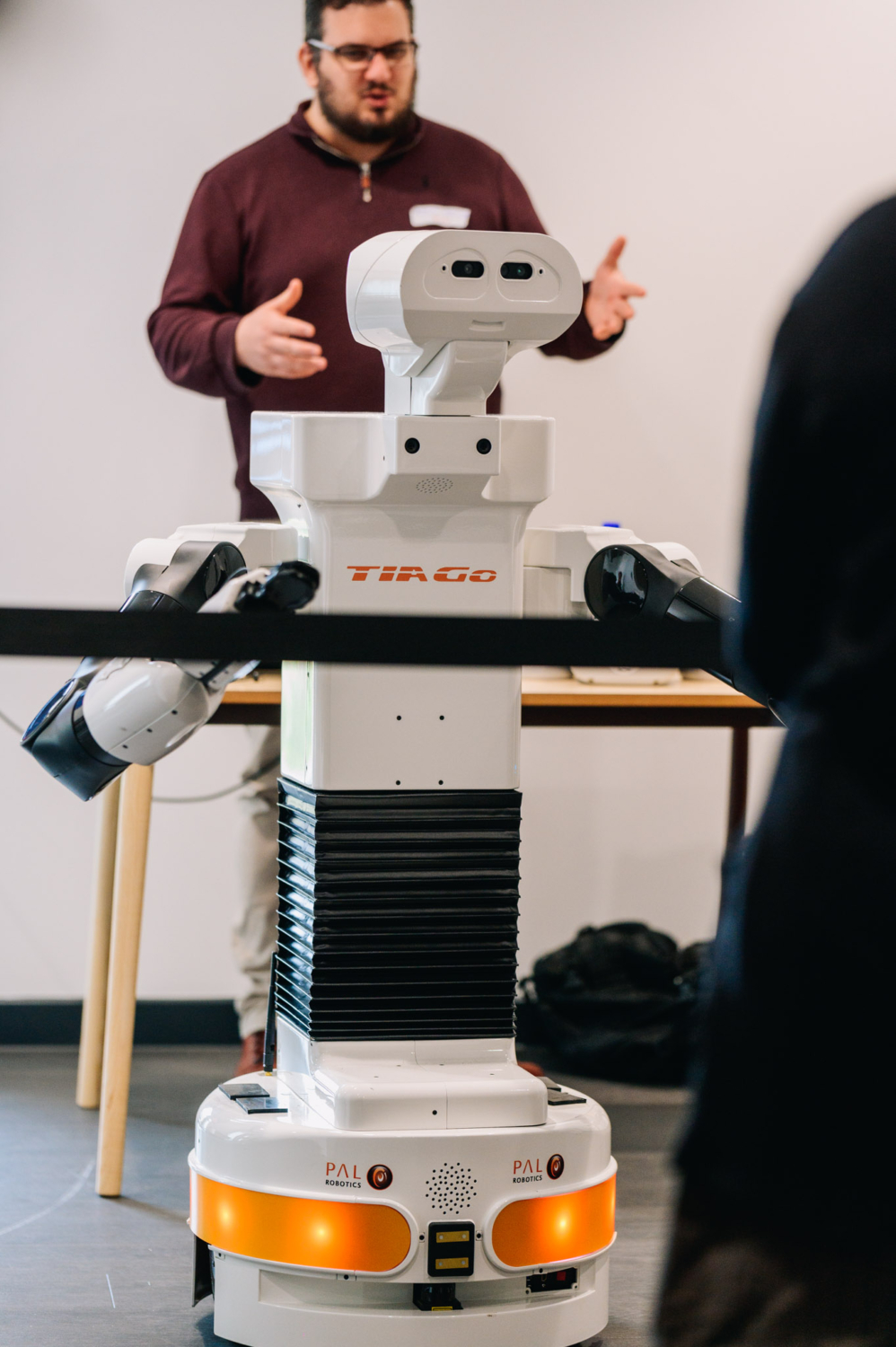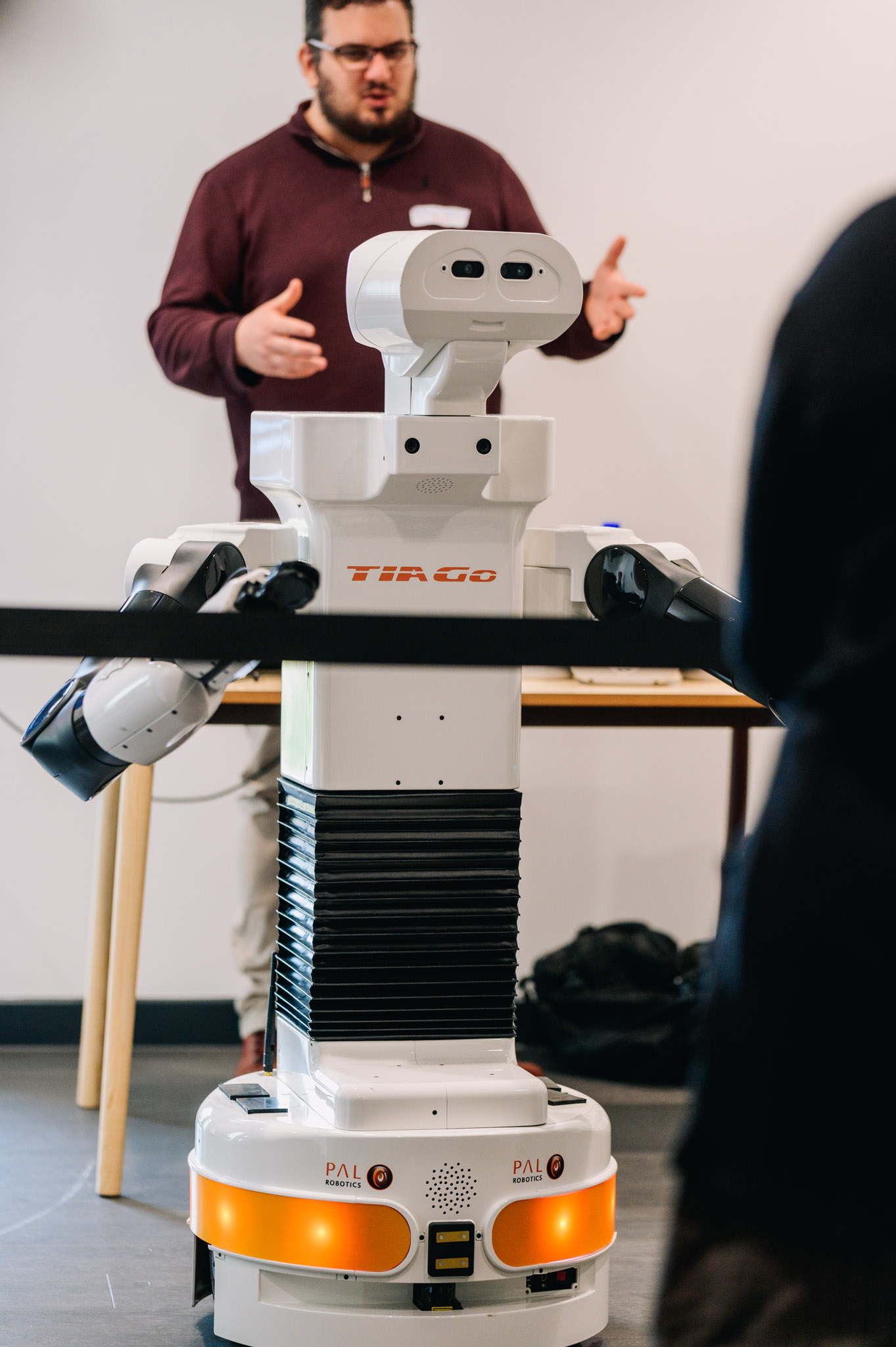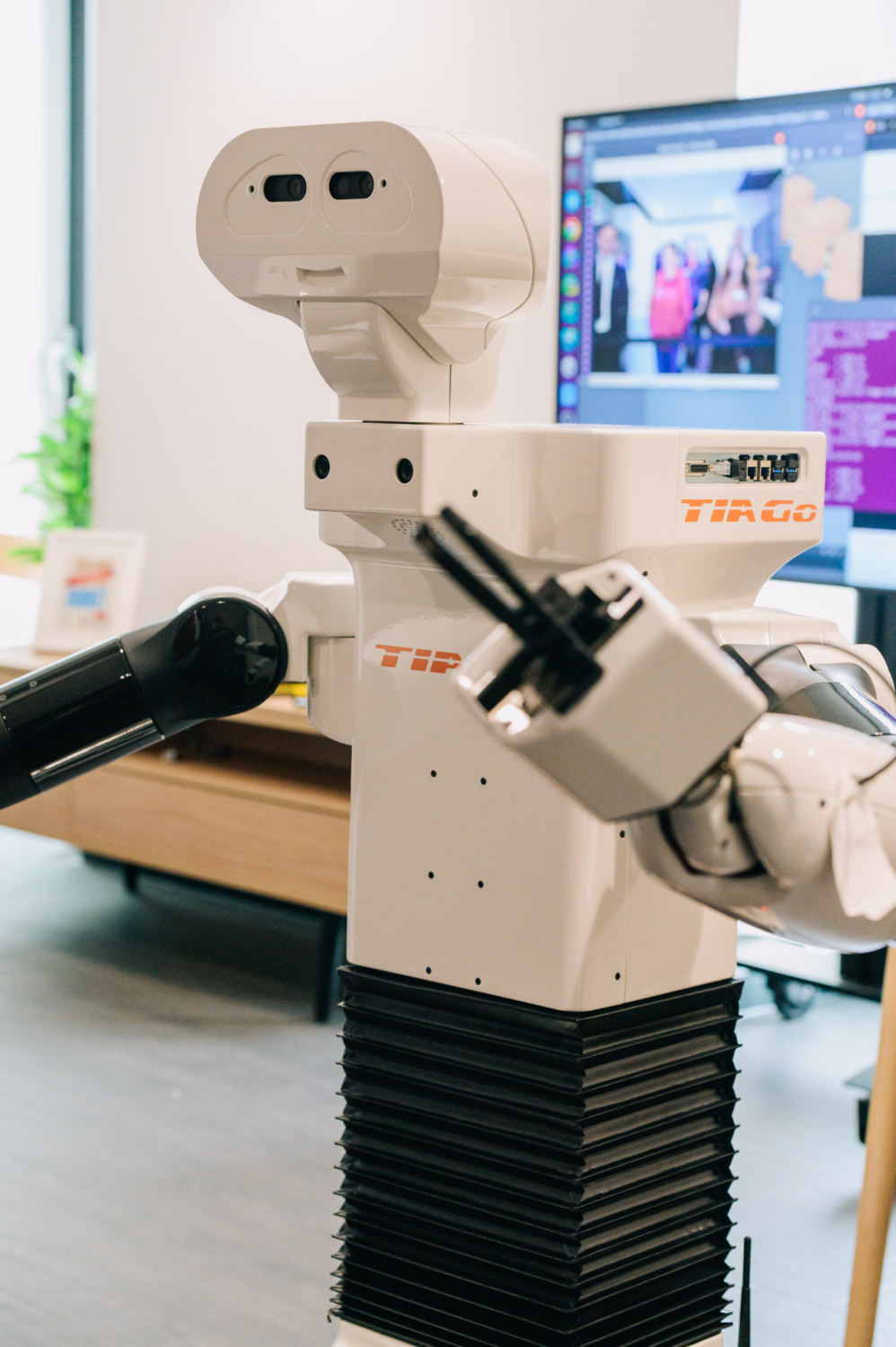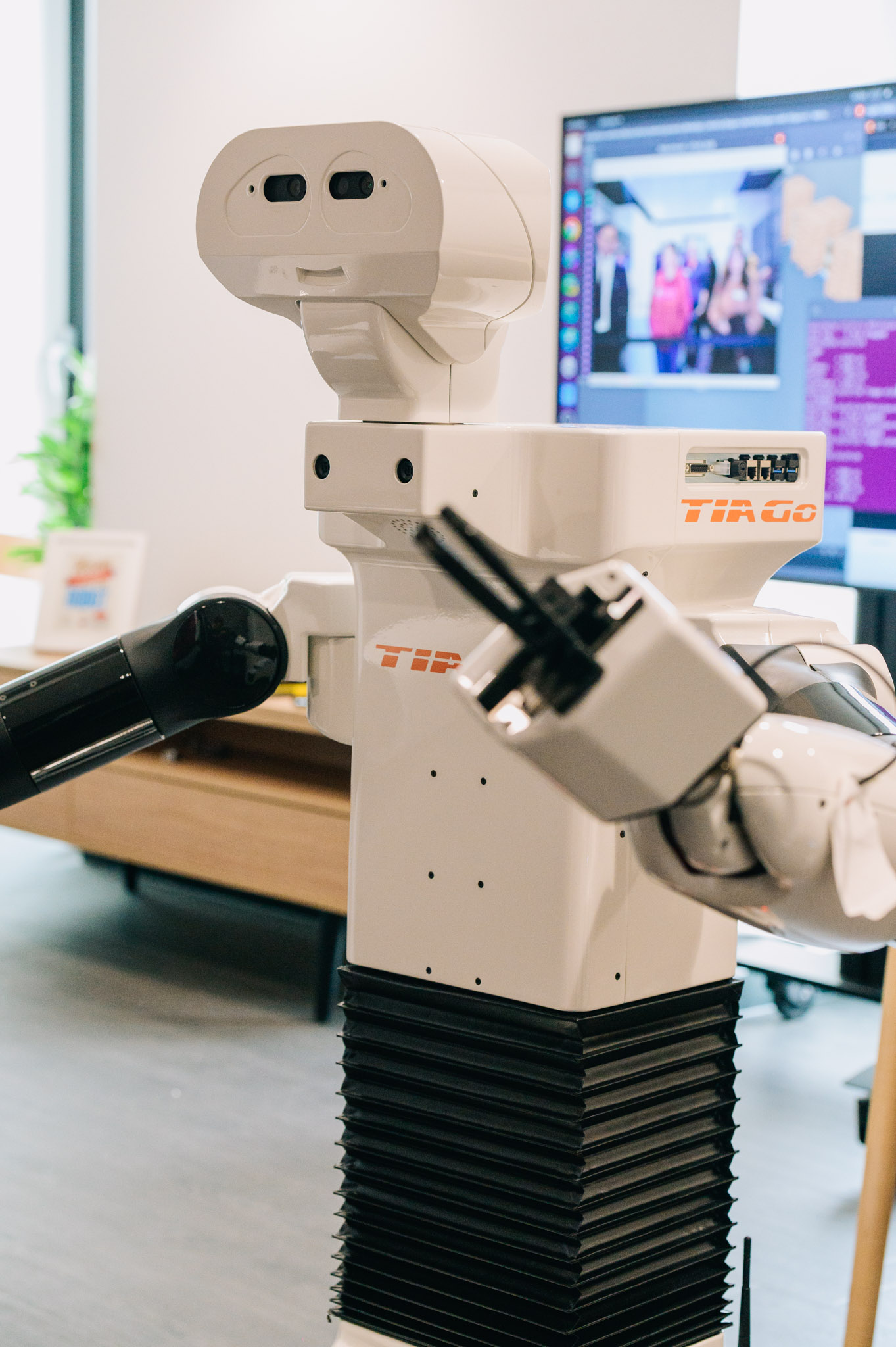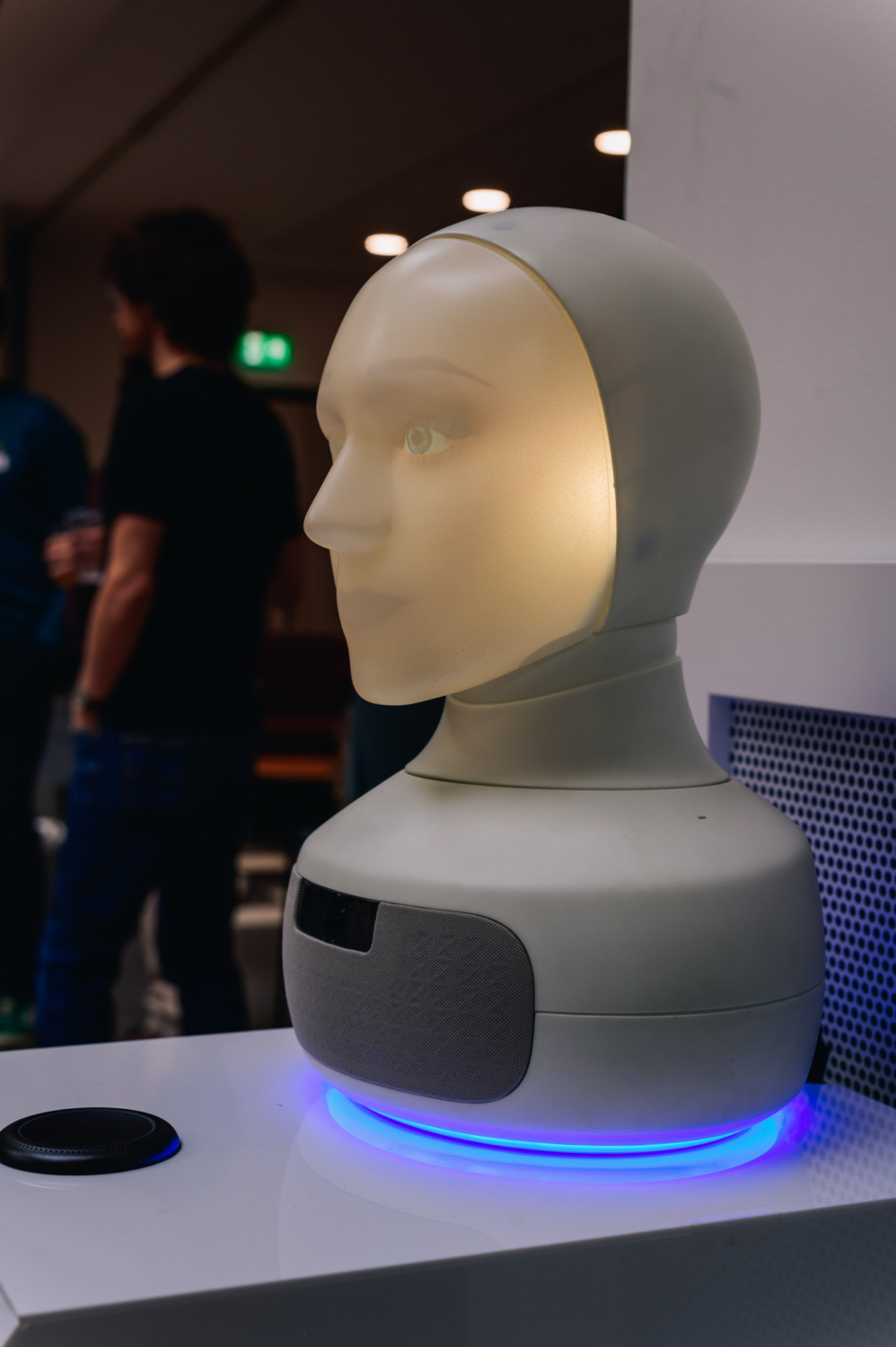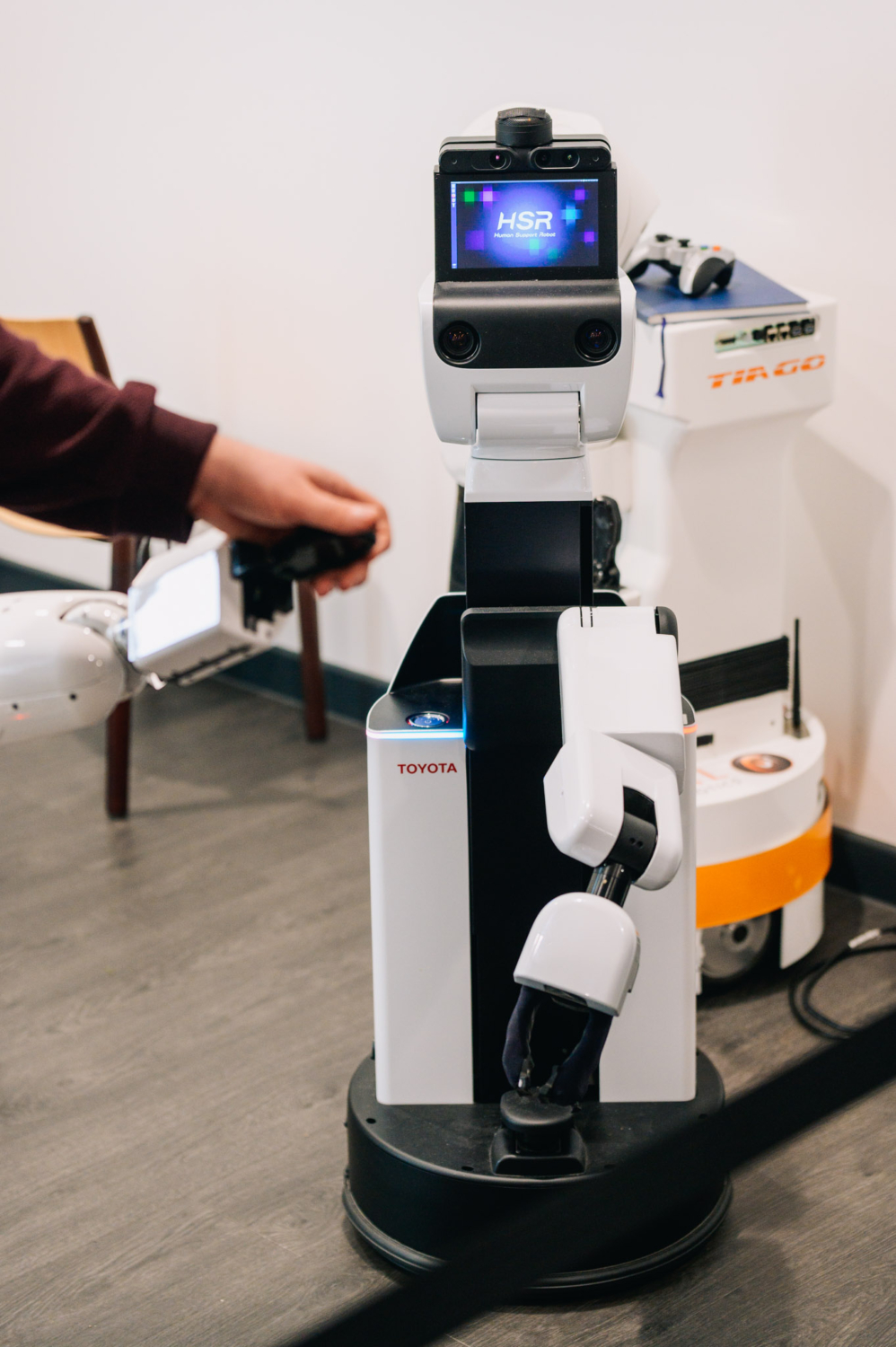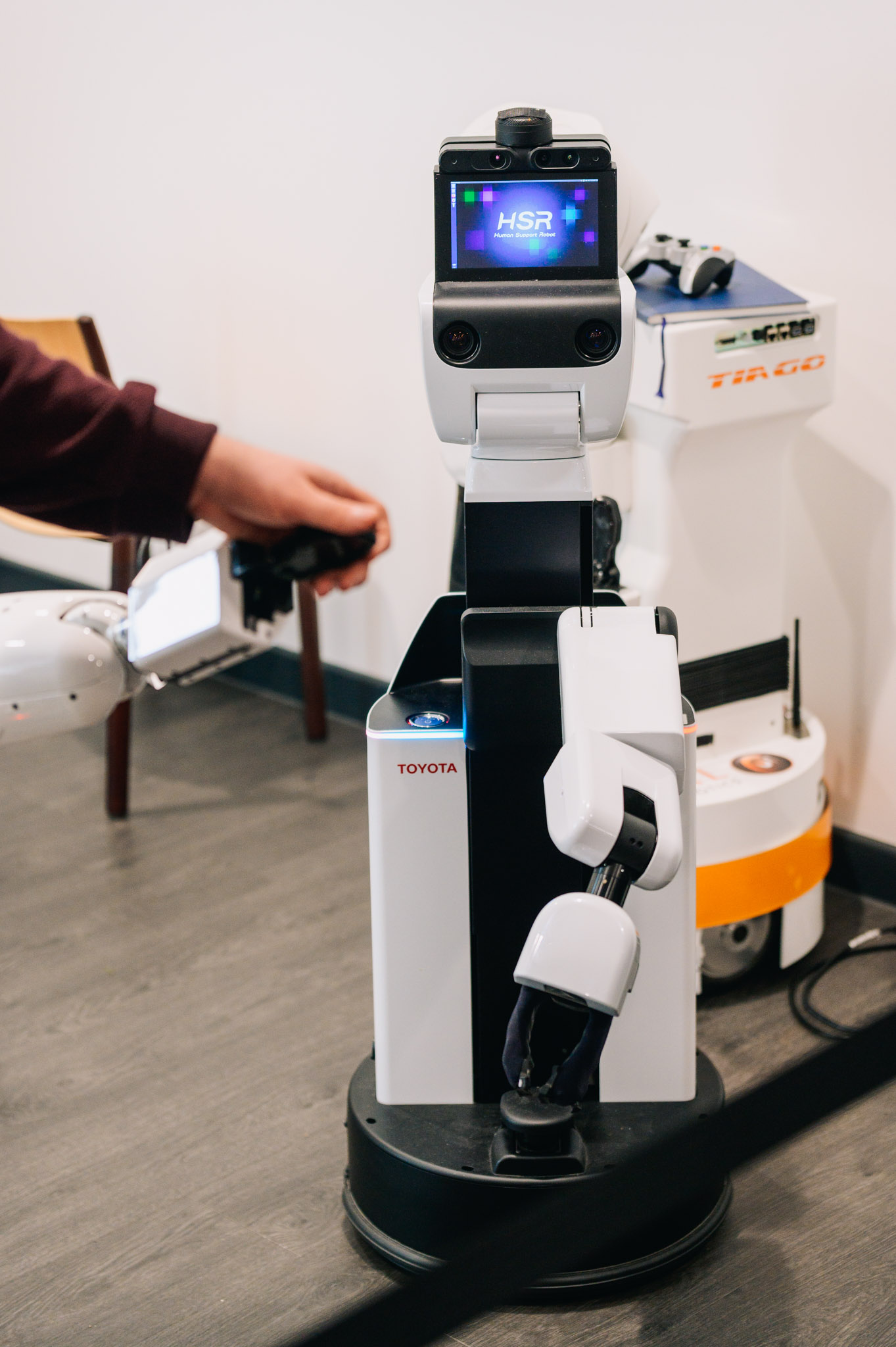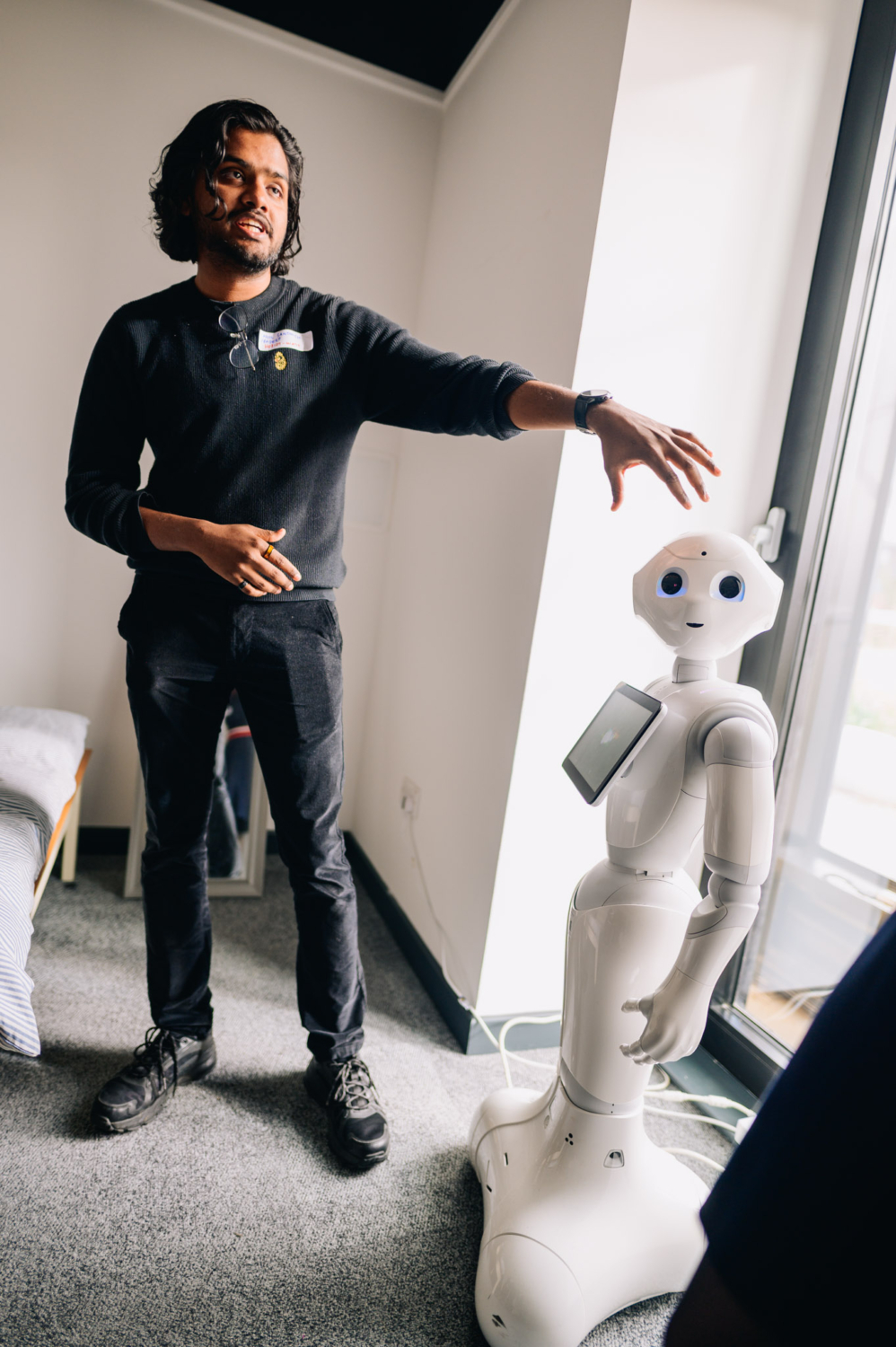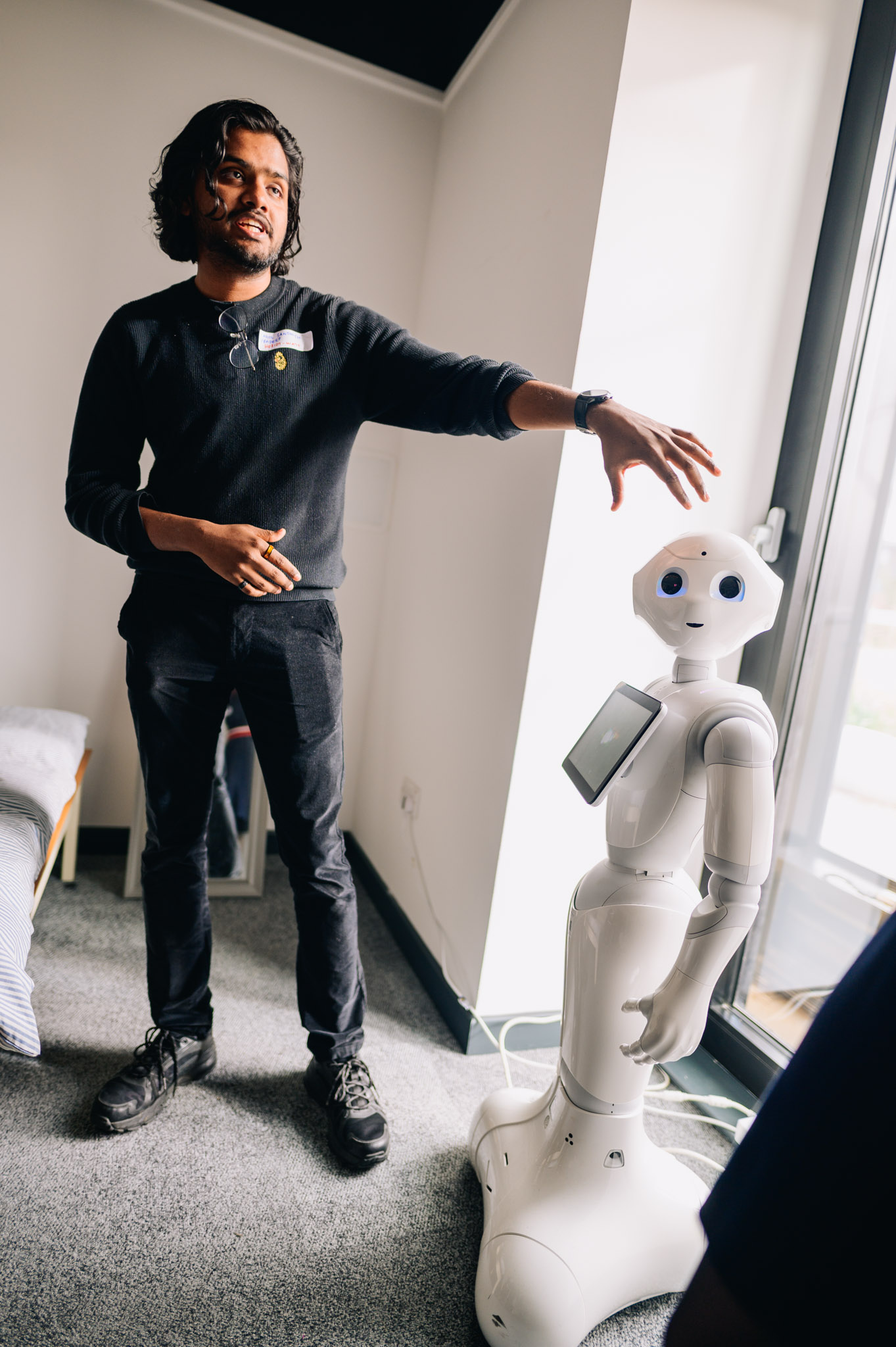
The National Robotarium, the UK’s leading centre for robotics and Artificial Intelligence at Heriot-Watt University, is to be involved in the development of new products and services that help to advance the safe adoption of robotics in the public sector.
As part of round 11 of the CivTech Challenge, a Scottish Government programme that brings the public, private and third sectors together to create new innovations that can make people’s lives better, The National Robotarium and the Directorate for Digital aims to support the development of pioneering ideas that can enable greater adoption of new robotic and smart technologies in public organisations.
Any organisation, team or individual can respond to Challenge 11.8, ‘How can the public sector ensure a safe, secure and transparent adoption of robotics’, with the most promising solutions given the chance to access up to £1.2m in public contracts.
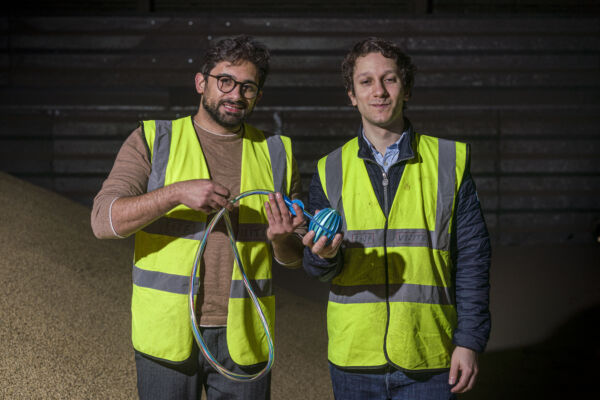
CEO Stewart Miller with Robotics Engineer Coena Das
Chief Executive Officer of The National Robotarium, Stewart Miller, said: “Our mission at The National Robotarium is to build the UK’s presence in the robotics sector, support new technology companies in getting their robotic products to market, and encourage businesses to increase the use of robotic technologies in their day-to-day operations.
“A major part of this involves ensuring that companies feel confident in having more robots working side-by-side with humans, customers or other users, and that requires robust cybersecurity that protects their programming and automation.
“Through the CivTech Challenge, we have the opportunity to support the rapid advancement of new products or services that can protect robots – and businesses – from even the most sophisticated cyber-attacks, enabling a smoother transition to robotics adoption.”
Innovators, entrepreneurs, startups, SMEs and established businesses interested in taking on the CivTech Challenge have until 2 September to submit their initial proposal via Public Contracts Scotland.
Hear Stewart discuss the challenge in more detail at: https://youtu.be/SrJM_IONP6E
A partnership between Scotland’s leading technology and agricultural research institutions is developing 5G-connected robotics applications that enable farmers to implement precision agriculture techniques while addressing rural connectivity challenges.
The collaboration between Heriot-Watt University’s The National Robotarium, James Hutton Institute, Scotland 5G Centre, Boston Dynamics, and Freshwave is advancing robotic systems that can perform precision farming tasks – including crop health monitoring, targeted fertiliser application, and soil condition assessment – through portable 5G private networks.
Through private, mobile 5G connectivity, robots like Boston Dynamics’ Spot can undertake real-time scanning and mapping operations in remote or rural settings (photography by Ben Glasgow)
The technology addresses critical challenges facing modern agriculture, such as rising input costs, labour shortages, environmental regulations, and the need to increase food production while reducing environmental impact. Traditional farming approaches often involve uniform treatment across entire fields, but 5G-connected robotics enable plant-by-plant precision, applying resources only where needed.
The robotic systems use high-speed 5G connections to communicate with other robotic devices securely in real time as well as transmit detailed information about crops, soil conditions, and growing environments, enabling farmers to make informed decisions based on current field conditions.
A key breakthrough has been addressing connectivity limitations in rural areas. Agricultural operations requiring data-intensive robotic applications often face inadequate mobile network coverage and bandwidth constraints. The partnership has worked with portable 5G private networks that can be rapidly deployed on farms, providing the high-speed, low-latency connectivity essential for real-time robotic operations.
The robotic systems can stream high-definition video, generate detailed field mapping and, with under-development visual recognition systems, identify issues such as disease, pest infestations, or water stress significantly earlier than traditional monitoring methods. Applications that previously required expensive specialised equipment, technical expertise, and optimal weather conditions can now be implemented more efficiently and cost-effectively.
With global food production required to increase by more than 50% by 2050 while reducing environmental impact, advanced agricultural technologies are becoming essential. The agricultural sector, which contributes £2.2 billion to Scotland’s economy, is positioned to lead development of practical precision farming solutions that address real-world operational challenges.
Project Manager at The National Robotarium, Ruth Plant
Following a demonstration of the 5G-connected robotics technologies at The National Robotarium, Ruth Plant, Project Manager, said:
“What’s exciting about this project is seeing the technology develop from initial concept to working demonstration. We’ve successfully shown that portable 5G networks can provide the connectivity needed for real-time robotic operations in agricultural settings. The integration of these technologies creates opportunities for precision farming that weren’t previously possible in areas with limited connectivity.
“This partnership demonstrates exactly what the National Robotarium was designed to achieve – bringing together leading academic research, innovative companies, and industry expertise to develop practical solutions to real-world challenges. Our facility provides the collaborative environment where these breakthrough technologies can be developed, tested, and demonstrated to the partners and stakeholders who can help bring them to market.”
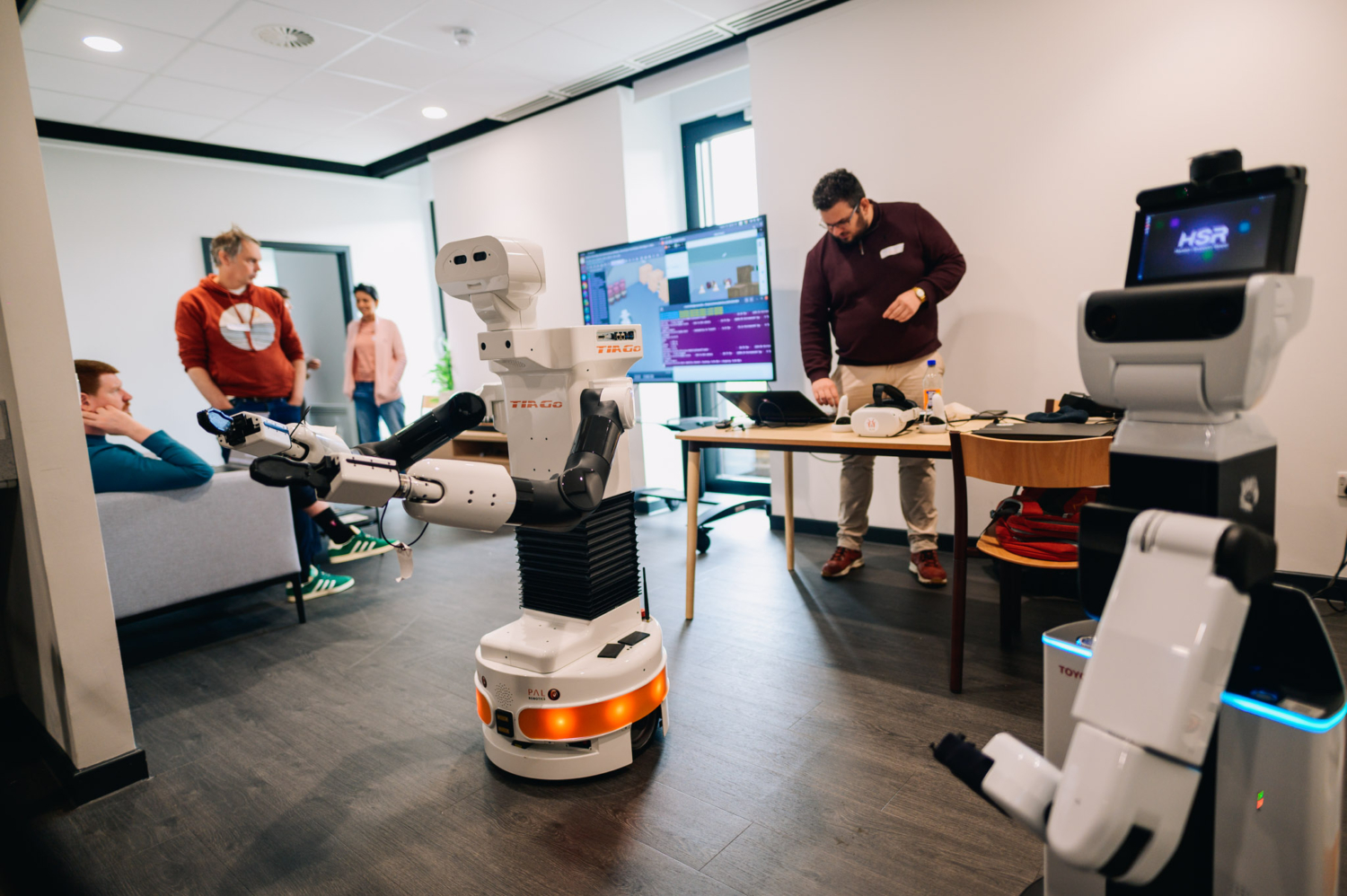
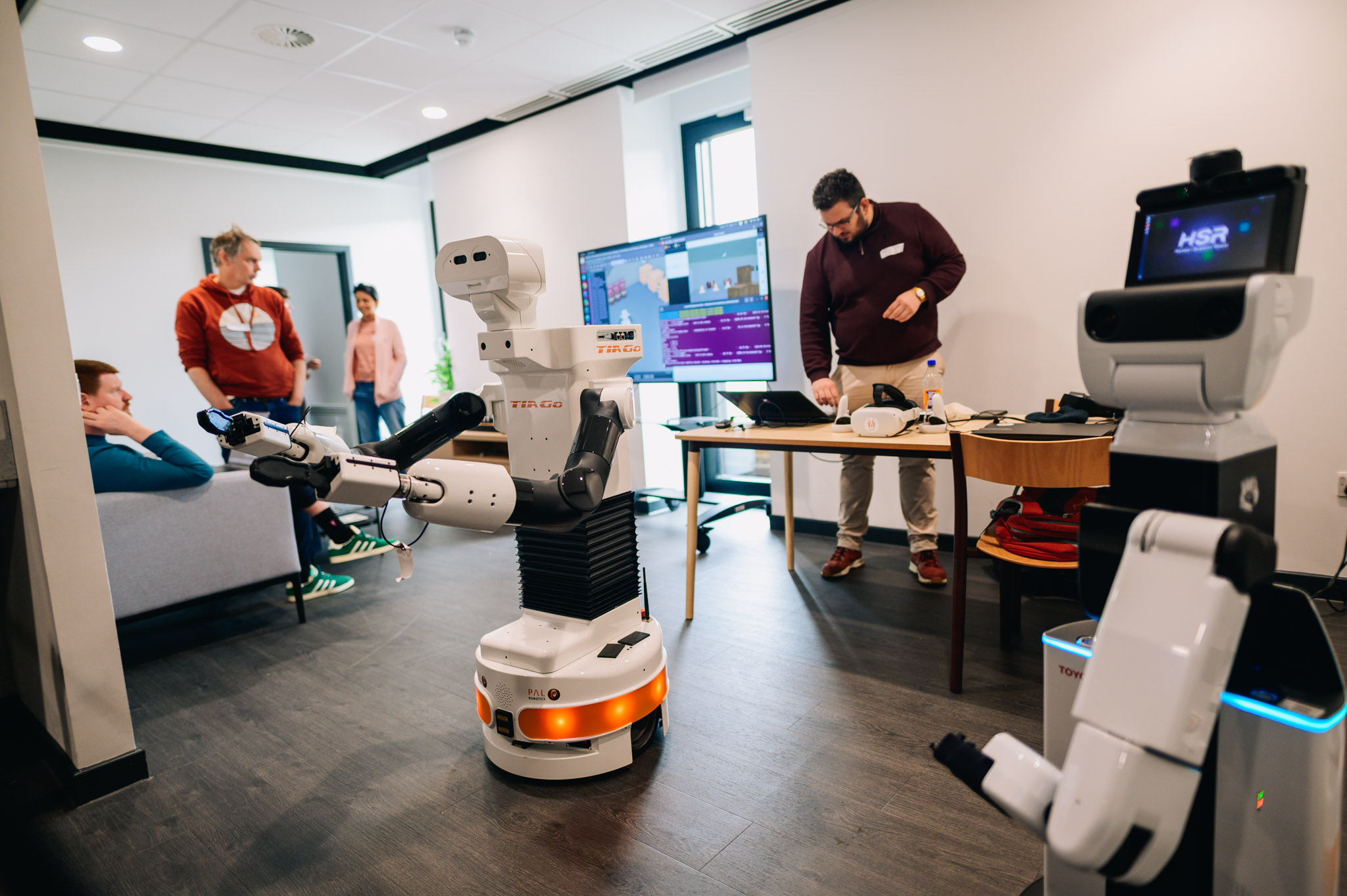
The technology was demonstrated at a 5G-connected robotics showcase, held at The National Robotarium on 30 June 2025 (photography by Ben Glasgow)
Andrew Christie, agritech specialist at The James Hutton Institute, said:
“As an evolution of precision farming technology being used in modern agriculture, robotics are a next step in the progression towards data driven farming practices, but a barrier to uptake has been the speed and reliability for real time communication and a need for manual intervention for data processing.
“With the integration of 5G private networks in robotics we can address these issues enabling high volumes of data to be transmitted at low latency and allowing us to use our current equipment more effectively, whilst also enabling future progress in swarm robotics, real-time sensors for digital twinning and active data processing through cloud computing.
“The use of remotely deployable 5G private networks as showcased at The National Robotarium and The James Hutton Institute provides relevance to all rural settings, and agricultural businesses regardless of farm type.”
Ian Sharp, Head of Delivery at the Scotland 5G Centre, said:
“The Scotland 5G Centre (S5GC) is focussed on enabling Scotland to unlock the benefits of advanced wireless connectivity, so we are very pleased to play an active role in this partnership.
“The collaboration highlights clearly how advanced wireless communications (5G) can enable new and exciting applications of robotics in an agricultural setting. It’s easy to see from the project how the 5G connected robotics can provide new opportunities to increase productivity and reduce costs.
“It’s also important to note that the partnership itself highlights the collaborative nature and strength of Scotland’s innovation ecosystem, particularly in working closely with industry partners.
“We were able to seed this project through use of funding from our Innovate UK Technology Mission Fund Programme. The IUK Programme ended in March 2025 and enabled a number of other 5G related projects, some of which continued the theme of addressing rural connectivity through the use of mobile 5G test networks deployed in harsh outdoor conditions.”
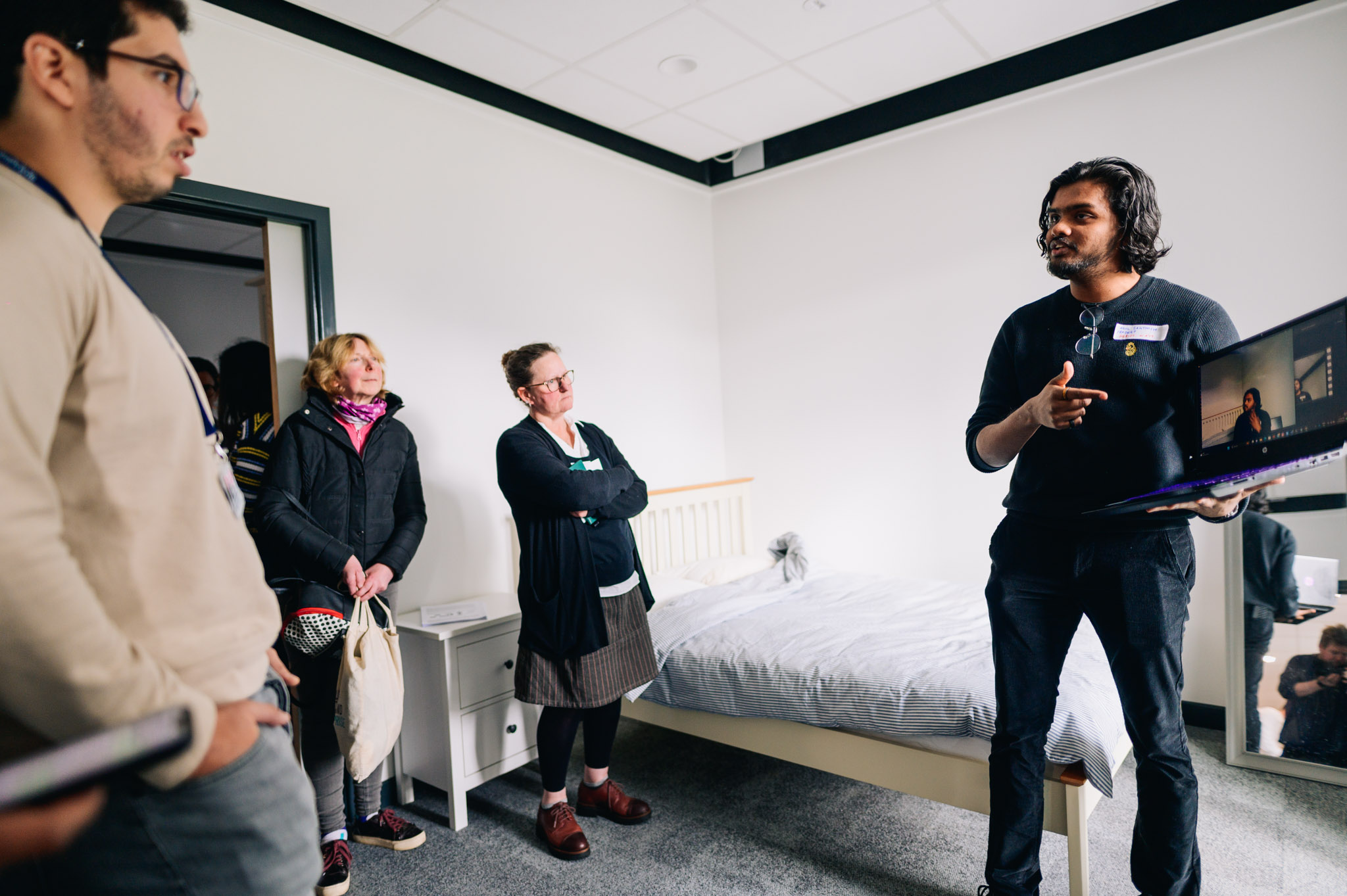
Robotics Engineer Hari operates the 5G-connected robot using VR
Tom Bennett, Chief Technology Officer at Freshwave, said:
“We’re proud to be enabling next-generation connectivity at the cutting edge of agritech research. Reliable, portable private 5G is unlocking new possibilities for robotics and automation, and we’re excited to support the National Robotarium as they help shape the future of sustainable agriculture alongside their partners and customers.”
WATCH STV News for a special report on The National Robotarium’s 5G Connected Robotics showcase event.
Interested in finding out if 5G-connected robotics can help your business? Contact Project Manager Ruth Plant at r.plant@hw.ac.uk
https://thenationalrobotarium.com/wp-content/uploads/Robotarium-5G-Showcase-130-Spot-1000px.jpg6661000Louise Jackhttp://thenationalrobotarium.com/wp-content/uploads/Robotarium.pngLouise Jack2025-07-02 10:15:002025-07-02 10:15:005G connected robotics set to revolutionise the farming sector
The National Robotarium welcomes the UK Government’s announcement of £40 million funding to create a network of robotics adoption hubs as part of the new Industrial Strategy, marking a pivotal moment in the UK’s journey towards robotics leadership.
This significant investment will establish specialist facilities across the UK designed to accelerate robotics adoption and innovation, demonstrating how our country can transform from a robotics consumer into a global producer and technology leader. The strategic importance of this initiative has been highlighted in both the UK Government’s Advanced Manufacturing strategy and the Technology Adoption Review, also published today.
The National Robotarium, a global research institute at Heriot-Watt University, has proven the transformative potential of strategic robotics investment. Since launching in September 2022 with £22.4 million in capital funding from the Edinburgh and South East Scotland City Region Deal, we have supported over 100 jobs, nurtured 14 innovative robotics companies, and engaged approximately 27,000 young people in robotics education, demonstrating the economic and social returns possible from focused robotics initiatives.
This new investment comes at a critical time. The UK currently ranks just 24th globally for robots per manufacturing worker, with Germany alone installing eight times more robots than the entire UK in 2023. The global robotics market is projected to reach £218 billion by 2030, representing enormous opportunities for countries that position themselves as producers rather than consumers.
The new robotics adoption hubs will focus on accelerating technology uptake and supporting businesses in understanding and implementing robotics solutions. This approach addresses the urgent need identified in the Industrial Strategy – that approximately 20,000 of the UK’s 27,000 manufacturing SMEs currently operate without robots, representing a massive untapped opportunity for productivity improvement.
International evidence shows that every £1 invested in R&D generates up to £7 in economic benefits. These new facilities will create high-skilled jobs, support innovative businesses, and drive productivity improvements while building the foundation for a thriving UK robotics sector.
Stewart Miller presents ‘Reaping the Rewards of the Robotics Revolution’ at the UK Parliament, March 2024
The robotics revolution is accelerating globally, and this investment positions the UK to move from the sidelines to serious contention. The National Robotarium stands ready to support this national effort and share our expertise to ensure these new facilities succeed in transforming the UK’s robotics capabilities.
As a proven model of successful robotics innovation, we welcome the opportunity to contribute to this nationwide expansion and help position the UK as a global robotics leader in the technologies that will define the future economy.
Stewart Miller
Chief Executive Officer
The National Robotarium
https://thenationalrobotarium.com/wp-content/uploads/Building-side-1000px.jpg15001000Louise Jackhttp://thenationalrobotarium.com/wp-content/uploads/Robotarium.pngLouise Jack2025-06-23 16:09:092025-12-16 15:09:28The National Robotarium welcomes UK Government’s transformative £40 million robotics investment
Scotland risks missing out on the global robotics revolution as other nations surge ahead in a market projected to reach £218 billion by 2030, but a major new policy paper published today (19 June 2025) by The National Robotarium shows how the country can still establish itself as a world leader.
Stewart Miller, CEO of the National Robotarium, a Heriot-Watt University Global Research Institute, has today launched the comprehensive policy discussion paper ‘Making Scotland a World Leader in Robotics’ warning that urgent action is needed to prevent Scotland from falling further behind international competitors, while outlining a clear pathway to robotics leadership.
“We’re at a critical juncture,” Miller said. “Countries like China, America, and Singapore are racing ahead in robotics adoption and innovation, while the UK ranks just 24th globally for robots per manufacturing worker. But Scotland has exceptional foundations that, with the right approach, could make us a global robotics powerhouse.”
CEO of the National Robotarium, Stewart Miller (credit Ben Glasgow photography)
The scale of the challenge facing Scotland, highlighted on the front page of The Herald when the policy paper launched, is sobering. Asia dominates with 72% of global robot installations, while Germany installs nearly eight times more robots than the entire UK. Denmark has become a robotics leader through strategic investment in collaborative robots and automation, creating a thriving ecosystem that attracts international companies and talent.
“Other nations aren’t waiting – they’re building robotics capabilities that will define their economic futures,” Miller explained. “While we’ve been developing excellent innovations, our European neighbours and countries like Australia have been creating the systems and support that turn innovation into economic leadership. We risk becoming developers of technology for other countries to commercialise.”
The policy paper highlights the stark reality of missed opportunities. Approximately 20,000 UK manufacturing SMEs currently operate without robotics technology, representing massive untapped potential. According to recent analysis, if UK automation levels matched leading countries, productivity could increase by 22%, potentially contributing £184 billion to the economy over the next decade.
The healthcare sector presents equally concerning gaps. While the global healthcare robotics market is projected to grow to £3.4 billion by 2028, Scotland struggles to translate its clinical expertise and innovation capability into systematic adoption, potentially missing out on £21.7 million in annual efficiency savings for NHS Scotland alone.
“We have companies like Edinburgh-based BioLiberty developing breakthrough stroke rehabilitation technology, but they’re launching in North American markets because we haven’t created the pathways for domestic success,” Miller said. “We’re funding innovations that primarily benefit other countries.”
Companies like Bioliberty have launched stroke rehabilitation technology Lifeglov (pictured) in North America due to lack of pathways to market in the UK
However, Miller’s analysis reveals that Scotland is uniquely positioned to reverse this trend and establish genuine robotics leadership. Unlike countries starting from scratch, Scotland possesses world-class research excellence, outstanding engineering heritage, and proven entrepreneurial spirit.
“The difference between concern and optimism is action,” Miller explained. “Scotland has all the ingredients needed – we just need to combine them more effectively. The National Robotarium has demonstrated what’s possible, supporting over 100 jobs and nurturing 14 innovative companies in less than three years. This success can be replicated and scaled.”
The policy paper identifies three sectors where Scotland can establish clear competitive advantages. The offshore renewables sector offers immediate opportunities, with robotics applications in wind farm operations alone representing a £341 million annual market by 2030. Scotland’s global leadership in offshore energy provides a natural platform for marine robotics excellence.
Healthcare presents extraordinary potential for Scottish innovation. With world-class clinical expertise and growing recognition among healthcare leaders of robotics possibilities, Scotland could become the global centre for healthcare robotics development.
Manufacturing offers perhaps the broadest opportunity, with Scotland’s expertise positioning it to capture significant market share as automation demand accelerates across thousands of ready-to-adopt businesses.
Stewart Miller (pictured with Robotics Engineer Coena Das) argues widespread adoption of robotics in UK manufacturing could lead to greater productivity and efficiencies
“Every challenge becomes an opportunity when viewed through the robotics lens,” Miller said. “NHS pressures could drive healthcare robotics innovation. Manufacturing skills shortages could accelerate automation adoption. Our offshore energy leadership could establish Scotland as the global centre for marine robotics.”
The emergence of embodied AI has created unprecedented opportunities for countries that move decisively. With over a hundred companies worldwide receiving billions in investment to develop genuinely human-capable systems, Scotland’s combination of AI expertise and robotics capability positions it perfectly for this next wave of innovation.
Miller emphasises that Scotland’s advantages extend beyond technology to include cultural and institutional strengths. The country’s collaborative approach between industry, academia, and government – exemplified by the National Robotarium’s ‘triple helix’ model – creates ideal conditions for rapid ecosystem development.
The National Robotarium’s track record provides compelling evidence of Scotland’s potential. Since launching in September 2022, the facility has become internationally recognised, with the Tony Blair Institute for Global Change citing its model in their landmark October 2024 report on robotics leadership. The recent expansion to Orkney through the International Blue Economy Robotarium demonstrates how targeted sector focus can accelerate market leadership.
Professor Gillian Murray, Deputy Principal of Business and Enterprise at Heriot-Watt University, said: “Heriot-Watt has a proud 200-year heritage of pioneering engineering and innovation that has shaped industries worldwide. The National Robotarium exemplifies our commitment to mobilising intellectual and capital assets for global impact. This policy paper demonstrates how Scotland can build on our university sector’s world-class research capabilities to establish genuine leadership in the technologies that will define the future economy.”
Deputy Principal of Business and Enterprise at Heriot-Watt University, Professor Gill Murray
The policy paper outlines a comprehensive vision for establishing Scotland as a global robotics powerhouse through four strategic initiatives:
Create Robotics Scotland as a national coordinating body to accelerate collaboration between research, industry, and international partners
Establish a National Healthcare Robotics Initiative to position Scotland as the global leader in medical robotics innovation
Launch a Marine Robotics Innovation Programme, leveraging Scotland’s offshore expertise to dominate this emerging market
Develop a National Robotics Skills Strategy, ensuring Scotland has the talent to lead across all robotics applications
Miller envisions these initiatives creating a virtuous cycle where Scottish success attracts international investment, talent, and partnerships, transforming Scotland from a country watching the robotics revolution to one leading it.
“We have all the building blocks in place,” Miller concluded. “Outstanding research through institutions like the National Robotarium, breakthrough innovations in technology, and world-class university capabilities. The question isn’t whether Scotland can become a robotics leader – it’s whether we’ll act quickly enough to make it happen.”
https://thenationalrobotarium.com/wp-content/uploads/Robots-and-human.jpg5721000Louise Jackhttp://thenationalrobotarium.com/wp-content/uploads/Robotarium.pngLouise Jack2025-06-19 11:06:142025-06-19 11:06:14Scotland risks being left behind in robotics revolution
The National Robotarium has launched a new work experience programme for secondary schools.
Overseen by Schools Engagement Lead (and former Computer Science teacher), Sabaht Bashir, the immersive week-long programme ran from 9-13 June 2025, offering a glimpse behind-the-scenes at the UK’s centre for robotics innovation.
The group, made-up of young people from schools across Scotland and England, kicked-off the week with a tour the facility’s high-spec labs and workshops, and the wider Heriot-Watt campus, taking in its vast green spaces and multi-million pound Oriam Sports Centre.
They learned about the different roles undertaken at the facility, ranging from Robotics Engineers and Technicians to Project Management and Marketing and Communications, as well as the different pathways to robotics careers, including Heriot-Watt University’s Graduate Apprenticeship scheme.
They also got hands-on experience operating some of the robotic technologies being developed for research and industry partners, such as the Boston Dynamics Spot robot dogs, as well as interacting with social engagement humanoid Ameca, and building their own robotic cars with the help of Senior Robotics Engineer Ronnie Smith. On the final day, members of the National Robotarium Leadership team judged their efforts during a presentation showcase in the main Atrium space.
Work experience participants with School Engagement Lead Sabaht Bashir, COO Steve Maclaren, Robotics Engineer Ronnie Smith, and Project Manager Rowanne Miller
Callum Samson, a 4th year pupil from St John’s RC High School in Dundee, was one of the participants. He said: “I really enjoyed work experience at the Robotarium – the members of staff were all really friendly. I was really surprised at how big the centre is, with lots of different jobs that are really interesting.
“Spending a week at The National Robotarium has changed my perceptions of robots and their levels of advancement. There are lots of different robots for different tasks however they need a lot of support and programming by humans to undertake these.
“I’ve really enjoyed my time here and definitely would like to come back when I’m older to study or work.”
Jakub Przybek from St Modan’s High School said: “Visiting The National Robotarium for work experience has opened my eyes to a whole new world of integrated robotics in so many different sectors.
“I’ve found robots can be used for every type of industry and aren’t just limited to mechanical or manufacturing tasks.
“I’d love to become a Robotics Engineer at the Robotarium when I’m older!”
Other participants in the group were Ben Lake, George Heriot’s, Manuel Amadiegwu, Dartford Grammar School, Alex Vynnytskyi, St Modan’s, Jamie Stephenson, The Priory Academy LSST, Daniel Gregor, Boroughmuir HS, and Alex Florea and Oakley Dow, both St Kentigerns Academy.
Want to know more about The National Robotarium’s work experience programme? Contact s.bashir@hw.ac.uk for information on 2025/26 opportunities.
https://thenationalrobotarium.com/wp-content/uploads/Image-12-scaled.jpeg25601920Louise Jackhttp://thenationalrobotarium.com/wp-content/uploads/Robotarium.pngLouise Jack2025-06-16 14:48:322025-06-16 16:02:50The National Robotarium work experience programme inspires budding roboticists
European investors have gathered in Edinburgh to hear Scotland’s new advanced manufacturing strategy, alongside pitches from top-rated deep tech scaleups.
Investors and experts from the European Growth Deeptech Tech Tour joined key players from the Scottish tech ecosystem at the University of Edinburgh-led technology showcase EIE25.
Business champion Mark Logan presented Scotland’s Deep Tech Supercluster initiative, which aims to provide currently lacking scale-up pathways for innovative hardware companies rooted in advanced science and engineering.
The National Robotarium will co-lead the Supercluster in partnership with Scottish Enterprise and the National Manufacturing Institute Scotland, alongside Scottish universities including Edinburgh, Glasgow and Heriot-Watt. It will build a new large-scale advanced manufacturing facility in Renfrewshire and, from September, will add new high-value posts to existing facilities and services.
Mr Logan said: “The Deep Tech Supercluster creates additional pathways to scale for Scotland’s deep tech startups and spinouts. Complementary to the Techscaler initiative, it will provide facilities and services so that companies that require advanced manufacturing capabilities, in fields such as robotics and semiconductors, can grow.”
The Tech Tour event at The National Robotarium saw eight Scottish businesses pitch to European tech investors
Elsewhere at the joint EIE/Tech Tour event, 47 companies from across the world pitched for startup and scaleup investment, including eight Scottish businesses which were top rated out of 130 by the Tech Tour panel for their growth potential. Pitching companies raised a total of €1.3billion following the European Growth Deeptech Tech Tour event last year.
Deputy Principal for Business and Enterprise at Heriot-Watt, Professor Gill Murray introduced the event at The National Robotarium
Eight Scottish businesses came to The National Robotarium to pitch to Tech Tour and EIE investors. They were Bright Ascension (aerospace), Ceres Holographics (enhanced reality), IOtech Systems (industrial operating technologies), Novosound (ultrasound technology), pureLiFi (wireless communications), Skyrora (space rockets), Sofant Technologies (satellite communications) and Sunamp (thermal energy storage).
The session kicked-off with introductory speeches from Deputy Principal for Business and Enterprise at Heriot-Watt University, Professor Gill Murray, Director of Northface Ventures, David Farquhar, and Head of Digital Economy and Data Driven Business at The Scottish Government Stephen O’Neill.
https://thenationalrobotarium.com/wp-content/uploads/Tech-tour-land-scaled.jpeg22002560Louise Jackhttp://thenationalrobotarium.com/wp-content/uploads/Robotarium.pngLouise Jack2025-05-16 15:19:272025-05-16 15:33:43Scotland’s new tech strategy unveiled at technology showcase
The International Blue Economy Robotarium – dubbed the ‘Blue Robotarium’ – will bring together leading experts in science and industry to test and develop cutting-edge robotic technologies to revolutionise the global blue economy.
Over the coming months, the Blue Robotarium aims to:
Develop an expansive programme that explores learning and solutions related to robotics, AI and data management for the offshore wind and tidal energy sectors;
Rapidly advance the testing and development of robotic systems to improve the sustainability of marine industry operations;
Create a centre in Orkney for testing, certification and performance validation of new robotic, AI digital technologies;
Support and facilitate the safe deployment of new technologies, underpinned by expert support and management;
Stewart Miller, CEO of The National Robotarium, spearheaded the new consortium alongside Professor Sandy Kerr, Director, School of Energy, Geoscience, Infrastructure and Society at Heriot-Watt’s Orkney campus.
Stewart said: “This is a hugely exciting opportunity to showcase how the National Robotarium model can be adapted to drive robotic innovations for specific sectors.
“The International Blue Economy Robotarium will explore sustainable solutions that will enhance the offshore energy, marine and renewables industries through advanced technology.
“With access to a network of 400 service specialists, the Blue Robotarium will be a one-stop-shop for enterprising companies seeking to enhance efficiencies and improve sustainability using robotics.”
https://thenationalrobotarium.com/wp-content/uploads/IBER-all-energy-land-1.jpeg13372082Louise Jackhttp://thenationalrobotarium.com/wp-content/uploads/Robotarium.pngLouise Jack2025-05-14 16:32:312025-05-20 10:53:04New ‘Blue Robotarium’ aims to transform marine energy industry
Included in the ambitious plan were commitments to:
Form AI Scotland, a new national transformation programme for academia, industry and government to work together in advancing the adoption of the technology;
Launch a University Proof of Concept fund to help promising research projects develop into new companies;
Establish a Technology Council of global business and scientific experts to advise ministers on how best to adopt emerging technologies;
In response to the announcement, CEO of The National Robotarium, Stewart Miller, said:
“Today’s ambitious Programme for Government demonstrates a clear commitment to positioning Scotland as a global leader in innovation, entrepreneurship and technology. The launch of AI Scotland as a national transformation programme is particularly significant, as it recognises the critical role that AI and robotics will play in Scotland’s economic future.
“As the UK’s centre for robotics and AI, the National Robotarium stands ready to be a key delivery partner in this vision, helping to implement the national AI adoption programme for SMEs and contributing to the Technology Council of global business and academic experts that will now advise the Government on applying and benefiting from emerging technological trends.
“The Government’s plan to establish a University Proof of Concept Fund is a welcome step that will help bridge the gap between research and commercialisation – something we’ve identified as crucial to building a robotics manufacturing ecosystem in Scotland. By supporting research projects with significant economic potential to progress towards forming new companies, this initiative will help ensure more Scottish innovations reach the market and create economic value within our borders.”
https://thenationalrobotarium.com/wp-content/uploads/SG-PfG-2025.png831580Louise Jackhttp://thenationalrobotarium.com/wp-content/uploads/Robotarium.pngLouise Jack2025-05-08 11:22:402025-05-09 17:24:04Our response to the 2025-2026 Scottish Programme for Government
This article was originally published by Frankie Macpherson in healthandcare.scot on Monday 28 April
A new project has spotlighted the potential of robotic technical to support independent living and social engagement for people living in assisted residential accommodation, at the same time as ensuring a quick response when things go wrong.
Scottish researchers partnered with charity and specialist home care provider, Blackwood Homes and Care to explore how robotics might work alongside, and potentially improve, Blackwood’s existing care systems.
Lead researcher and expert in assistive robotics, Heriot-Watt University’s Dr Mauro Dragone said:
“Robotics offers a powerful solution for independent living, enabling remote monitoring, reducing staff pressures, and increasing personal choice and care flexibility. Projects like this help de-risk innovation by embedding technical expertise into care environments, ensuring reliability and user acceptance.
“To achieve lasting impact, partnerships — such as with the National Robotarium at Heriot-Watt — are essential.
“They provide the research, support and training needed to scale new technologies responsibly and effectively across Scotland’s health and care sector.”
Temi: robot first responders
The Temi is being used as a first responder for residents at Blackwood Homes and Care, providing 24/7 support.
At the heart of the project was the ‘Temi’ robot, which was integrated with the digital telecare systems already used across three buildings in Glasgow. Temi could reach people in their apartments to help Blackwood’s Homes and Care 24/7 emergency response team and carry out routine health and wellbeing check-ins.
Dr Dragone said that the robots have been developed with input from staff and residents. He said: “These robots acted as first responders, automatically travelling to residents’ flats during emergencies and enabling live video contact with care teams. Unlike traditional devices, they ensured support even when residents couldn’t access their phones or tablets.
“Beyond emergency response, the robots also carried out daily mental health and wellbeing check-ins.
“Developed through co-design with residents and staff, the robot could ask questions, play music, and facilitate contact with the care team — adding value to day-to-day life and increasing social interaction.
“One of the most successful aspects of the collaboration between the research team at Heriot-Watt University and the innovation team in Blackwood was these participatory design activities, to understand their concerns but also their aspiration, preferences and desires for the new technology.”
Participants in the trial reported increased satisfaction with the enhanced service, highlighting Temi’s contribution to both social engagement and accessibility of care services.
A care work team leader who attended one of the sessions demonstrating how the robotics work described themselves as “totally converted” from a non-believer in robotics to seeing it as something that can help “shape the future of care”.
The UK’s National Robotarium played a ‘pivotal role’ in advancing robotic and software solutions through this partnership, with Heriot-Watt researchers developing “custom software and user interfaces” for Temi.
The research team also trained staff, and integrated the system within Blackwood’s residences, and now hope to continue to advance robotic-assisted independent living and care.
One person involved in the trial said they had “immensely enjoyed” the process, adding:
“I initially got involved as I was curious about what robotics encompassed, and despite being unsure about technology, I kept an open mind. From the very first workshop, I saw how they could be of benefit. Contributing ideas from a service user point of view felt such a privilege and now that I have seen my ‘mental health check-in’ idea has been incorporated into the robot, is just mind blowing!
“It makes me feel not only proud of my idea, but more importantly, that it can be of benefit to others. That makes me happy to know that someone else might feel better because of it.”
Remote triage
One challenge the teams worked to address for remote care staff is that systems often rely on the person who is in trouble to trigger an emergency video call.
The researchers explain this can “difficult to manage”, as it may not be possible if someone has fallen out of sight of the device or is feeling ill or confused.
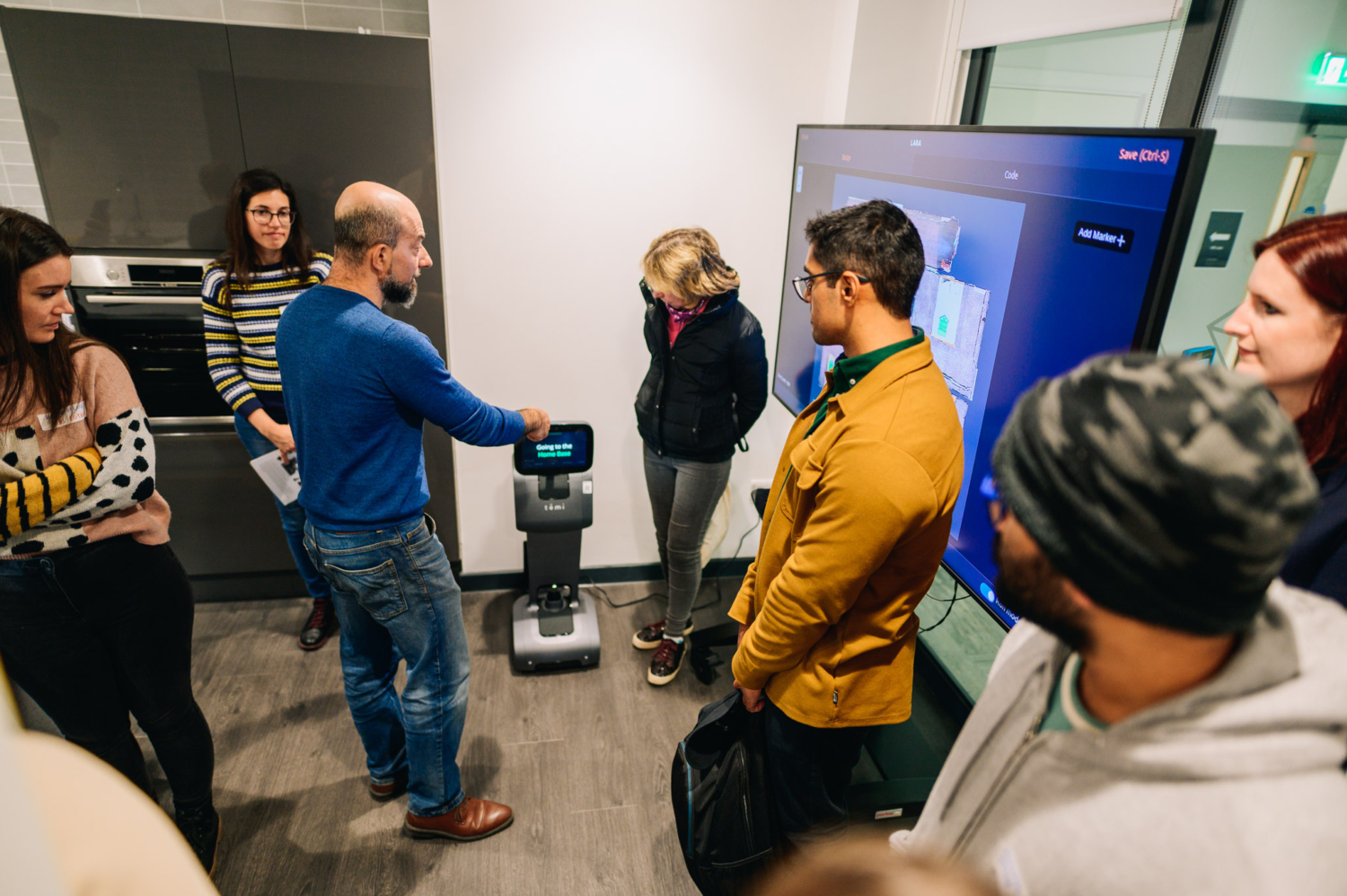
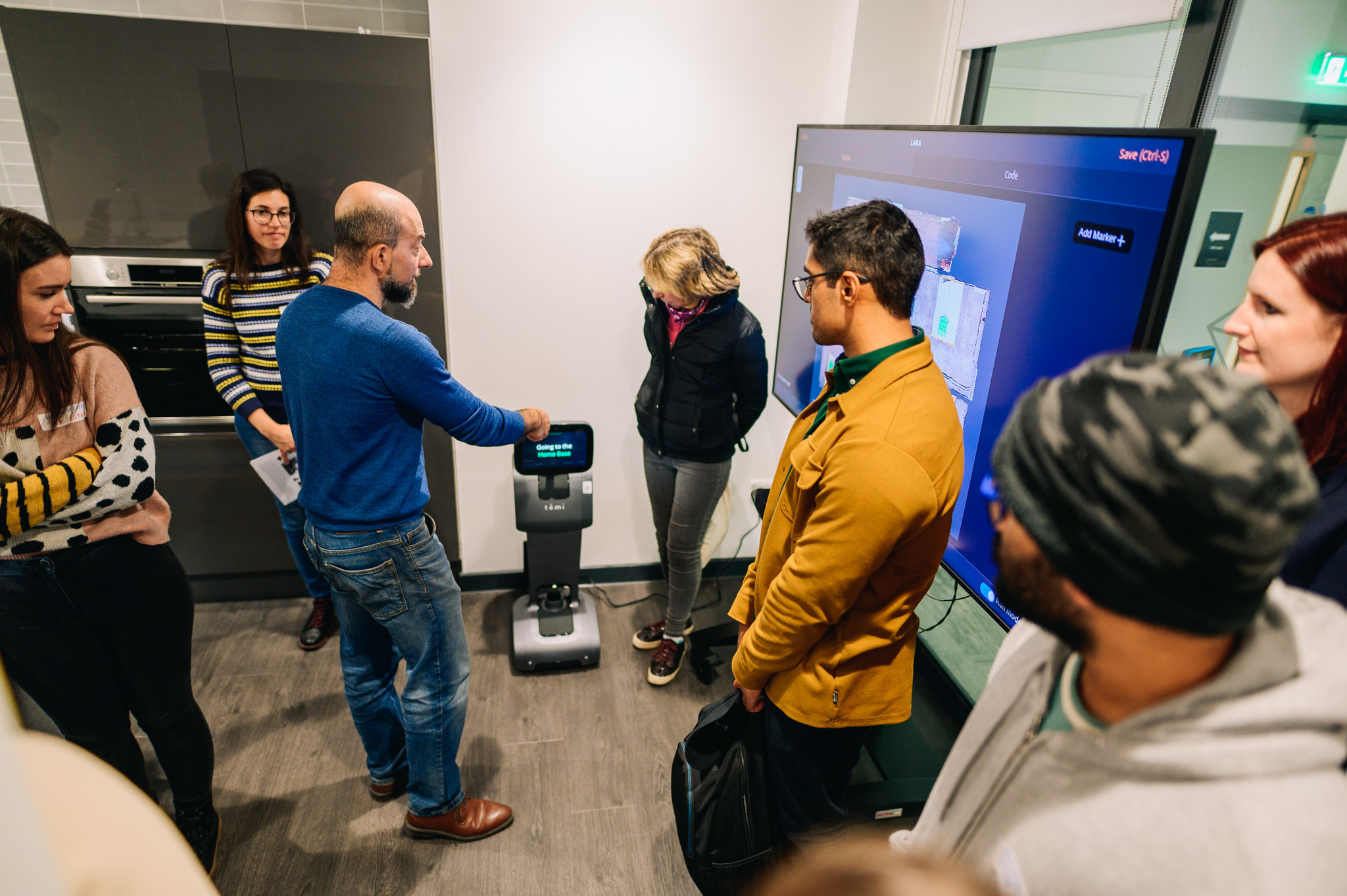
Dr Mauro Dragone showcases the Temi robot to health and social care practitioners with the National Robotarium Laboratory for Robotic Assistive living (LARA).
Dr Dragone explained Temi could respond to an emergency being trigged without residents using a phone or tablet. It travels from the ground floor, using the building’s lifts if needed, to reach and connect residents with a virtual care team through a live video feed. Once connected, the responder from the remote care team takes control of the robot, assesses the situation and can speak to the resident.
He said: “This allowed remote staff to assess the situation accurately and quickly enhanced emergency response and enabling care even during travel restrictions.
“Temi is a mobile robot with a tablet and camera for video calls, combined with obstacle detection, navigation software, and the ability to operate lifts and doors.
“While Temi doesn’t currently carry out physical tasks, Heriot-Watt is now developing smart home devices and modular robotic furniture to work alongside robots like Temi — extending their support potential in care settings.”
He added that this is particularly helpful during stations where there are travel or social distancing restrictions, as seen during the COVID crisis.
Dr Dragone emphasised that robotics is an increasing key component of independent living, not just for remote monitoring but also promoting social connections and self-management at times of self-isolation or travel restrictions.
Find out how our cutting-edge technology and expertise can help your business
https://thenationalrobotarium.com/wp-content/uploads/Mauro-Dragone-at-EMERGENCE.jpg6661000Louise Jackhttp://thenationalrobotarium.com/wp-content/uploads/Robotarium.pngLouise Jack2025-04-28 17:03:262025-04-28 18:05:13Enhancing independent living with robotics
Blair Wilson, Schools and Industry Engagement Lead, shares his reflections on the Scottish regional finals of the 2025 First Tech Challenge UK competition, which took place at The National Robotarium on 23 April
This week, The National Robotarium played host to the Scotland Regional Finals of the First Tech Challenge UK, one of the world’s largest robot competitions for 12-18 year olds. The regional event marked the culmination of our thriving partnership with the First Tech Challenge team which began – alongside sponsors at Hearts of Midlothian FC Innovation Centre – in December 2023, when I led a team of our robotics engineers to inspire the ten competing teams at an all-day, community ‘scrimmage’ event at Tynecastle Park, Hearts FC football ground.
Blair Wilson is Outreach and Engagement Lead at The National Robotarium
It was a big deal for the National Robotarium to be invited; the facility was just over a year old and I, along with my colleague Sabaht, had spent the past 12 months building an engagement programme for schools, industry and the general public. The programme had to not only help raise awareness of the positive benefits greater adoption of robotics and AI can have in our everyday lives, it also aimed to increase inclusion and diversity in computer science, technology, and other robotics-related STEM subjects, and address future skills gaps by building the UK’s robotics talent base.
The first Scottish scrimmage event, which was kicked-off (pardon the pun) with an inspiring introduction from our CEO Stewart Miller, was a day of creativity, building and operating rudimentary robots with the teams receiving demonstrations and advice from our engineers on everything ranging from automation to soft robotics.
Blair and Spot at the First Tech Scottish Scrimmage at Hearts Innovation Centre (Dec 2023)
Since then, we’ve hosted a number of First Tech events at The National Robotarium, including training sessions for teachers and volunteers. However, nothing we’ve done so far matched the levels of excitement brought by the regional finalists! Throughout the day, our Atrium space was vibrant; full of teamwork, community spirit and lots and lots of robots!
It was clear that each of the competing teams had put in a tonne of work in the lead-up to the contest. The innovation and creativity showcased in the robotic creations was incredible, with every one a serious contender. However, there could only be one winner, and P4F (Passion4Fusion) Robotics took home the Inspire Award for their robot ‘Shabalala’, meaning they will battle it out at the UK finals event, taking place in London on 26-27 June. An amazing achievement.
2025 Scottish Inspire Award winners Passion4Fusion Robotics
Since joining The National Robotarium, I have engaged with 10,000’s of young people, teachers, learners, community groups, robot enthusiasts – and, occasionally, robot sceptics! – showcasing and discussing robots, their capabilities and the types of exciting career opportunities these emerging technologies bring. Like the PC in the 80s and the mobile phone in the 90s, robotics will soon become part of everyone’s daily lives, and we need to ensure we have the skills, knowledge and understanding required for seamless integration and adoption.
Robots are not going to replace humans, but instead help humans’ everyday lives, taking on the dull, dirty or dangerous tasks, and, in the education sector, augmenting learning and teaching, so teachers can focus on the vital, human elements of the role; guiding, inspiring, and motivating young people to achieve their very best.
Whilst hosting events like the First Tech Challenge takes an enormous amount of work, they give young people an entry point to understanding how they operate and the limitless things they – the roboticists – can do with their help.
Get involved!
Thinking about joining the one of the UK’s most epic STEM challenges? Heart of Midlothian FC’s Innovation Centre are hosting an open Summer Showcase event in June (date TBC). Come along and meet this year’s First Tech Challenge teams, watch the robots in action, , and find out everything you need to get started ahead of next year’s contest, starting in September 2025.
We’ll be sharing more information on this exciting event soon but, in the meantime, you can email Blair for more info at: Blair.Wilson@hw.ac.uk
https://thenationalrobotarium.com/wp-content/uploads/First-Tech-Inspire-Award-April-25.jpg7501000Louise Jackhttp://thenationalrobotarium.com/wp-content/uploads/Robotarium.pngLouise Jack2025-04-25 14:32:472025-07-28 13:26:45BLOG: Leading the next generation of Scottish roboticists to the First Tech Challenge UK finals – Blair Wilson
We may request cookies to be set on your device. We use cookies to let us know when you visit our websites, how you interact with us, to enrich your user experience, and to customize your relationship with our website.
Click on the different category headings to find out more. You can also change some of your preferences. Note that blocking some types of cookies may impact your experience on our websites and the services we are able to offer.
Essential Website Cookies
These cookies are strictly necessary to provide you with services available through our website and to use some of its features.
Because these cookies are strictly necessary to deliver the website, refusing them will have impact how our site functions. You always can block or delete cookies by changing your browser settings and force blocking all cookies on this website. But this will always prompt you to accept/refuse cookies when revisiting our site.
We fully respect if you want to refuse cookies but to avoid asking you again and again kindly allow us to store a cookie for that. You are free to opt out any time or opt in for other cookies to get a better experience. If you refuse cookies we will remove all set cookies in our domain.
We provide you with a list of stored cookies on your computer in our domain so you can check what we stored. Due to security reasons we are not able to show or modify cookies from other domains. You can check these in your browser security settings.
Google Analytics Cookies
These cookies collect information that is used either in aggregate form to help us understand how our website is being used or how effective our marketing campaigns are, or to help us customize our website and application for you in order to enhance your experience.
If you do not want that we track your visit to our site you can disable tracking in your browser here:
Other external services
We also use different external services like Google Webfonts, Google Maps, and external Video providers. Since these providers may collect personal data like your IP address we allow you to block them here. Please be aware that this might heavily reduce the functionality and appearance of our site. Changes will take effect once you reload the page.
Google Webfont Settings:
Google Map Settings:
Google reCaptcha Settings:
Vimeo and Youtube video embeds:
Other cookies
The following cookies are also needed - You can choose if you want to allow them:
Privacy Policy
You can read about our cookies and privacy settings in detail on our Privacy Policy Page.