
The National Robotarium, the UK’s leading centre for robotics and Artificial Intelligence at Heriot-Watt University, is to be involved in the development of new products and services that help to advance the safe adoption of robotics in the public sector.
As part of round 11 of the CivTech Challenge, a Scottish Government programme that brings the public, private and third sectors together to create new innovations that can make people’s lives better, The National Robotarium and the Directorate for Digital aims to support the development of pioneering ideas that can enable greater adoption of new robotic and smart technologies in public organisations.
Any organisation, team or individual can respond to Challenge 11.8, ‘How can the public sector ensure a safe, secure and transparent adoption of robotics’, with the most promising solutions given the chance to access up to £1.2m in public contracts.
Full Challenge Information
Challenge Title:
How can the public sector ensure a safe, secure and transparent adoption of robotics?
Sponsored by:
The National Robotarium and Scottish Government, Directorate for Digital
Challenge Summary
Robotics is rapidly advancing and with ever-increasing capabilities there are massive opportunities to improve public services and so make people’s lives better. Unlike traditional IT systems robots interact with the physical world. This means that cyber-attacks can potentially result in not just data breaches, but also operational disruption, safety hazards and other harms. So, unless clear standards, assurance requirements and robust testing are established and in place, there are risks to robotics adoption at scale in the public sector supply chain.
So how can we ensure that robotic systems are resilient, trustworthy and capable of withstanding evolving cyber threats?
https://thenationalrobotarium.com/wp-content/uploads/Round-11-Hero-Landscape.png7201280Louise Jackhttp://thenationalrobotarium.com/wp-content/uploads/Robotarium.pngLouise Jack2025-07-25 09:14:022025-09-08 10:59:37Submissions open for CivTech challenge into safe adoption of robotics – closes 2 Sept 2025
The National Robotarium, the UK’s leading centre for robotics and Artificial Intelligence at Heriot-Watt University, is to be involved in the development of new products and services that help to advance the safe adoption of robotics in the public sector.
As part of round 11 of the CivTech Challenge, a Scottish Government programme that brings the public, private and third sectors together to create new innovations that can make people’s lives better, The National Robotarium and the Directorate for Digital aims to support the development of pioneering ideas that can enable greater adoption of new robotic and smart technologies in public organisations.
Any organisation, team or individual can respond to Challenge 11.8, ‘How can the public sector ensure a safe, secure and transparent adoption of robotics’, with the most promising solutions given the chance to access up to £1.2m in public contracts.
CEO Stewart Miller with Robotics Engineer Coena Das
Chief Executive Officer of The National Robotarium, Stewart Miller, said: “Our mission at The National Robotarium is to build the UK’s presence in the robotics sector, support new technology companies in getting their robotic products to market, and encourage businesses to increase the use of robotic technologies in their day-to-day operations.
“A major part of this involves ensuring that companies feel confident in having more robots working side-by-side with humans, customers or other users, and that requires robust cybersecurity that protects their programming and automation.
“Through the CivTech Challenge, we have the opportunity to support the rapid advancement of new products or services that can protect robots – and businesses – from even the most sophisticated cyber-attacks, enabling a smoother transition to robotics adoption.”
Innovators, entrepreneurs, startups, SMEs and established businesses interested in taking on the CivTech Challenge have until 2 September to submit their initial proposal via Public Contracts Scotland.
Hear Stewart discuss the challenge in more detail at: https://youtu.be/SrJM_IONP6E
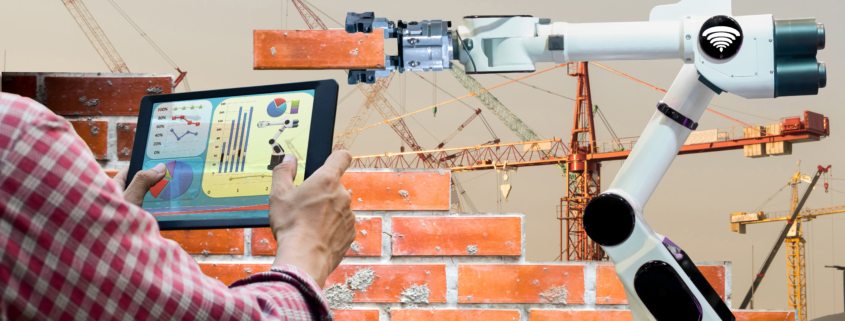
Robotics and automation are already helping to reduce risk to humans and increase productivity on building sites, writes Pete Felton, Business Development Executive at the National Robotarium.
FROM its early use on films such as Rocky, Marathon Man, and The Shining through to its modern appearances at the side of football matches and other sporting clashes, the Steadicam has revolutionised the life of camera operators, removing much of the strain of manoeuvring heavy equipment from their shoulders and arms. Soon, construction workers should be benefiting from similar assisted technology too.
In the same way that the Steadicam rig helps camera operators by spreading the weight of cameras, batteries, and monitors throughout their core, engineers are developing systems to aid construction workers in handling heavy tools. Rather than putting the pressure on workers’ shoulders or arms, these robotic structures should help to spread the load, cutting down on the number of potential workplace injuries.
Other robotic systems are already making a difference on construction sites. Hilti’s Jaibot semi-autonomous drilling robot is harnessing data from building information modelling (BIM) systems to carry out mechanical, electrical, and plumbing (MEP) installation tasks such as overhead drilling, both improving productivity and reducing the strain on human workers.
Helping to narrow the skills gap
That focus on health and safety is one of the key areas in which robotics and automation can help to take people away from dangerous and dirty jobs, helping to improve the quality of life for everyone. Robots and people can work side by side in safety.
This isn’t about robots taking people’s jobs – there’s a massive skills shortage in the construction industry and so if we can take workers away from mundane and repetitive jobs and use robots instead then those workers can be retrained to carry out more skilled tasks, adding greater value to projects and giving them more job satisfaction.
Brick-laying machines don’t work well because people are better suited to that type of skilled work. But, in the pre-construction phase, robots could be assembling panels and other prefabricated materials, freeing up people to do tasks on site that require finer skills – such as sealing, plumbing, or installing electrics – which are much harder for robots.

Pete Felton, Business Development Executive at the National Robotarium
Harnessing the power of digital twins
Here at The National Robotarium, we know that it’s no good talking the talk if we don’t walk the walk as well. That’s why we used a Spot robot – built by Boston Dynamics and kitted out with sensors by our team – to inspect our building site at night when construction was underway on our flagship facility.
This type of simultaneous localisation and mapping work is going to become even more important when stricter building regulations are introduced throughout the UK. Robots can help to gather the data that will be needed to prove that construction projects comply with environmental regulations – if robots don’t carry out this type of work then construction companies will need to employ people, at significant expense, to carry out mundane tasks such as checking sealant and auditing insulation.
Ultimately, using robots to gather data will enable the creation of digital twins while office blocks and industrial projects are being constructed, creating an accurate record of where each wire, cable, pipe, and duct is situated. Those digital twins can then be passed on by the builder to the facilities manager, making the maintenance of properties much easier and creating a digital link all the way through from the architect to the maintenance staff.
Widening opportunities for export success
As well as improving conditions for workers and increasing productivity in the UK, the greater use of robotics and automation could also generate an economic boost for Britain through exports too. If British construction companies harness the power of robots then the technologies they create and the expertise they develop could be exported to markets throughout the world.
The building boom across the Gulf States and the wider Middle East is set to be eclipsed by the growth of the affluent middle classes in India, with the ensuing need for buildings that rapid urbanisation will bring. Such growth can only be achieved in an environmentally sustainable way if robotics and automation are harnessed throughout the construction process, from prefabrication through to retrofitting of existing buildings to make sure they keep dwellers cool in the summer and warm in the winter.
BIM and automation go hand-in-hand when it comes to energy efficiency, both for cooling systems and heating systems, making sure that buildings consume as little power as possible. If we get these factors correct in the UK then we can export that expertise around the world.
Health and safety and digital twinning are just two of the exciting areas in which robots can make a difference to building projects, but our engineers are always looking to work with staff at the sharp end of the construction industry to come up with new ideas – that’s why the doors at The National Robotarium are always open for collaborations.
This article was originally published in BIM Plus magazine on 11 January 2024.
https://thenationalrobotarium.com/wp-content/uploads/AdobeStock_220539261-scaled.jpeg17072560Louise Jackhttp://thenationalrobotarium.com/wp-content/uploads/Robotarium.pngLouise Jack2024-01-22 16:23:192024-01-22 16:24:25How robots are taking BIM to the next level
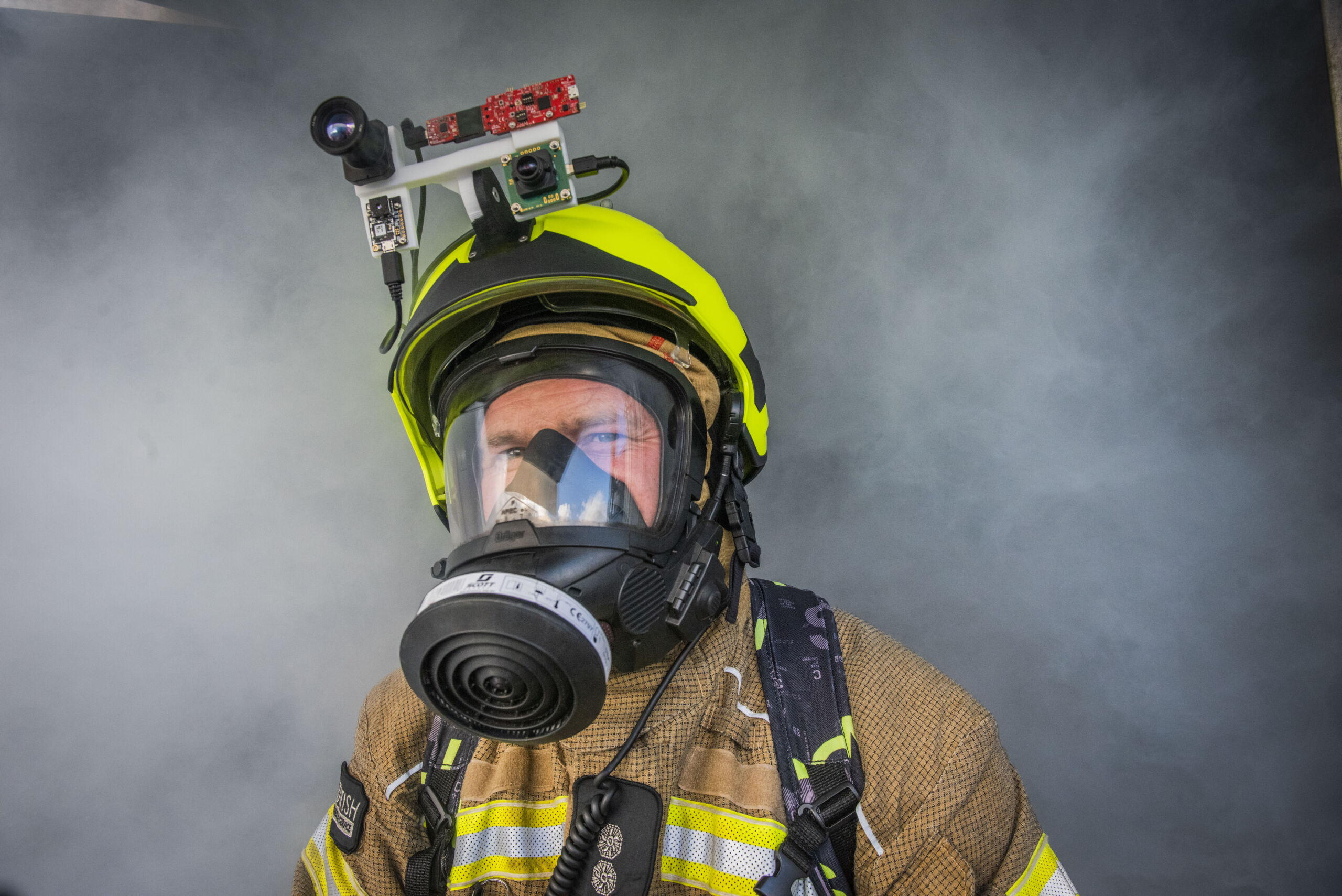
Pioneering new helmet technology which could help firefighters quickly map their surroundings, navigate hazardous environments and efficiently locate fire-scene victims is being developed by University of Edinburgh researchers at the National Robotarium.
The research breakthrough announcement comes as the £22.4 million National Robotarium facility officially opens its doors today, Wednesday 28 September 2022.
Combining feeds from thermal cameras, radar and inertial sensors mounted on a standard-issue firefighting helmet, the technology uses cutting-edge artificial intelligence to provide wearers with real-time information that can help detect victims, recognise teammates and provide an accurate understanding of their own location.
Developmental field trials of the new technology have been conducted in partnership with Scottish Fire and Rescue Service personnel at its £10.5 million training facility in Newbridge, Edinburgh.
It’s hoped that the first-of-its-kind technology could support firefighters and scene commanders to more safely navigate adverse or low-visibility conditions such as smoke-filled fire scenes and reduce the time it takes to rescue victims.
Developed by researchers at the University of Edinburgh’s School of Informatics and the National Robotarium, a world-leading centre for robotics and artificial intelligence hosted by Heriot-Watt University and the University of Edinburgh, the project has received funding from the Scottish Informatics and Computer Science Alliance (SICSA) and the Scottish Funding Council’s SFC Saltire scheme, as well as funding from the University of Edinburgh.
Stewart Miller is CEO of the National Robotarium. Speaking at the opening of the new purpose-built facility today, said: “The development of a smart fire fighting helmet that has the potential to support firefighters and help save lives is an excellent example of the pedigree of research coming from the National Robotarium’s two partner universities, each amongst the most prestigious in Scotland.
“As we open the doors of our dedicated, state-of-the-art facility today, we are able to showcase Scotland and the UK’s role at the forefront of global developments in AI and robotics, and the role of the National Robotarium in championing and developing solutions to some of society and industry’s biggest challenges.”
Based at Heriot-Watt University’s Edinburgh campus, the National Robotarium houses extensive world-class facilities for researchers and businesses. The facility provides a catalyst for entrepreneurship, bringing together academics and global companies, and is expected to deliver sustainable economic benefit to Edinburgh, the UK and beyond.
Dr Chris Lu, Lecturer in Cyber-Physical Systems in the School of Informatics at the University of Edinburgh who is leading the project, said: “Firefighters often operate in environments with very low or no visibility due to the vast amount of smoke released from a fire. This can make detecting the location of potential victims and whereabouts of firefighters very challenging in situations that are often extremely time-sensitive.
“This new technology has the potential to support on-the-ground firefighters and scene commanders to make crucial in-the-moment decisions that can enhance search rescue efficiency, ensure safer collaboration between teammates and, most importantly, improve outcomes for potential victims of fire scenes.
“Our entire sensor rig weighs less than a kilogram and is composed of affordable, off-the-shelf components that can be easily retrofitted to existing standard-issue firefighting helmets. This means it has the potential to be an incredibly efficient and accessible resource to fire and rescue teams in Scotland, the UK and beyond once fully developed.
“We are continuing to expand the capabilities of the technology with the support of the Scottish Fire & Rescue Service, to whom we are enormously grateful. Our next ambition is to give the helmet the ability to generate 3D maps and an embedded display, which will provide the wearer with even more spatial awareness. We are actively looking to engage with industry partners to help make this next step a reality.”
Bryan Todd, Group Commander in Training, Safety & Assurance at Scottish Fire and Rescue Service, said: “We are proud that our staff at our Newbridge Training Centre have been able to support with the trialling of this technology. Safety, Teamwork and Innovation are three of our core values as a service and we always welcome opportunities to work in partnership with higher education organisations and the fantastic work they do in exploring ideas to improve community and firefighter safety.”
https://thenationalrobotarium.com/wp-content/uploads/Chris-Watt-Photgraphy_201-scaled.jpg17092560Louise Jackhttp://thenationalrobotarium.com/wp-content/uploads/Robotarium.pngLouise Jack2022-09-28 00:01:412022-09-29 12:11:35The National Robotarium teams-up with Scottish Fire and Rescue Service on AI-empowered smart helmet that helps firefighters better locate victims
We may request cookies to be set on your device. We use cookies to let us know when you visit our websites, how you interact with us, to enrich your user experience, and to customize your relationship with our website.
Click on the different category headings to find out more. You can also change some of your preferences. Note that blocking some types of cookies may impact your experience on our websites and the services we are able to offer.
Essential Website Cookies
These cookies are strictly necessary to provide you with services available through our website and to use some of its features.
Because these cookies are strictly necessary to deliver the website, refusing them will have impact how our site functions. You always can block or delete cookies by changing your browser settings and force blocking all cookies on this website. But this will always prompt you to accept/refuse cookies when revisiting our site.
We fully respect if you want to refuse cookies but to avoid asking you again and again kindly allow us to store a cookie for that. You are free to opt out any time or opt in for other cookies to get a better experience. If you refuse cookies we will remove all set cookies in our domain.
We provide you with a list of stored cookies on your computer in our domain so you can check what we stored. Due to security reasons we are not able to show or modify cookies from other domains. You can check these in your browser security settings.
Google Analytics Cookies
These cookies collect information that is used either in aggregate form to help us understand how our website is being used or how effective our marketing campaigns are, or to help us customize our website and application for you in order to enhance your experience.
If you do not want that we track your visit to our site you can disable tracking in your browser here:
Other external services
We also use different external services like Google Webfonts, Google Maps, and external Video providers. Since these providers may collect personal data like your IP address we allow you to block them here. Please be aware that this might heavily reduce the functionality and appearance of our site. Changes will take effect once you reload the page.
Google Webfont Settings:
Google Map Settings:
Google reCaptcha Settings:
Vimeo and Youtube video embeds:
Other cookies
The following cookies are also needed - You can choose if you want to allow them:
Privacy Policy
You can read about our cookies and privacy settings in detail on our Privacy Policy Page.