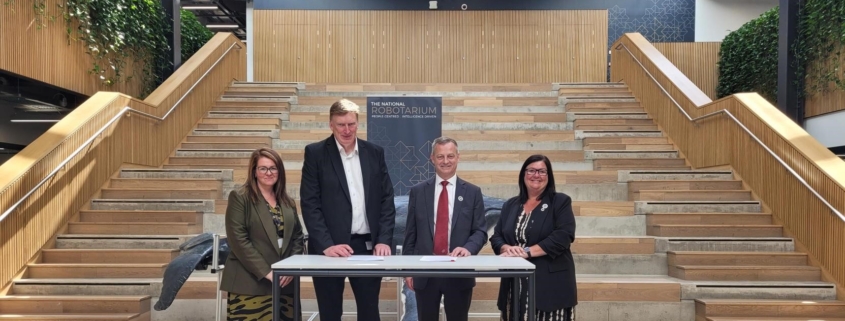
The National Robotarium entered into an international partner agreement with Robotics Australia Group (RAG), a non-profit national association that brings together companies, educational institutions, and public stakeholders to build a strong and sustainable interconnected robotics and autonomation ecosystem.
In a Letter of Intent signed by CEO of The National Robotarium, Stewart Miller and RAG CEO Nicci Rossouw in a virtual meeting on 2 December 2025, the two partners aim to develop joint initiatives and foster cooperation in areas including research and technology transfer, bilateral events and visits, and vocational and educational opportunities.
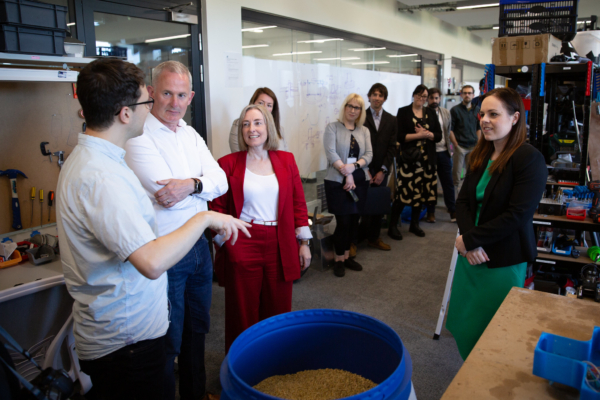
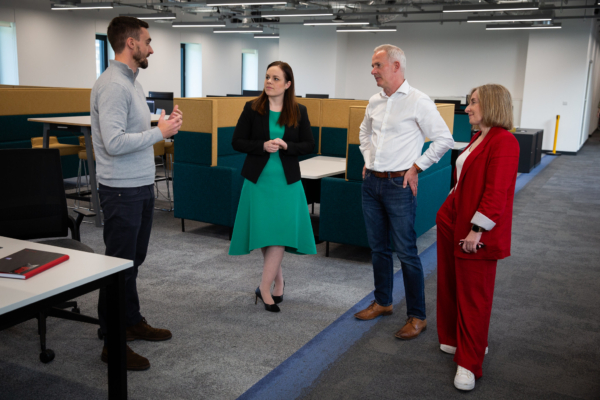
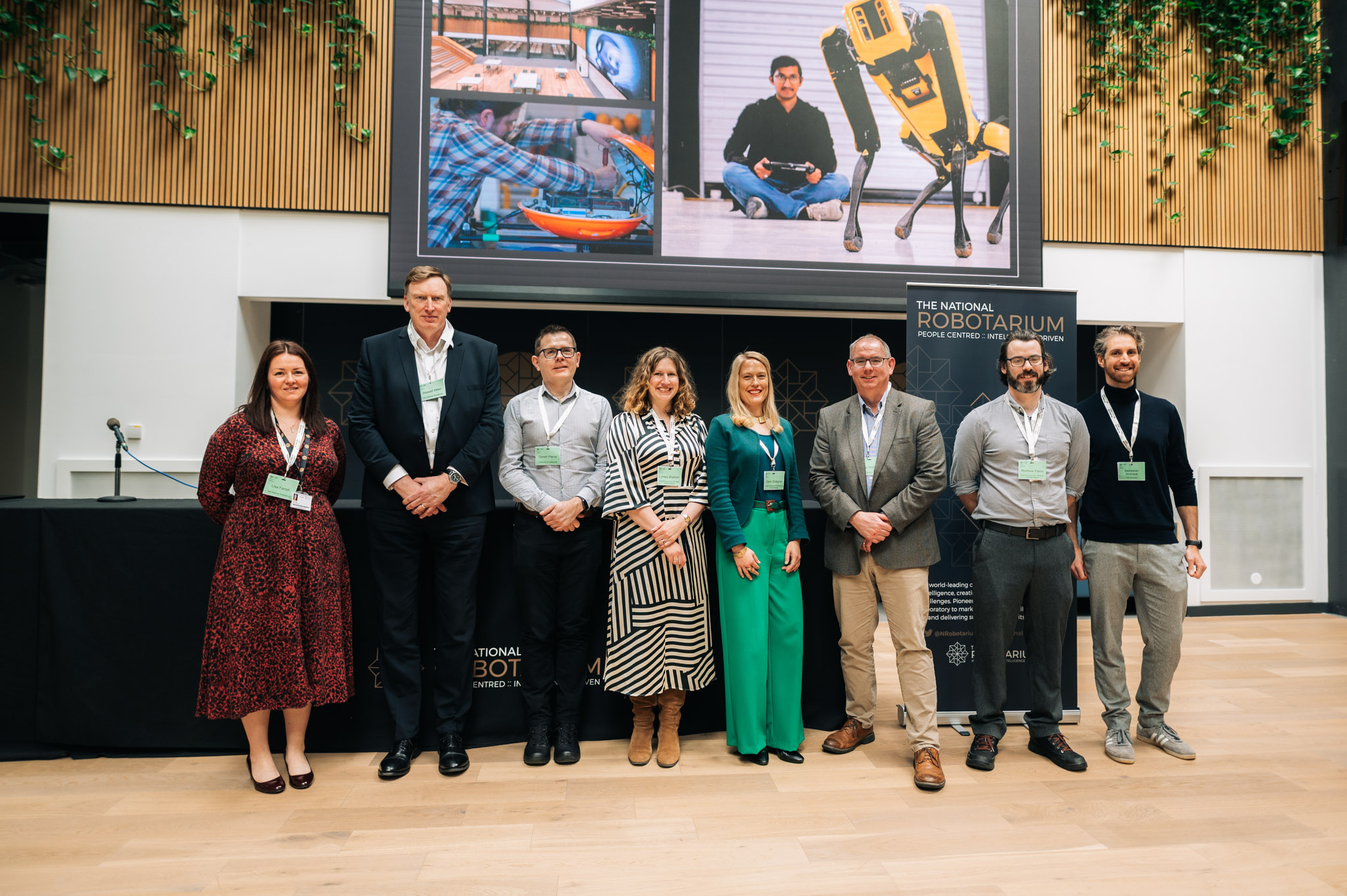
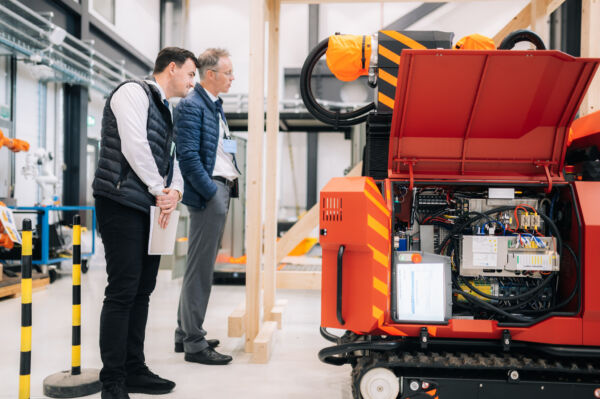
[clockwise from bottom: Stewart Miller, CEO and Steve Maclaren, COO of The National Robotarium, Nicci Rossouw, CEO of Robotics Australia Group]
This marks The National Robotarium’s second major international collaboration in 2025, following a Memorandum of Understanding signed in June with Robotekin, the Basque Association for Robotics and Automation. Together, these partnerships reinforce the centre’s commitment to building a globally connected robotics ecosystem that supports innovation, aligns regulatory frameworks, and accelerates technological progress.
Stewart Miller said: “Partnering with Robotics Australia Group marks an important step in our mission to build a globally interconnected robotics ecosystem. By combining our strengths, we can accelerate innovation, support emerging talent, and ensure that advances in robotics benefit industry and society worldwide.
“This agreement brings us closer to realising our ambition of becoming a truly globally significant centre for robotics.”
Nicci Rossouw said: “We are delighted to formalise our partnership with The National Robotarium. Together, we can build powerful pathways for collaboration that elevate research, talent development and industry capability across both nations.
“This relationship strengthens our shared vision for a thriving, sustainable robotics ecosystem.”
https://thenationalrobotarium.com/wp-content/uploads/Robotics-Australia-Group-e1765284080591.jpg12811813Louise Jackhttp://thenationalrobotarium.com/wp-content/uploads/Robotarium.pngLouise Jack2025-12-10 14:04:182025-12-10 14:04:18The National Robotarium signs strategic agreement with Robotics Australia Group to accelerate robotics innovation
The Data-Driven Innovation (DDI) Programme, a strategic partnership led by the University of Edinburgh and Heriot-Watt University, from which The National Robotarium centre for robotics and Artificial Intelligence was created, has won the Collaborative Initiative of the Year award at the prestigious Institute of Economic Development (iED) Annual Awards 2025.
This year saw a record-breaking number of entries, with almost 60 submissions received for seven award categories, and shortlisted nominations were assessed by an expert judging panel in September.
The Collaborative Initiative of the Year award, which this year is sponsored by Recurve Solutions, recognises outstanding cross-sector economic development collaboration between two or more partners drawn from local authorities, private sector, third sector, business and academia.
The submission outlined how the £700 million Data-Driven Innovation Programme, supported by the £1.3 billion Edinburgh and South East Scotland City Region Deal, unites the University of Edinburgh and Heriot-Watt University with six regional councils and industry to transform South East Scotland into the data capital of Europe. Delivering new infrastructure, thousands of skilled graduates, and high-growth ventures, the DDI programme is driving both inclusive growth and global competitiveness.
iED Director and former Chair Bev Hurley CBE, who hosted the awards honouring achievements across the public and private sectors, said: “Our judges said the Data-Driven Innovation Programme exemplifies the power of strategic collaboration to drive inclusive economic growth. With over £200 million in investment, support for over 600 companies, and a robust skills pipeline, the initiative demonstrates both measurable impact and long-term sustainability. They reported the seamless integration of public, academic, and industry partners sets a new benchmark for regional innovation.
“Our judges also praised the programme’s scale, infrastructure, innovation capacity, skills development, and global relevance, noting that these combined strengths position it as a catalyst for widespread economic and social benefit. In addition, they described the DDI Programme as a flagship model of collaborative economic development, delivering innovation, skills, and infrastructure at scale, and said that it is a benchmark for data-led transformation.”
Reflecting on the award, Professor Kim Graham, Provost of the University of Edinburgh and Senior Responsible Officer for the Data Driven Innovation Programme, commented: “This award is fantastic recognition of the impact of the DDI programme. The partnership between the universities of Edinburgh and Heriot-Watt is a shining example of how place-based investment in innovation and skills can have a transformative effect on economic growth, jobs and productivity, benefiting people in the region and beyond.”
Stewart Miller, Chief Executive Officer of The National Robotarium, said: “The National Robotarium is proud to be a part of the Data-Driven Innovation programme, a shining example of how collaboration between academia and industry can drive technological progress and create opportunities that will benefit businesses and communities across the region, the UK and beyond.
“Congratulations to the DDI delivery team and to our partner hubs for this award success.”
To find out more about the Data-Driven Innovation initiative and its partner hubs, visit: https://ddi.ac.uk/
https://thenationalrobotarium.com/wp-content/uploads/IED-awards-1500x500-1.jpeg5001500Louise Jackhttp://thenationalrobotarium.com/wp-content/uploads/Robotarium.pngLouise Jack2025-11-27 12:53:082025-11-27 13:00:32Data-Driven Innovation Programme wins Collaborative Initiative of the Year award at iED Annual Awards 2025
Two projects recently delivered by The National Robotarium, the UK’s centre for robotics and Artificial Intelligence at Heriot-Watt University, have been shortlisted for The Engineer C2i (Collaborate to Innovate) Awards 2025.
The awards, now in their tenth year, were launched to uncover and celebrate great examples of engineering collaboration and to recognise the role that engineers are playing in addressing some of the world’s biggest challenges.
The 5G Future Farming: Robotics project worked with agricultural and telecommunications specialists to test autonomous robots for precision farming tasks in remote or rural environments
The National Robotarium is shortlisted in the Information, Data & Connectivity and Wild Card categories for the projects:
5G Future Farming: Robotics (in partnership with James Hutton Institute, Scotland 5G Centre, Boston Dynamics and Freshwave)
A collaboration between technology and agricultural research, this project developed 5G-connected robotics applications to enable farmers to implement precision agriculture techniques while addressing rural connectivity challenges.
UNITE (with Heriot-Watt University in partnership with Imperial College London, Fugro, and Frontier Robotics)
This 3-year project, supported by Engineering and Physical Sciences Research Council (EPSRC), is developing autonomous, electric remotely-operated vehicles (eROVs) to conduct maintenance and repair of offshore wind turbines.
Now a prestigious panel of leading UK engineers will judge the shortlisted submissions with the winners being announced at a special event, taking place on Thursday 26 February 2026 in London.
Frontier Robotics, a spinout from Heriot-Watt University, support the UNITE project’s aims to develop smart, AI-enabled autonomous ROVs for wind turbine maintenance
Chief Executive Officer at The National Robotarium, Stewart Miller said: “Being shortlisted in not one, but two, categories is a fantastic result for the teams involved in delivering these complex, visionary projects.
“At The National Robotarium our robotics engineers and research teams are pushing the boundaries of innovation, and advancing the rapid adoption of smart and autonomous robotics that can help improve productivity, sustainability and safety in different industries.”
Editor of The Engineer Jon Excell said:
“Once again, the Collaborate to Innovate awards has uncovered a remarkable crop of innovative projects and initiatives from across the world of engineering. Between them, this year’s shortlisted finalists, provide a compelling illustration of the technologies and trends that are shaping our future and the role that UK engineers are playing at the forefront of some of the most critical technology developments of our times.”
https://thenationalrobotarium.com/wp-content/uploads/C2i_Awards_25-29-Facebook_1350x1350Shortlisted.png13501350Louise Jackhttp://thenationalrobotarium.com/wp-content/uploads/Robotarium.pngLouise Jack2025-11-20 10:27:422025-11-20 11:25:57The National Robotarium makes the shortlist in The Engineer C2I Awards 2025
Join us for the first regional event in the Scottish Robotics and Autonomous Systems (RAS) Cluster engagement series, bringing together businesses, researchers, and public partners from across Scotland’s robotics ecosystem.
This interactive session marks the start of a new national initiative to connect the full robotics supply chain – from start-ups and SMEs to universities, investors, and manufacturers — and to build a coordinated, high-impact cluster that accelerates innovation, strengthens collaboration, and drives economic growth. This session focusses on stakeholders within Glasgow and the surrounding areas in the West of Scotland.
Insights into the Scottish Cluster Scheme and the vision for the RAS Cluster.
Networking with peers, innovators, and potential collaborators from across the robotics ecosystem.
Discussions on opportunities, challenges, and priorities shaping the future of robotics in Scotland.
The chance to contribute directly to the Cluster Development Strategy and Roadmap that will guide the sector to 2026 and beyond.
Why Attend?
By joining this event, you’ll:
Help shape the direction of Scotland’s robotics and automation landscape.
Connect across the entire supply chain, from component developers to systems integrators and end users.
Gain early access to collaboration opportunities, insights, and support through the national cluster initiative.
Contribute to strengthening Scotland’s international competitiveness in robotics and autonomous systems.
Who should attend?
Businesses, innovators, component suppliers, manufacturers, venture capitalists, funding bodies, researchers, educators, start-ups and SMEs, policymakers, and anyone stakeholders in robotics, automation, AI, or digital manufacturing within Glasgow and the surrounding area.
https://thenationalrobotarium.com/wp-content/uploads/ROSCon_UK_2025-TIAGO-1000px.jpg6571000Louise Jackhttp://thenationalrobotarium.com/wp-content/uploads/Robotarium.pngLouise Jack2025-11-07 17:57:592025-11-07 16:46:59Scottish RAS Cluster Pilot Stakeholder Event – Glasgow – 26 Nov 2025
The National Robotarium and Robotekin – Basque Association for Robotics and Automation have forged a new global partnership to advance innovation, research and skills development in Robotics and Autonomous Systems (RAS).
In July, the UK’s centre for robotics and AI at Heriot-Watt University welcomed a delegation from Robotekin, a not-for-profit consortium in the Basque Country, during which a Letter of Intent was signed by CEO of The National Robotarium, Stewart Miller, and Robotekin Director, Daniel Ruiz Corres. The letter outlines each organisation’s commitment to sharing knowledge and developing joint initiatives in areas including applied research and technology transfer, international projects, outreach and events.
[l-r] Daniel Ruiz Corres, Robotekin Director, and Stewart Miller, CEO of The National Robotarium sign the letter of intent (July 2025)
The delegation – which included Robotekin industry members Smartlog Group, Seaquenz, BIC Araba, Ikaslan, IKERLAN and DACO Ingeniería – followed a visit by National Robotarium Chief Operating Officer, Steve Maclaren, to Robotekin’s headquarters in Álava, Spain in December. During the visit, Steve presented on the National Robotarium’s holistic enterprise model that is advancing science in robotics and automation, and supporting early-stage technology companies. It was agreed that a reciprocal visit be arranged, paving the way towards a more formalised partnership.
Steve said: “Following my insightful visit to Robotekin’s headquarters last year, it was an honour to welcome the team and their associates to The National Robotarium. As well as getting a tour our state-of-the-art labs, the visit was hugely valuable in learning more about each other’s delivery models, and exploring opportunities to drive forward new collaborations.”
Steve Maclaren (centre) visited Robotekin in Spain in Dec 2025
Robotekin operates as a ‘cooperative ecosystem’, creating a link between R&D, education, manufacturing and user testing, rapidly driving new technological and business projects that address genuine industry and customer needs. The success of the Robotekin model could provide a blueprint for other nations looking to create a circular robotics supply chain that harnesses scientific excellence, private and government investment, and entrepreneurial spirit, manufacturing and production. Building a similar robotics ecosystem for Scotland is a key recommendation in The National Robotarium’s recent policy paper ‘Making Scotland a World Leader in Robotics’.
Stewart Miller said: “Scotland stands to gain significantly from a hub-and-spoke model like Robotekin. By acting as a physical hub for industry, government and science to work closely together on fast-tracking new robotic innovations, we not only benefit people’s lives but also create a driver for economic prosperity and talent retention.
“This partnership offers a valuable opportunity to explore alternative delivery models that could be key to securing long-term success for robotics in Scotland.”
https://thenationalrobotarium.com/wp-content/uploads/Robotekin-group-dinner-1000px.jpg7501000Louise Jackhttp://thenationalrobotarium.com/wp-content/uploads/Robotarium.pngLouise Jack2025-07-31 17:19:342025-07-31 17:21:20The National Robotarium forges new partnership with Robotekin
The International Blue Economy Robotarium – dubbed the ‘Blue Robotarium’ – will bring together leading experts in science and industry to test and develop cutting-edge robotic technologies to revolutionise the global blue economy.
Over the coming months, the Blue Robotarium aims to:
Develop an expansive programme that explores learning and solutions related to robotics, AI and data management for the offshore wind and tidal energy sectors;
Rapidly advance the testing and development of robotic systems to improve the sustainability of marine industry operations;
Create a centre in Orkney for testing, certification and performance validation of new robotic, AI digital technologies;
Support and facilitate the safe deployment of new technologies, underpinned by expert support and management;
Stewart Miller, CEO of The National Robotarium, spearheaded the new consortium alongside Professor Sandy Kerr, Director, School of Energy, Geoscience, Infrastructure and Society at Heriot-Watt’s Orkney campus.
Stewart said: “This is a hugely exciting opportunity to showcase how the National Robotarium model can be adapted to drive robotic innovations for specific sectors.
“The International Blue Economy Robotarium will explore sustainable solutions that will enhance the offshore energy, marine and renewables industries through advanced technology.
“With access to a network of 400 service specialists, the Blue Robotarium will be a one-stop-shop for enterprising companies seeking to enhance efficiencies and improve sustainability using robotics.”
https://thenationalrobotarium.com/wp-content/uploads/IBER-all-energy-land-1.jpeg13372082Louise Jackhttp://thenationalrobotarium.com/wp-content/uploads/Robotarium.pngLouise Jack2025-05-14 16:32:312025-05-20 10:53:04New ‘Blue Robotarium’ aims to transform marine energy industry
The National Robotarium has partnered with Highland and Islands Enterprise for a TechHUB webinar exploring how can benefit the food and drink, and agricultural sectors. 🥔 🍊 🚜
Join the FREE webinar on Mon 16 Sept and learn:
✅ The robots currently being used across the sectors;
✅ Automation vs. Robotics – what works best?
✅ Ways to assess your robotics-readiness;
✅How the National Robotarium can support your journey into robotics;
This article was originally published by Frankie Macpherson in healthandcare.scot on Monday 28 April
A new project has spotlighted the potential of robotic technical to support independent living and social engagement for people living in assisted residential accommodation, at the same time as ensuring a quick response when things go wrong.
Scottish researchers partnered with charity and specialist home care provider, Blackwood Homes and Care to explore how robotics might work alongside, and potentially improve, Blackwood’s existing care systems.
Lead researcher and expert in assistive robotics, Heriot-Watt University’s Dr Mauro Dragone said:
“Robotics offers a powerful solution for independent living, enabling remote monitoring, reducing staff pressures, and increasing personal choice and care flexibility. Projects like this help de-risk innovation by embedding technical expertise into care environments, ensuring reliability and user acceptance.
“To achieve lasting impact, partnerships — such as with the National Robotarium at Heriot-Watt — are essential.
“They provide the research, support and training needed to scale new technologies responsibly and effectively across Scotland’s health and care sector.”
Temi: robot first responders
The Temi is being used as a first responder for residents at Blackwood Homes and Care, providing 24/7 support.
At the heart of the project was the ‘Temi’ robot, which was integrated with the digital telecare systems already used across three buildings in Glasgow. Temi could reach people in their apartments to help Blackwood’s Homes and Care 24/7 emergency response team and carry out routine health and wellbeing check-ins.
Dr Dragone said that the robots have been developed with input from staff and residents. He said: “These robots acted as first responders, automatically travelling to residents’ flats during emergencies and enabling live video contact with care teams. Unlike traditional devices, they ensured support even when residents couldn’t access their phones or tablets.
“Beyond emergency response, the robots also carried out daily mental health and wellbeing check-ins.
“Developed through co-design with residents and staff, the robot could ask questions, play music, and facilitate contact with the care team — adding value to day-to-day life and increasing social interaction.
“One of the most successful aspects of the collaboration between the research team at Heriot-Watt University and the innovation team in Blackwood was these participatory design activities, to understand their concerns but also their aspiration, preferences and desires for the new technology.”
Participants in the trial reported increased satisfaction with the enhanced service, highlighting Temi’s contribution to both social engagement and accessibility of care services.
A care work team leader who attended one of the sessions demonstrating how the robotics work described themselves as “totally converted” from a non-believer in robotics to seeing it as something that can help “shape the future of care”.
The UK’s National Robotarium played a ‘pivotal role’ in advancing robotic and software solutions through this partnership, with Heriot-Watt researchers developing “custom software and user interfaces” for Temi.
The research team also trained staff, and integrated the system within Blackwood’s residences, and now hope to continue to advance robotic-assisted independent living and care.
One person involved in the trial said they had “immensely enjoyed” the process, adding:
“I initially got involved as I was curious about what robotics encompassed, and despite being unsure about technology, I kept an open mind. From the very first workshop, I saw how they could be of benefit. Contributing ideas from a service user point of view felt such a privilege and now that I have seen my ‘mental health check-in’ idea has been incorporated into the robot, is just mind blowing!
“It makes me feel not only proud of my idea, but more importantly, that it can be of benefit to others. That makes me happy to know that someone else might feel better because of it.”
Remote triage
One challenge the teams worked to address for remote care staff is that systems often rely on the person who is in trouble to trigger an emergency video call.
The researchers explain this can “difficult to manage”, as it may not be possible if someone has fallen out of sight of the device or is feeling ill or confused.
Dr Mauro Dragone showcases the Temi robot to health and social care practitioners with the National Robotarium Laboratory for Robotic Assistive living (LARA).
Dr Dragone explained Temi could respond to an emergency being trigged without residents using a phone or tablet. It travels from the ground floor, using the building’s lifts if needed, to reach and connect residents with a virtual care team through a live video feed. Once connected, the responder from the remote care team takes control of the robot, assesses the situation and can speak to the resident.
He said: “This allowed remote staff to assess the situation accurately and quickly enhanced emergency response and enabling care even during travel restrictions.
“Temi is a mobile robot with a tablet and camera for video calls, combined with obstacle detection, navigation software, and the ability to operate lifts and doors.
“While Temi doesn’t currently carry out physical tasks, Heriot-Watt is now developing smart home devices and modular robotic furniture to work alongside robots like Temi — extending their support potential in care settings.”
He added that this is particularly helpful during stations where there are travel or social distancing restrictions, as seen during the COVID crisis.
Dr Dragone emphasised that robotics is an increasing key component of independent living, not just for remote monitoring but also promoting social connections and self-management at times of self-isolation or travel restrictions.
Find out how our cutting-edge technology and expertise can help your business
https://thenationalrobotarium.com/wp-content/uploads/Mauro-Dragone-at-EMERGENCE.jpg6661000Louise Jackhttp://thenationalrobotarium.com/wp-content/uploads/Robotarium.pngLouise Jack2025-04-28 17:03:262025-04-28 18:05:13Enhancing independent living with robotics
Blair Wilson, Schools and Industry Engagement Lead, shares his reflections on the Scottish regional finals of the 2025 First Tech Challenge UK competition, which took place at The National Robotarium on 23 April
This week, The National Robotarium played host to the Scotland Regional Finals of the First Tech Challenge UK, one of the world’s largest robot competitions for 12-18 year olds. The regional event marked the culmination of our thriving partnership with the First Tech Challenge team which began – alongside sponsors at Hearts of Midlothian FC Innovation Centre – in December 2023, when I led a team of our robotics engineers to inspire the ten competing teams at an all-day, community ‘scrimmage’ event at Tynecastle Park, Hearts FC football ground.
Blair Wilson is Outreach and Engagement Lead at The National Robotarium
It was a big deal for the National Robotarium to be invited; the facility was just over a year old and I, along with my colleague Sabaht, had spent the past 12 months building an engagement programme for schools, industry and the general public. The programme had to not only help raise awareness of the positive benefits greater adoption of robotics and AI can have in our everyday lives, it also aimed to increase inclusion and diversity in computer science, technology, and other robotics-related STEM subjects, and address future skills gaps by building the UK’s robotics talent base.
The first Scottish scrimmage event, which was kicked-off (pardon the pun) with an inspiring introduction from our CEO Stewart Miller, was a day of creativity, building and operating rudimentary robots with the teams receiving demonstrations and advice from our engineers on everything ranging from automation to soft robotics.
Blair and Spot at the First Tech Scottish Scrimmage at Hearts Innovation Centre (Dec 2023)
Since then, we’ve hosted a number of First Tech events at The National Robotarium, including training sessions for teachers and volunteers. However, nothing we’ve done so far matched the levels of excitement brought by the regional finalists! Throughout the day, our Atrium space was vibrant; full of teamwork, community spirit and lots and lots of robots!
It was clear that each of the competing teams had put in a tonne of work in the lead-up to the contest. The innovation and creativity showcased in the robotic creations was incredible, with every one a serious contender. However, there could only be one winner, and P4F (Passion4Fusion) Robotics took home the Inspire Award for their robot ‘Shabalala’, meaning they will battle it out at the UK finals event, taking place in London on 26-27 June. An amazing achievement.
2025 Scottish Inspire Award winners Passion4Fusion Robotics
Since joining The National Robotarium, I have engaged with 10,000’s of young people, teachers, learners, community groups, robot enthusiasts – and, occasionally, robot sceptics! – showcasing and discussing robots, their capabilities and the types of exciting career opportunities these emerging technologies bring. Like the PC in the 80s and the mobile phone in the 90s, robotics will soon become part of everyone’s daily lives, and we need to ensure we have the skills, knowledge and understanding required for seamless integration and adoption.
Robots are not going to replace humans, but instead help humans’ everyday lives, taking on the dull, dirty or dangerous tasks, and, in the education sector, augmenting learning and teaching, so teachers can focus on the vital, human elements of the role; guiding, inspiring, and motivating young people to achieve their very best.
Whilst hosting events like the First Tech Challenge takes an enormous amount of work, they give young people an entry point to understanding how they operate and the limitless things they – the roboticists – can do with their help.
Get involved!
Thinking about joining the one of the UK’s most epic STEM challenges? Heart of Midlothian FC’s Innovation Centre are hosting an open Summer Showcase event in June (date TBC). Come along and meet this year’s First Tech Challenge teams, watch the robots in action, , and find out everything you need to get started ahead of next year’s contest, starting in September 2025.
We’ll be sharing more information on this exciting event soon but, in the meantime, you can email Blair for more info at: Blair.Wilson@hw.ac.uk
https://thenationalrobotarium.com/wp-content/uploads/First-Tech-Inspire-Award-April-25.jpg7501000Louise Jackhttp://thenationalrobotarium.com/wp-content/uploads/Robotarium.pngLouise Jack2025-04-25 14:32:472025-07-28 13:26:45BLOG: Leading the next generation of Scottish roboticists to the First Tech Challenge UK finals – Blair Wilson
The National Robotarium has signed a new MOU (Memorandum of Understanding) with Corps Monitoring that will underpin the safe development of technologies for healthcare and other sectors.
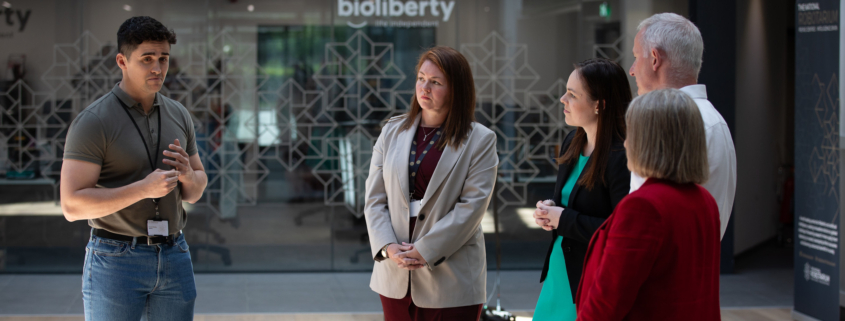
The agreement, which was co-signed by Robotarium CEO Stewart Miller and CEO of Corps Monitoring Mike Bullock, during a visit to the National Robotarium on 3 June, kick-starts a collaboration that will focus on improving security and monitoring services for the social care sector.
Researchers in Human-Robot Interaction at Heriot-Watt University are developing applications, such as smart sensors and remote technologies, to enhance care provision in assisted-living environments. One current project involves the deployment of assistive robots within a real-use care organisation being led by Associate Professor Dr Mauro Dragone in partnership with Blackwood Homes and Care Services. Corps Monitoring, a division of Corps Security, will apply its extensive expertise in specialist security solutions to ensure these technologies are deployed safely, with enhanced cybersecurity to protect patient data and information.
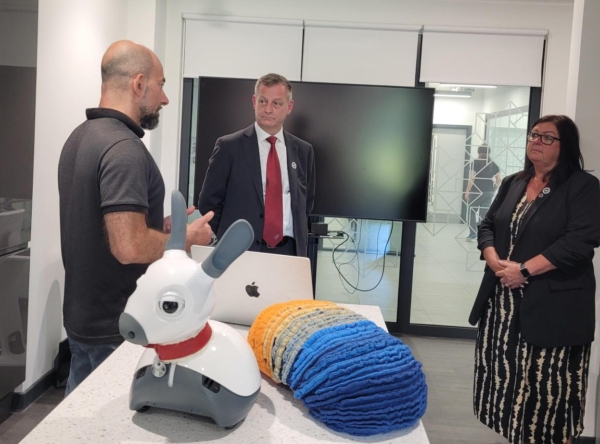
Dr Mauro Dragone (far-left), who leads the Laboratory for Assisted Robotic Living at the National Robotarium
“The aim of our partnership with the National Robotarium, is to improve the quality of life for many whilst striving forward with innovative technology advances.” Andrea Strong, MD of Corps Monitoring
National Robotarium Business Development Manager Lisa Farrell, who spearheaded the partnership, led the visit. She said:
“We were delighted to welcome Andrea and Mike to the National Robotarium to co-sign our new partnership agreement with Corps Monitoring.
“Our researchers are making huge advancements into the use of smart sensors, data analysis and machine vision to support greater independent living, however their security is a must if they are to be adopted by care providers on a wider scale.
“The expertise of Corps Monitoring will help underpin the safe development of these technologies, ensuring patient data remains private and protected and maintaining confidence within the sector.”
Andrea Strong, Managing Director of Corps Monitoring, also attended the signing. She said:
“The advancement of technology is moving at such a rapid pace. This partnership won’t just allow us to ‘keep up’ but to be ahead of the curve. By focusing on innovations that not only enhances independent living within the varying care sectors but aids the security and other sectors in general.
“The aim of our partnership with the National Robotarium, is to improve the quality of life for many whilst striving forward with innovative technology advances.”
https://thenationalrobotarium.com/wp-content/uploads/Corps-Monitoring-MOU.jpeg10061663Louise Jackhttp://thenationalrobotarium.com/wp-content/uploads/Robotarium.pngLouise Jack2024-06-05 14:17:292024-06-07 10:06:29New partnership will safeguard remote technologies for healthcare
We may request cookies to be set on your device. We use cookies to let us know when you visit our websites, how you interact with us, to enrich your user experience, and to customize your relationship with our website.
Click on the different category headings to find out more. You can also change some of your preferences. Note that blocking some types of cookies may impact your experience on our websites and the services we are able to offer.
Essential Website Cookies
These cookies are strictly necessary to provide you with services available through our website and to use some of its features.
Because these cookies are strictly necessary to deliver the website, refusing them will have impact how our site functions. You always can block or delete cookies by changing your browser settings and force blocking all cookies on this website. But this will always prompt you to accept/refuse cookies when revisiting our site.
We fully respect if you want to refuse cookies but to avoid asking you again and again kindly allow us to store a cookie for that. You are free to opt out any time or opt in for other cookies to get a better experience. If you refuse cookies we will remove all set cookies in our domain.
We provide you with a list of stored cookies on your computer in our domain so you can check what we stored. Due to security reasons we are not able to show or modify cookies from other domains. You can check these in your browser security settings.
Google Analytics Cookies
These cookies collect information that is used either in aggregate form to help us understand how our website is being used or how effective our marketing campaigns are, or to help us customize our website and application for you in order to enhance your experience.
If you do not want that we track your visit to our site you can disable tracking in your browser here:
Other external services
We also use different external services like Google Webfonts, Google Maps, and external Video providers. Since these providers may collect personal data like your IP address we allow you to block them here. Please be aware that this might heavily reduce the functionality and appearance of our site. Changes will take effect once you reload the page.
Google Webfont Settings:
Google Map Settings:
Google reCaptcha Settings:
Vimeo and Youtube video embeds:
Other cookies
The following cookies are also needed - You can choose if you want to allow them:
Privacy Policy
You can read about our cookies and privacy settings in detail on our Privacy Policy Page.