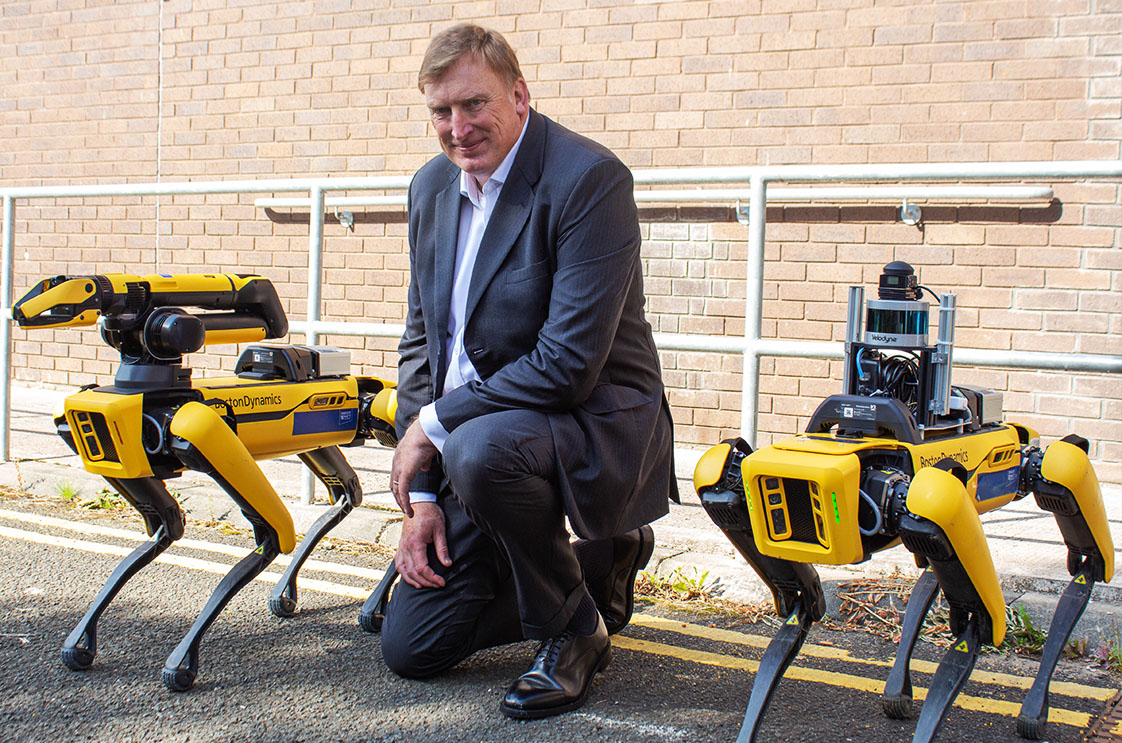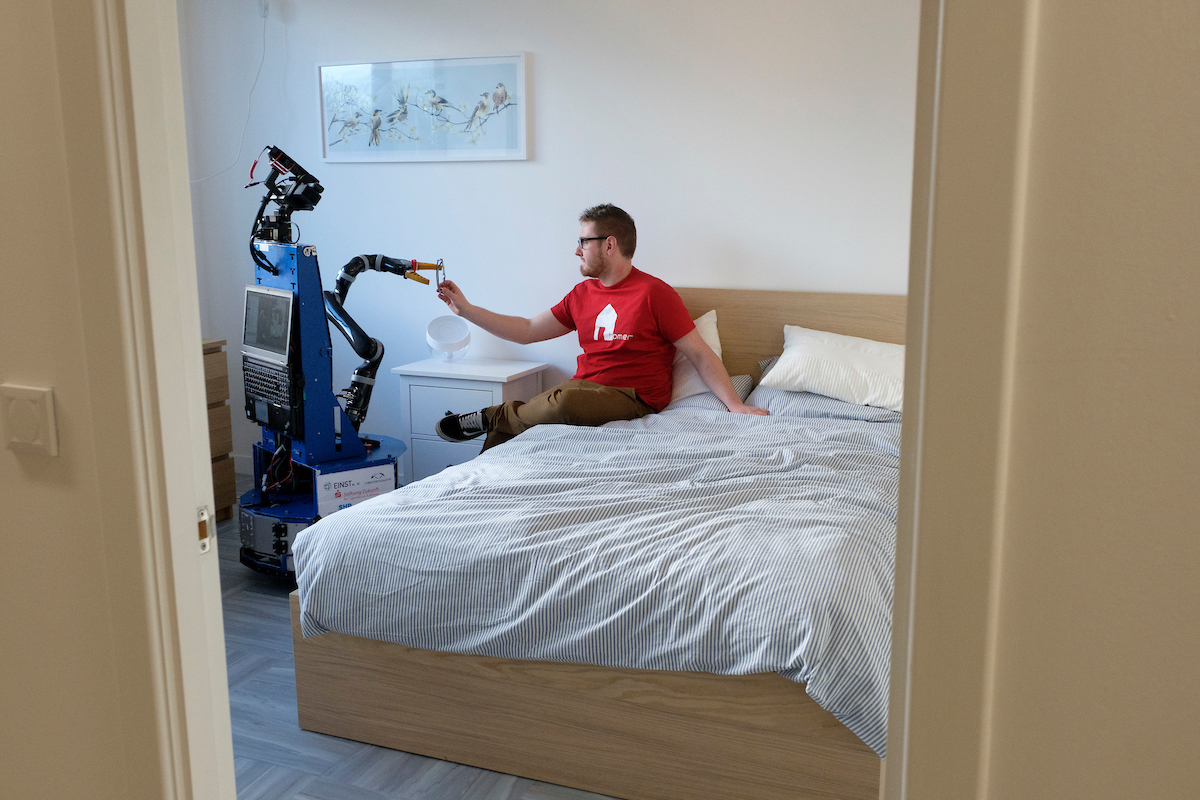

Dr Ingo Keller has been appointed as the first Head of Robotics at the National Robotarium, the UK’s centre for Robotics and Artificial Intelligence.
A software, AI and robotics engineer with over 20 years of experience in science and industry, Ingo will lead the facility’s growing team of robotics engineers as they test and develop new technologies and systems to address real-world challenges. Current projects include robotics for sectors including agriculture, construction, manufacturing, aerospace and fisheries.
Ingo has in-depth, hands-on experience with a multitude of robotic systems, including all phases of software development, life-cycle management and DevOps tooling. He has co-founded a number of start-up technology companies in software architecture and database management systems, developing a keen understanding of the potential of applied emerging technologies for addressing industry challenges.
Prior to his new role, he was Chief Technology Officer at Xihelm, a London-based robotic harvesting solutions company, where he worked while completing a PhD in Data Augmentation for Human-Robot Interaction at Heriot-Watt University, where the National Robotarium is based.
On his new appointment, Ingo said: “I’m delighted to join the National Robotarium team at this exciting stage of its development and lead on the creation of robotics, AI and engineering systems that can truly transform people’s lives and work. My goal is to get more robots out of the lab and into the wild, and being able to talk directly to industry leaders about their challenges means we can develop safe, practical, and effective robotic technologies that can be seamlessly integrated into society.
“I’m also passionate about sharing the knowledge and expertise of our talented team to build robotics skills in different sectors, ensuring people are equipped with the tools they need to operate and manage robotics and AI, and promoting the positive benefits of these technologies to all.”
Stewart Miller, Chief Executive Officer, said: “The appointment of Ingo as our first Head of Robotics is an important and exciting milestone for the National Robotarium. He is passionate about applying his extensive expertise to new and interdisciplinary problem spaces and will be a great ambassador, working with experts in all fields of science and industry to advance state-of-the-art robotics systems.”
https://thenationalrobotarium.com/wp-content/uploads/WebsitePic-400x400-1.png400400Louise Jackhttp://thenationalrobotarium.com/wp-content/uploads/Robotarium.pngLouise Jack2023-08-29 09:50:122023-10-24 12:06:29The National Robotarium appoints first Head of Robotics
Professor Lemon, whose background is focused on Artificial Intelligence (AI), brings many years of experience developing machine learning and Natural Language Processing (NLP) models, building knowledge to better understand how robots can interact with humans using conversational speech in visual and spatial use-cases. Current projects being led by Professor Lemon include SPRING, based at the facility’s state-of-the-art HRI labs, which is developing Socially Assistive Robotics to perform multi-person interactions in complex environments, specifically with older patients in hospitals and other healthcare settings.
A former Senior Research Fellow at Stanford University and the University of Edinburgh, and Visiting Scientist at NASA, Professor Lemon has extensive experience working with industry. He has led national and international research projects with partners such as PAL Robotics, SoftBank, France Telecom, and BMW, and is Chief AI Officer and co-founder of the conversational AI company Alana AI. The spinout has recently developed advanced vision-and-language conversational AI solutions for blind and partially-sighted people in partnership with RNIB (Royal National Institute for the Blind) and for stroke patients, as part of the European Commission’s RES-Q+ medical AI project.
Professor Lemon has also supervised three student teams in the Amazon Alexa Simbot Challenge, an artificial intelligence competition focused on conversational agents. In the latest challenge, on embodied AI, the team were the only non-US competitors to be shortlisted in the top ten, and made it all the way through to the final stages.
His appointment follows the departure of Professor Helen Hastie, who has held the position – alongside incumbent Professor Yvan Petillot – since 2020, overseeing the research strategy of the world-leading Robotics and Artificial Intelligence centre, based at Heriot-Watt University. Working closely with co-academic leads at the University of Edinburgh, Professors Adam Stokes and Sethu Vijayakumar, these important roles were created to strengthen academic collaboration between the two partner institutions. The ties between organisations will be further strengthened when Professor Hastie takes up a new post as Head of the School of Informatics at The University of Edinburgh.
Professor Lemon said: “I’m delighted to join the National Robotarium as its new co-academic lead and continue its work developing science-led robotics and AI solutions to address people’s needs.
”As a co-founder of Alana AI, I understand how to bridge the gap between science and industry and move academic research from labs to market, a core delivery theme at the National Robotarium. I look forward to playing a strategic role supporting its mission to advance the adoption of robotics and AI to help people at work and at home. I’m particularly excited to bring the latest advances in Foundation Models and Large Language Models such as ChatGPT into robotics.”
Stewart Miller, Chief Executive Officer at the National Robotarium said: “I’m very pleased to welcome Oliver to the National Robotarium as our new co-academic lead. His extensive experience into language models for robotics, as well as his many years of research into how humans interact with robots, make him a natural successor to Professor Hastie and I’m keen to work with him to develop the next generation of robotics using safe and responsible AI.”
https://thenationalrobotarium.com/wp-content/uploads/MicrosoftTeams-image-30-scaled-1.jpg25602388Louise Jackhttp://thenationalrobotarium.com/wp-content/uploads/Robotarium.pngLouise Jack2023-07-14 10:12:012023-10-24 12:06:36Professor Oliver Lemon named as new co-academic lead at the National Robotarium
An underwater robotic sorting device which helps fishing trawlers prevent bycatch by identifying and sizing fish and other marine life in real-time is being developed by Heriot-Watt University scientists with support from experts in the National Robotarium’s Robotics and Autonomous Systems (RAS) laboratory.
Funded by the UK Seafood Innovation Fund and delivered in partnership with Fisheries Innovation & Sustainability (FIS), Smartrawl uses AI-technology to determine the individual size and species of marine life captured inside a trawl net using images taken by an underwater stereo camera. It then releases or retains each marine animal depending on whether it qualifies against a trawler’s intended catch using a computer-controlled robotic gate.
Trawling is a fishing practice that herds and captures target species, like fish or prawns, by towing a net along the ocean floor. This method of fishing is known to cause discarding and bycatch, where fish or other marine animals are accidentally caught and returned to the sea, most often dead. According to global marine fisheries data, it is estimated that 46% of all marine fish that are discarded come from this method of fishing.
The brainchild of Professor Paul Fernandes based at Heriot-Watt’s Lyell Centre for Earth and Marine Sciences, the Smartrawl sorting device is being supported by experts in underwater autonomous systems at the National Robotarium and designed in collaboration with the UK fishing industry. It is able to fit into existing nets of all sizes of vessels and requires no additional cables due to the device’s patented gate system which works with the force of the water to rotate between open and closed states.
“Smartrawl has been developed to ensure that vessels only catch the fish they’re targeting, releasing other animals back into their natural environment quickly and without harm. As a result, we’re confident that discarding and bycatch could quickly become a thing of the past and our precious marine life preserved.”
Components of the project have already been tested at sea and further trials are scheduled for later this year [2023] in Shetland using the research vessel Atlantia, operated by the University of the Highlands and Islands.
Administered by the Centre for Environment, Fisheries and Aquaculture Science (Cefas), on behalf of Department for Environment, Food and Rural Affairs (Defra), the UK Seafood Innovation Fund supports innovative projects which aim to bring new ideas and technology to the UK seafood sector and is part of the wider UK Seafood Fund.
Paul Fernandes (pictured above), the inventor of Smartrawl, is scientific lead for the project. He is a professor of fisheries science and technology at the Lyell Centre at Heriot-Watt University. He said:
“More than 4 million tonnes of marine fish are unintentionally caught by trawlers around the world every year, as well as bycatch of sharks, rays, dolphins, critically endangered turtles and seabirds. The sad reality is that these creatures, more often than not, are returned to the sea dead or dying.
“Current methods used on trawlers are unable to distinguish between different species and animals or give skippers enough information to build an accurate understanding of the size of individual fish prior to capture.
“Smartrawl has been developed to ensure that vessels only catch the fish they’re targeting, releasing other animals back into their natural environment quickly and without harm. As a result, we’re confident that discarding and bycatch could quickly become a thing of the past and our precious marine life preserved.”
FIS Executive Director, Kara Brydson, said:
“The UK Seafood Innovation Fund supports bold and ambitious tech-driven projects that will enable a step-change in the productivity and sustainability of the UK seafood sector. That perfectly describes Smartrawl, and this grant will take us nearer to our goal of enabling UK fishers to select and retain their high-quality catch while releasing non-target species back into our seas.”
https://thenationalrobotarium.com/wp-content/uploads/AI-empowered-fishing-net-being-loaded-onto-trawler-scaled-1.jpg19202560Louise Jackhttp://thenationalrobotarium.com/wp-content/uploads/Robotarium.pngLouise Jack2023-06-28 09:16:522023-10-26 14:32:36AI-empowered fishing net to help prevent marine bycatch
The National Robotarium was a winner at this year’s PRCA Scotland Dare Awards, an event which celebrates excellence in the public relations and communications industry.
The UK’s leading robotics and AI facility was presented with the award for ‘Event/Launch of the Year’ in recognition of its communications campaign to launch the opening of its new state-of-the-art £22.4m building in September 2022.
Other winners on the night were Scotland’s university innovation springboard competition, Converge, which received PRCA Scotland’s ‘B2B Campaign of the Year’ award for its works launching its 13th annual programme of competitions.
In May [2023], Converge unveiled the 100 start-ups and spinouts that will receive support to turn their ideas for products and services into reality as part of its 2023 programme, with a growing number of companies using robotics and AI to help tackle challenges including the climate emergency, health conditions, and childhood literacy.
Expressing delight at winning, Research Communications Manager at the National Robotarium, Louise Jack said:
“The National Robotarium and Converge share a common vision to transform the world through cutting-edge technology and innovation. These awards serve as a testament to our unwavering dedication to achieving that goal and, importantly, ensuring its story is told.
“We’re incredibly grateful to the PRCA Scotland for acknowledging our achievements and would like to thank our public relations partner Hot Tin Roof for its support and dedication throughout the delivery of this media campaign.”
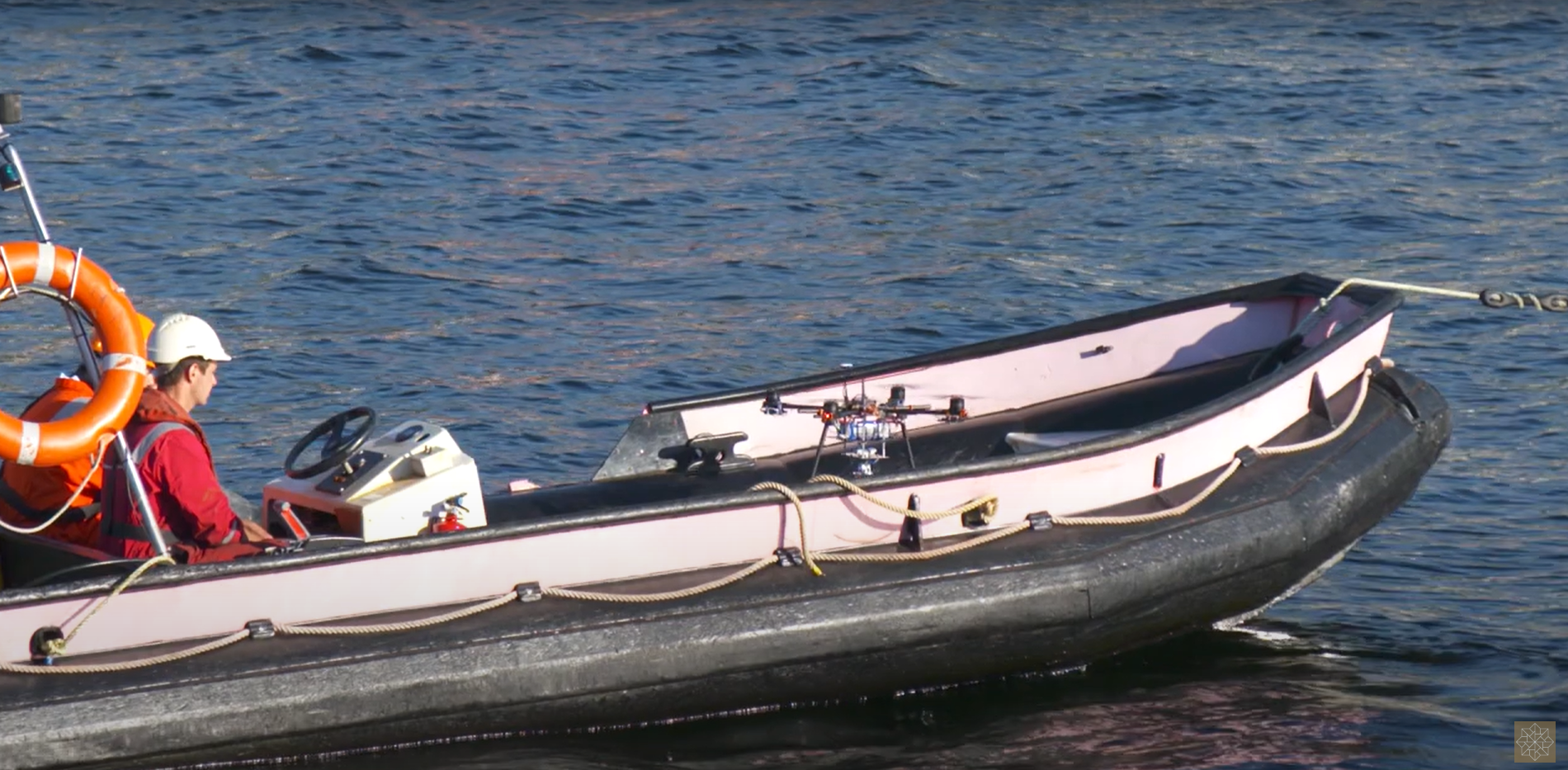
Electric remotely operated vehicles (eROVs) that perform maintenance and repair tasks on offshore wind turbines are being developed by the National Robotarium in partnership with Fugro, the world’s leading Geo-data specialist. Deployed from Fugro’s uncrewed surface vessels (USVs), the companies are working closely together to explore how the offshore energy sector can benefit from advancing this autonomous technology.
The £1.4 million Underwater Intervention for Offshore Renewable Energies (UNITE) project aims to dramatically improve health and safety for workers by reducing the need for potentially hazardous offshore maintenance missions conducted by crewed support vessels.
The remotely operated robotic systems will address a number of additional sector challenges including supporting industry to reduce carbon emissions, improve offshore turbine productivity through reduced downtime, and make maintenance and repair exercises more cost-effective and timely.
The UK has more than 11,000 offshore wind assets around its shores, with thousands more planned by 2050. On average, each turbine requires up to three maintenance check-ups per year and this figure increases as turbines age and require more maintenance to stay fully operational.
Current industry maintenance methods involve vessels travelling into and working in areas of open ocean where a mix of trained divers and ship-based crews manually inspect and or deploy tele-operated robots for repair of individual wind turbines.
When applied to the whole of the UK’s offshore wind sector, this translates into potentially hundreds of thousands of crewed maintenance missions every year which are costly for business, contribute emissions to the environment and present a safety risk for workers.
In addition to supporting the uncrewed and remotely operated vessels, the pioneering research project will help develop autonomous and semi-autonomous ROVs capable of conducting subsea inspection, maintenance and repair tasks which can be monitored onshore whilst remotely deployed and operated from anywhere in the world.
Researchers will specifically focus on developing technologies which allow robots to build more accurate maps of the subsea terrain to better navigate obstacles and targets. The project will also explore how robots autonomously interact with underwater structures, such as grasping or moving objects, whilst being subject to external forces like changing currents or rough seas.
The project will be delivered by researchers from Heriot-Watt University and Imperial College London working within the National Robotarium, the UK’s leading AI and Robotics centre, in collaboration with Fugro and funded by the Engineering and Physical Science Research Council, part of UK Research and Innovation.
The National Robotarium is part of the Data-Driven Innovation initiative, supported by £21 million from the UK Government and £1.4 million from the Scottish Government. The initiative aims to turn Edinburgh into the data capital of Europe and is part of the wider £1.3 billion Edinburgh and South-East Scotland City Region Deal.
Co-academic lead at the National Robotarium, Prof. Yvan Petillot
Prof. Yvan Petillot is academic co-lead at the National Robotarium and principal investigator of the UNITE project. He said:
“We’re only a generation away from our obligation to deliver on our net zero promises by 2050 and 2045 in Scotland, so can’t afford to let the challenges faced by the offshore renewables sector slow down the construction and operation of essential, green energy assets like wind turbines.
“Remote inspection and repair using robotic systems deployed in the field and controlled from shore is within our grasp. The long-term ambition is for crewless boats to be able to do this autonomously without direct human control based on a predetermined maintenance cycle – critical if we’re to see the widespread adoption of robotics in the rapidly expanding offshore wind sector.
“The National Robotarium’s partnership with Fugro presents an exciting opportunity to develop this next generation of underwater technologies as well as the skills and expertise needed to support the transition to net zero. UNITE has enormous potential to power the UK’s offshore renewable sector and beyond, delivering worldwide economic and environmental impact that can benefit communities around the world.”
Mark Bruce, Global Product Manager – Next Generation ROV Systems at Fugro, said:
“As the expansion and influence of marine robotics stretches ever further across the marine industry, we are committed to leading the industry’s remote and autonomous revolution. Key to this is overcoming the challenges of remote operations by increasing our awareness and autonomy level in the sub-sea environment. It’s an exciting time as we bring more USVs and respective eROVs into the market, working on commercial projects across Europe providing greater agility, safety and sustainability.”
UK Government Minister for Scotland Malcolm Offord said:
“This pioneering research into remote robotic systems will create the next generation of underwater technologies that will reduce carbon emissions, increase productivity and make offshore work safer.
“The UK Government has invested £21 million in the National Robotarium to foster their world-leading research and support high quality jobs, investment and growth. This is part of £2.3 billion for regional projects levelling up right across Scotland.”
Scottish Government Wellbeing Economy Secretary Neil Gray said:
“This innovative research is another example of the valuable work conducted at the National Robotarium, which benefited from Scottish and UK Government support through the Edinburgh and South East Scotland City Region Deal.
“It recognises the growing and changing requirements of offshore wind businesses and can help boost productivity in an industry which is key to the just transition from fossil fuels and promises to create substantial numbers of well-paid green jobs.
“As outlined in the draft Energy Strategy and Just Transition Plan, delivering on our climate obligations is an absolute priority for this Government – but so too is our unwavering commitment to ensuring the journey to net zero is fair and just for everyone.”
https://thenationalrobotarium.com/wp-content/uploads/Fugro-Blue-Volta®-eROV-on-the-seafloor-scaled-1.jpg15712560Louise Jackhttp://thenationalrobotarium.com/wp-content/uploads/Robotarium.pngLouise Jack2023-06-01 09:26:122023-11-22 14:57:14Crewless maintenance vessels to support offshore wind farm repairs
Selfies with robots, brain-controlled drones and a quadruped waiter were just some of the activities on display at Robots After Dark, a special evening event held on Saturday 15 April at the National Robotarium.
The leading robotics and AI research and engineering facility, which opened last year on Heriot-Watt University’s Edinburgh campus, in partnership with the University of Edinburgh, welcomed nearly 200 people to the sell-out event, which explored the relationship between humans and robots, and how to build trust in robotic and autonomous systems.
As well as hands-on activities, which also included a robot petting zoo, a live soft robotics battle, robot crafting, and live laser alignment in the £22.4m facility’s Precision Laser Applications lab, guests enjoyed talks from leading Heriot-Watt scientists and students. Professor in Developmental Psychology, Thusha Rajendran, spoke on humans’ cognitive ability to trust robots and AI, robotics CDT student Alexandre Colle shared insights into the use of design and aesthetics in robotics, and Assistant Professor in Computer Science, Dr Marta Romeo discussed her research into building trust with assistive technologies in social wellbeing and healthcare.
Dr Alistair McConnell, Assistant Professor in Computer Science and one of the event’s lead organisers said: “It was great to work with the amazing Edinburgh Science Festival team to create this unique experiential event at the National Robotarium and we were thrilled that so many people attended.
“Robotics and autonomous systems have huge potential to make people’s lives safer, more efficient and more productive, however adoption is only possible if the technology is developed with human usability, trust and safety at its core.
“As well as getting to hear interesting talks and meet some of our friendly robots, I hope that visitors have had a chance to consider how they feel about living in a more roboticised world.”
The adults-only event was organised by members of the Heriot-Watt University and National Robotarium engagement teams in collaboration with Edinburgh Science Festival as part of the two-week festival’s closing weekend. The ‘living laboratory’ event has attracted 1000s of visitors to celebrate and explore science, experimentation, and innovation from across the region.
https://thenationalrobotarium.com/wp-content/uploads/Ben-41-scaled.jpg17032560Louise Jackhttp://thenationalrobotarium.com/wp-content/uploads/Robotarium.pngLouise Jack2023-04-18 09:50:072023-10-19 15:36:09Trust in robots explored at the National Robotarium for Edinburgh Science Festival
The awards, the world’s largest celebration of military veterans in second careers, highlight the links between military values and business excellence, raising awareness among both employers and service leavers and demonstrating the value that military-gained qualities add to the UK economy.
Steve has been shortlisted in the Business Leader of the Year category having served 22 years in the Royal Navy as an Aircraft Engineer prior to undertaking his successful career in IT and digital solutions.
He joined the National Robotarium as COO in April 2022 and manages the facility’s growing portfolio of industry partnerships and robotics engineering projects, as well as digital transformation and other strategic initiatives. Prior to this, Steve was lead IT and Digital Business Partner for aeronautical company Leonardo UK, where he co-ordinated teams of engineers, project managers and partner companies to deliver complex digital solutions for technical and logistics contracts, primarily for the Ministry of Defence.
Steve said: “I am honoured to be shortlisted for a Scottish Ex-Forces in Business Award by my peers in the Armed Forces. My career since retiring from the Navy has led me to a number of diverse and interesting technology and data-oriented roles, culminating in my current position as COO at the National Robotarium, the UK’s leading centre for robotics and AI.
“In this, and previous business leadership roles, I have been able to apply a wealth of problem-solving skills and technical expertise that I developed during my 22 years of military service. The benefits of my time spent in the forces still resonate today and I am grateful to have had the opportunity to serve.”
Lt. Gen. Sir Andrew Gregory, CEO at SSAFA, the official charity partner who are sponsoring the event, said:
“As a former Chief of Defence People, I know just how important it is to have strong visibility both of the wide breadth of forces friendly employers and of veterans who have transitioned into meaningful second careers – these awards lead the way in amplifying that visibility.
“Our warmest congratulations but also sincere thanks must go to all of those who have been shortlisted for this year’s Scottish Ex-Forces in Business Awards for setting such a great example of how military-gained skills and values can be successfully applied across all sectors.”
The winners are decided by an independent judging panel, made up of 20 veterans and business leaders from major Scottish employers such as Addleshaw Goddard, Barclays, JPMorgan, Edrington and the Scottish Government, and will be announced at a special ceremony and gala dinner on 18 April in Glasgow.
https://thenationalrobotarium.com/wp-content/uploads/Steven-Maclaren-e1695837207324.jpg6661000Louise Jackhttp://thenationalrobotarium.com/wp-content/uploads/Robotarium.pngLouise Jack2023-03-21 15:13:112023-09-13 18:33:11National Robotarium COO nominated for Scottish Ex-Forces in Business Award 2023
A team of robotics researchers from the National Robotarium, supported by Heriot-Watt University and the University of Edinburgh, are through to the semi-finals of Amazon’s Alexa Prize SimBot Challenge – an artificial intelligence competition focused on conversational robots.
Team EMMA, the only non-US team to be shortlisted for the competition, have been developing an embodied conversational agent since the challenge launched in October 2021. Since July 2022, they have been competing in the ‘live interactions’ development phase, during which the agent has been interacting with real Amazon Alexa customers who provided real-time ratings, reviews and feedback.
The next stage of the challenge involves using Amazon’s new Echo Show device, which has a screen to show the robot moving around, as well as speakers and a microphone. The SimBot Challenge involves using various kinds of data, including user feedback, to train a virtual robot to follow human commands.
Dr Alessandro Suglia (pictured above, centre), a tenure-track research fellow in Robotics and Autonomous Systems, leads the team and said:
“It’s amazing to reach the semi-finals of such a prestigious and important competition in the artificial intelligence field.
“It was fun – but also challenging – to work through Amazon’s list of missions for our robot. Using spoken instructions only, we had to get it to do things in its virtual world from pouring milk to fixing a fuse box. We are basically developing the AI that underpins these commands and how the robot moves around its environment to do these things for the user.”
The semi-finals phase of the Alexa Prize SimBot Challenge runs from 2nd February to 22nd March 2023. If Team EMMA reach the finals, they will be competing with three other teams for the first prize of $500,000. The team have already received a grant of $250,000 from Amazon to develop their AI prototype.
The other Team EMMA members are Amit Parekh, a second-year PhD student focused on multi-agent negotiation, and three students from the EPSRC Centre for Doctoral Training in Robotics and Autonomous Systems. These are Hemanthage Supun Bhathiya, a second year PhD student working on multimodal conversational AI; Maria-Vasiliki (Malvina) Nikandrou, a second year PhD student working on continual learning techniques for vision and language models, and Georgios Michail Pantazopoulos, a first year PhD student developing novel techniques to improve the generalisation skills of multimodal machine learning models.
https://thenationalrobotarium.com/wp-content/uploads/TAS-Handshake-Web.jpeg6751200Louise Jackhttp://thenationalrobotarium.com/wp-content/uploads/Robotarium.pngLouise Jack2023-02-14 11:54:282023-09-27 17:05:25Team EMMA through to semi-finals of Amazon Alexa Challenge
The National Robotarium, the UK’s leading centre for robotics and artificial intelligence, hosted a Heriot-Watt University staff open day on 15 December.
The event was held to showcase the new facility to staff, many of whom were integral to its creation, design and development following completion of the project in 2022. , funded
Over 250 members of staff signed up to tour the building’s specialist labs and watch demonstrations of how researchers are using its high-spec technology and robotic systems to test and develop solutions in the areas of Robotics and Autonomous Systems (RAS), Human-Robot Interaction (HRI) and Precision Laser Applications (PLA). Members of some of the research teams were on-hand to demonstrate cutting-edge robotic technology and share with guests how science at the National Robotarium can help industry and society be safer, healthier and more productive.
Several members of University Court – who have had full oversight of the National Robotarium’s development since its funding from the UK and Scottish Governments was confirmed in 2018 – also attended the open day, with a private tour by CEO Stewart Miller and PLA lead Dr Richard Carter, who led on the organisation and delivery of the event.
Watch this video to find out more about the event.
https://thenationalrobotarium.com/wp-content/uploads/IMG_1400-small.jpg418627Louise Jackhttp://thenationalrobotarium.com/wp-content/uploads/Robotarium.pngLouise Jack2023-01-19 10:43:502023-10-19 15:36:02VIDEO: Heriot-Watt staff open day at the National Robotarium
Autonomous 3D-mapping technology and robotic surgery created by researchers at the National Robotarium are just two of the highlights in the inaugural Data-Driven Innovation (DDI) Annual Report.
The report, available to view via this link, highlights progress across a range of projects at Heriot-Watt University and The University of Edinburgh, partnership hosts of the six data-driven innovation hubs funded via the Edinburgh and South-East Scotland City Region Deal. Already opened are the National Robotarium, the Bayes Centre, Easter Bush Agritech Hub, and Edinburgh International Data Facility (EIDF). The Edinburgh Futures Institute and new Usher Institute building are due to complete construction over the next year.
The review highlights examples of data-driven research, external partnerships and education, showcasing diverse activity across the hubs including empowering students to become change agents to revolutionising cancer surgery with robotics, a breakthrough surgical method that is being developed by the National Robotarium research team, led by Dr Yuhang Chen, alongside industry partners and two leading clinicians working at the Western General Hospital in Edinburgh.
Research and development of software that allows construction companies to send a robot on-site to conduct surveys and create a 3D model of the environment, is also showcased it the review. The SLAM project, being developed by Kaicheng Zhang and colleagues from the National Robotarium, uses autonomous lidar technology in robotics to improve efficiency and reliability of data mapping in hazardous or remote locations.
These and other case studies within the review have been produced in podcast, video and article formats, providing accessible and shareable insights into the essential work of the community of researchers and partners whose work has been supported by the Data-Driven Innovation initiative.
Jarmo Eskelinen, DDI’s executive director, said: “It is a great privilege to lead an innovation programme of this scale and ambition. One of my drivers as DDI’s director is to help our hubs form a unified innovation platform, allowing researchers to work together at the crossroads of academic disciplines where exciting innovations can take place. This year’s review highlights the breadth of the initiative and – most importantly – the talented researchers who are realising the DDI ambitions of both the University of Edinburgh and Heriot-Watt University.”
Principal of Heriot-Watt University, Professor Richard A. Williams said: “As delivery partners for the Deal’s Data-Driven Innovation initiative, Professor Peter Mathieson [Principal of The University of Edinburgh] and I are committed to the vision of Edinburgh becoming the Data Capital of Europe, delivering inclusive growth, providing data skills to at least 100,000 people, and solutions to global challenges.
“The network of six Hubs is our tool to develop and experiment with new ways to teach, research and innovate. Hubs are exciting new spaces open to the world, enabling new intersections of academic disciplines and supporting partnerships across organisational boundaries.”
We may request cookies to be set on your device. We use cookies to let us know when you visit our websites, how you interact with us, to enrich your user experience, and to customize your relationship with our website.
Click on the different category headings to find out more. You can also change some of your preferences. Note that blocking some types of cookies may impact your experience on our websites and the services we are able to offer.
Essential Website Cookies
These cookies are strictly necessary to provide you with services available through our website and to use some of its features.
Because these cookies are strictly necessary to deliver the website, refusing them will have impact how our site functions. You always can block or delete cookies by changing your browser settings and force blocking all cookies on this website. But this will always prompt you to accept/refuse cookies when revisiting our site.
We fully respect if you want to refuse cookies but to avoid asking you again and again kindly allow us to store a cookie for that. You are free to opt out any time or opt in for other cookies to get a better experience. If you refuse cookies we will remove all set cookies in our domain.
We provide you with a list of stored cookies on your computer in our domain so you can check what we stored. Due to security reasons we are not able to show or modify cookies from other domains. You can check these in your browser security settings.
Google Analytics Cookies
These cookies collect information that is used either in aggregate form to help us understand how our website is being used or how effective our marketing campaigns are, or to help us customize our website and application for you in order to enhance your experience.
If you do not want that we track your visit to our site you can disable tracking in your browser here:
Other external services
We also use different external services like Google Webfonts, Google Maps, and external Video providers. Since these providers may collect personal data like your IP address we allow you to block them here. Please be aware that this might heavily reduce the functionality and appearance of our site. Changes will take effect once you reload the page.
Google Webfont Settings:
Google Map Settings:
Google reCaptcha Settings:
Vimeo and Youtube video embeds:
Other cookies
The following cookies are also needed - You can choose if you want to allow them:
Privacy Policy
You can read about our cookies and privacy settings in detail on our Privacy Policy Page.