
The National Robotarium is supporting a pioneering new initiative to monitor greenhouse gases in Edinburgh.
As part of the GEMINI+ project, led by Professor Paul Palmer and team from The University of Edinburgh’s School of Geosciences, a network of monitoring sites has been set-up across the city, using specialist instrumentation to map measurements of greenhouse gases, including carbon dioxide (CO₂) and methane.
The testing compound area at The National Robotarium, located in Riccarton as part of Heriot-Watt University’s campus, is being used as one base for the Bruker equipment, which will link up with similar instruments across other locations in the monitoring network, including Port of Leith Distillery, Queen Margaret University and The University of Edinburgh to continuously collect data. The network also includes automatic weather stations to monitor wind patterns, which are crucial for interpreting the gas measurements.
The sophisticated Bruker equipment autonomously gathers real-time greenhouse gas data
Dr Will Morrison a research scientist at The University of Edinburgh led the roll-out of the monitoring sites and currently analyses the data collected from each of the locations to quantify city-wide emission estimates of CO2 and methane. This information aims to inform long-term climate strategies for the city, which has a net-zero target by 2030.
Chief Operating Officer at The National Robotarium, Steve Maclaren
Chief Operating Officer at The National Robotarium, Steve Maclaren, was integral to the facility being involved in the study. He said: “As the UK’s leading robotics centre, we’re committed to developing new technologies that promote sustainability and create a cleaner, safer planet for all.
“Our purpose-built facility is powered by solar energy and was designed with energy efficiency at its core. Hosting one of the GEMINI instruments allows us to actively support Edinburgh’s long-term carbon-neutral goals and contribute to climate science in a meaningful way.”
The National Robotarium is one of six Data-Driven Innovation hubs, funded in partnership with The University of Edinburgh, as part of the £1.5bn Edinburgh and South-East Scotland City Region Deal.
https://thenationalrobotarium.com/wp-content/uploads/ROBOTARIUM-ROOF-1000px.jpg7491000Louise Jackhttp://thenationalrobotarium.com/wp-content/uploads/Robotarium.pngLouise Jack2025-08-19 17:25:382025-09-01 09:43:14The National Robotarium supports groundbreaking greenhouse gas monitoring initiative
A unique burrowing robot which ‘swims’ through grain bulks to ensure crops are stored more efficiently has been launched by agritech developer Crover, a new tenant of the world-leading centre for robotics and artificial intelligence the National Robotarium.
As part of its residency, the Edinburgh-based start-up will benefit from the National Robotarium’s incubation facilities, state-of-the-art labs and engineering expertise housed within its pioneering new £22.4 million research building, opened in September 2022.
Informed by sectoral needs, the facility works collaboratively with partners around the globe to define, develop and resolve industry challenges through the application of robotics and AI.
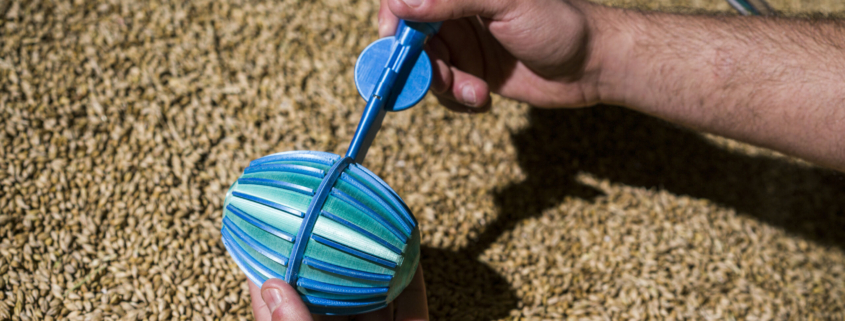
Crover’s t-shaped robot, which is being funded by Innovate UK, Scottish Enterprise and private funders, has been designed to offer grain aggregators, like farmers, better insight into the environmental conditions of grain crops, such as wheat and barley, when stored in sheds or silos.
The compact device has in-built moisture and temperature sensors and uses two domed-shaped wheels to propel itself through grain or other material in a bulk stack. It then feeds back analysis and data to a dashboard, giving users a more accurate understanding of the grain’s condition.
Temperature and humidity have a profound impact on grain storage and can contribute to the infestation of mould or insects which cause farmers to destroy significant portions of their stored crops. It is estimated that up to 30% of commodity grain is lost from the supply chain globally every year as a result.
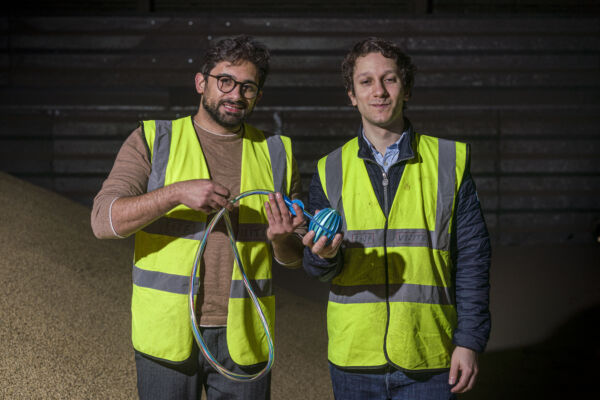
Gianlorenzo Di Santis (left) and Founding Director Lorenzo Conti (right) from Crover
Lorenzo Conti, founder and managing director of Crover, said:
“Working with the National Robotarium has significantly supported Crover’s development by providing us with access to state-of-the-art office and lab facilities and an extensive ecosystem of collaborators, industry experts and academic teams. It’s rare to be surrounded by a team who understand what it means to develop complex robots and we’re excited to continue sharing Crover’s journey with them.
“Traditional methods like spear sampling grain are time-consuming and laborious and quite often impractical and dangerous. In practice, grain storage operators are advised to sample bulk stacks at every 50 cm intervals. The reality is that, if done manually, someone could spend the best part of a week carrying out a single store check depending on the size of their crop load.
“Our device is designed to be controlled from one spot and saves whoever is operating it many hours of work as well as improving accuracy. The robot can ‘swim’ through the grain quickly generating a 3D map of temperature and moisture across the stack. This kind of insight can help people like farmers to better understand the condition of their grain and make informed decisions earlier like increasing ventilation or taking pest control measures.”

National Robotarium Chief Operating Officer, Steve Maclaren
Steve Maclaren is Chief Operating Officer at the National Robotarium. He said:
“The National Robotarium was launched with a mandate to assist all types of partners to accelerate research from laboratory to market, reduce cost and risk, increase opportunity and, ultimately, pave the way for the UK to take a global leadership role in AI and robotics technology.
“Innovations like Crover’s grain storage device – which could help solve a global problem for the world’s agriculture sector – are a great example of this mandate in action.
“The National Robotarium continues to be a leading collaborative hub, bringing together academics and global companies. Working with tenant companies like Crover, we want to provide a catalyst for entrepreneurship, and deliver sustainable economic benefit to the whole of the UK, its industries and society.”
UK Government Minister for Scotland, Malcolm Offord, said:
“It’s fantastic to see that farming and food and drink-boosting innovations like Crover’s new ‘grain-surfing’ robot will benefit from being part of the National Robotarium.
“Projects like this demonstrate the collaborative benefits the hub is providing, with resulting economic and environmental advances delivered to the UK.
“The UK Government is supporting the National Robotorium facilities at Heriot-Watt University with £21 million as part of more than £2.2 billion investment to level up communities across Scotland.”
Scottish Government Wellbeing Economy Secretary, Neil Gray, said:
“I welcome the development of this technology to help grain storage operators better understand the condition of grain and make informed decisions earlier.
“Technological advances like this show why the Scottish Government has supported the Robotarium through the Edinburgh and South East Scotland City Region Deal.”
LISTEN: Lorenzo Conti and National Robotarium Business Development Manager, Lisa Farrell, discuss how the National Robotarium is supporting Crover on BBC Radio Four’s Farming Today (broadcast 26 April 2023).

https://thenationalrobotarium.com/wp-content/uploads/Crover-grain-surfing-robot-scaled-e1695837394700.jpg6661000Louise Jackhttp://thenationalrobotarium.com/wp-content/uploads/Robotarium.pngLouise Jack2023-04-26 10:04:232023-09-13 17:35:42Grain-surfing robot the latest innovation to set up home at the National Robotarium
We may request cookies to be set on your device. We use cookies to let us know when you visit our websites, how you interact with us, to enrich your user experience, and to customize your relationship with our website.
Click on the different category headings to find out more. You can also change some of your preferences. Note that blocking some types of cookies may impact your experience on our websites and the services we are able to offer.
Essential Website Cookies
These cookies are strictly necessary to provide you with services available through our website and to use some of its features.
Because these cookies are strictly necessary to deliver the website, refusing them will have impact how our site functions. You always can block or delete cookies by changing your browser settings and force blocking all cookies on this website. But this will always prompt you to accept/refuse cookies when revisiting our site.
We fully respect if you want to refuse cookies but to avoid asking you again and again kindly allow us to store a cookie for that. You are free to opt out any time or opt in for other cookies to get a better experience. If you refuse cookies we will remove all set cookies in our domain.
We provide you with a list of stored cookies on your computer in our domain so you can check what we stored. Due to security reasons we are not able to show or modify cookies from other domains. You can check these in your browser security settings.
Google Analytics Cookies
These cookies collect information that is used either in aggregate form to help us understand how our website is being used or how effective our marketing campaigns are, or to help us customize our website and application for you in order to enhance your experience.
If you do not want that we track your visit to our site you can disable tracking in your browser here:
Other external services
We also use different external services like Google Webfonts, Google Maps, and external Video providers. Since these providers may collect personal data like your IP address we allow you to block them here. Please be aware that this might heavily reduce the functionality and appearance of our site. Changes will take effect once you reload the page.
Google Webfont Settings:
Google Map Settings:
Google reCaptcha Settings:
Vimeo and Youtube video embeds:
Other cookies
The following cookies are also needed - You can choose if you want to allow them:
Privacy Policy
You can read about our cookies and privacy settings in detail on our Privacy Policy Page.