The National Robotarium has launched a new work experience programme for secondary schools.
Overseen by Schools Engagement Lead (and former Computer Science teacher), Sabaht Bashir, the immersive week-long programme ran from 9-13 June 2025, offering a glimpse behind-the-scenes at the UK’s centre for robotics innovation.
The group, made-up of young people from schools across Scotland and England, kicked-off the week with a tour the facility’s high-spec labs and workshops, and the wider Heriot-Watt campus, taking in its vast green spaces and multi-million pound Oriam Sports Centre.
They learned about the different roles undertaken at the facility, ranging from Robotics Engineers and Technicians to Project Management and Marketing and Communications, as well as the different pathways to robotics careers, including Heriot-Watt University’s Graduate Apprenticeship scheme.
They also got hands-on experience operating some of the robotic technologies being developed for research and industry partners, such as the Boston Dynamics Spot robot dogs, as well as interacting with social engagement humanoid Ameca, and building their own robotic cars with the help of Senior Robotics Engineer Ronnie Smith. On the final day, members of the National Robotarium Leadership team judged their efforts during a presentation showcase in the main Atrium space.
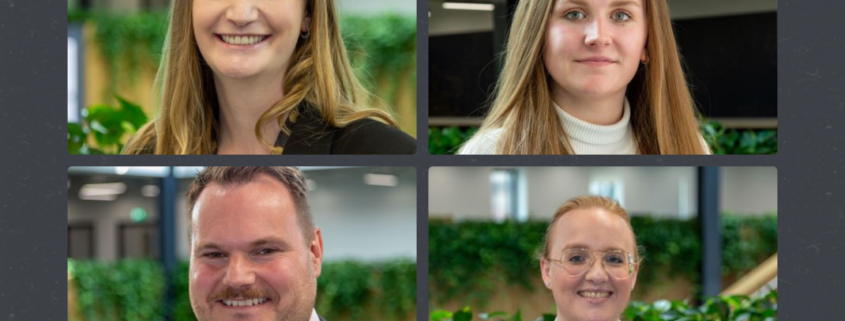
Work experience participants with School Engagement Lead Sabaht Bashir, COO Steve Maclaren, Robotics Engineer Ronnie Smith, and Project Manager Rowanne Miller
Callum Samson, a 4th year pupil from St John’s RC High School in Dundee, was one of the participants. He said: “I really enjoyed work experience at the Robotarium – the members of staff were all really friendly. I was really surprised at how big the centre is, with lots of different jobs that are really interesting.
“Spending a week at The National Robotarium has changed my perceptions of robots and their levels of advancement. There are lots of different robots for different tasks however they need a lot of support and programming by humans to undertake these.
“I’ve really enjoyed my time here and definitely would like to come back when I’m older to study or work.”
Jakub Przybek from St Modan’s High School said: “Visiting The National Robotarium for work experience has opened my eyes to a whole new world of integrated robotics in so many different sectors.
“I’ve found robots can be used for every type of industry and aren’t just limited to mechanical or manufacturing tasks.
“I’d love to become a Robotics Engineer at the Robotarium when I’m older!”
Other participants in the group were Ben Lake, George Heriot’s, Manuel Amadiegwu, Dartford Grammar School, Alex Vynnytskyi, St Modan’s, Jamie Stephenson, The Priory Academy LSST, Daniel Gregor, Boroughmuir HS, and Alex Florea and Oakley Dow, both St Kentigerns Academy.
Want to know more about The National Robotarium’s work experience programme? Contact s.bashir@hw.ac.uk for information on 2025/26 opportunities.
https://thenationalrobotarium.com/wp-content/uploads/Image-12-scaled.jpeg25601920Louise Jackhttp://thenationalrobotarium.com/wp-content/uploads/Robotarium.pngLouise Jack2025-06-16 14:48:322025-06-16 16:02:50The National Robotarium work experience programme inspires budding roboticists
Blair Wilson, Schools and Industry Engagement Lead, shares his reflections on the Scottish regional finals of the 2025 First Tech Challenge UK competition, which took place at The National Robotarium on 23 April
This week, The National Robotarium played host to the Scotland Regional Finals of the First Tech Challenge UK, one of the world’s largest robot competitions for 12-18 year olds. The regional event marked the culmination of our thriving partnership with the First Tech Challenge team which began – alongside sponsors at Hearts of Midlothian FC Innovation Centre – in December 2023, when I led a team of our robotics engineers to inspire the ten competing teams at an all-day, community ‘scrimmage’ event at Tynecastle Park, Hearts FC football ground.
Blair Wilson is Outreach and Engagement Lead at The National Robotarium
It was a big deal for the National Robotarium to be invited; the facility was just over a year old and I, along with my colleague Sabaht, had spent the past 12 months building an engagement programme for schools, industry and the general public. The programme had to not only help raise awareness of the positive benefits greater adoption of robotics and AI can have in our everyday lives, it also aimed to increase inclusion and diversity in computer science, technology, and other robotics-related STEM subjects, and address future skills gaps by building the UK’s robotics talent base.
The first Scottish scrimmage event, which was kicked-off (pardon the pun) with an inspiring introduction from our CEO Stewart Miller, was a day of creativity, building and operating rudimentary robots with the teams receiving demonstrations and advice from our engineers on everything ranging from automation to soft robotics.
Blair and Spot at the First Tech Scottish Scrimmage at Hearts Innovation Centre (Dec 2023)
Since then, we’ve hosted a number of First Tech events at The National Robotarium, including training sessions for teachers and volunteers. However, nothing we’ve done so far matched the levels of excitement brought by the regional finalists! Throughout the day, our Atrium space was vibrant; full of teamwork, community spirit and lots and lots of robots!
It was clear that each of the competing teams had put in a tonne of work in the lead-up to the contest. The innovation and creativity showcased in the robotic creations was incredible, with every one a serious contender. However, there could only be one winner, and P4F (Passion4Fusion) Robotics took home the Inspire Award for their robot ‘Shabalala’, meaning they will battle it out at the UK finals event, taking place in London on 26-27 June. An amazing achievement.
2025 Scottish Inspire Award winners Passion4Fusion Robotics
Since joining The National Robotarium, I have engaged with 10,000’s of young people, teachers, learners, community groups, robot enthusiasts – and, occasionally, robot sceptics! – showcasing and discussing robots, their capabilities and the types of exciting career opportunities these emerging technologies bring. Like the PC in the 80s and the mobile phone in the 90s, robotics will soon become part of everyone’s daily lives, and we need to ensure we have the skills, knowledge and understanding required for seamless integration and adoption.
Robots are not going to replace humans, but instead help humans’ everyday lives, taking on the dull, dirty or dangerous tasks, and, in the education sector, augmenting learning and teaching, so teachers can focus on the vital, human elements of the role; guiding, inspiring, and motivating young people to achieve their very best.
Whilst hosting events like the First Tech Challenge takes an enormous amount of work, they give young people an entry point to understanding how they operate and the limitless things they – the roboticists – can do with their help.
Get involved!
Thinking about joining the one of the UK’s most epic STEM challenges? Heart of Midlothian FC’s Innovation Centre are hosting an open Summer Showcase event in June (date TBC). Come along and meet this year’s First Tech Challenge teams, watch the robots in action, , and find out everything you need to get started ahead of next year’s contest, starting in September 2025.
We’ll be sharing more information on this exciting event soon but, in the meantime, you can email Blair for more info at: Blair.Wilson@hw.ac.uk
https://thenationalrobotarium.com/wp-content/uploads/First-Tech-Inspire-Award-April-25.jpg7501000Louise Jackhttp://thenationalrobotarium.com/wp-content/uploads/Robotarium.pngLouise Jack2025-04-25 14:32:472025-07-28 13:26:45BLOG: Leading the next generation of Scottish roboticists to the First Tech Challenge UK finals – Blair Wilson
The UNITE project, an EPSRC Prosperity Partnership programme spearheaded by The National Robotarium and Heriot-Watt University in collaboration with Imperial College London, was Highly Commended in the Multi-party Collaboration category at the 2025 Interface Scottish Knowledge Exchange awards.
The project team, which includes global geo-data specialists Fugro and Heriot-Watt spinout technology company Frontier Robotics, is developing advanced AI and autonomous systems for undertaking remote inspections of offshore wind farms to offer a safe, efficient and sustainable solution for global energy providers.
Picking up the prize on the night from Minister for Business, Richard Lochhead MSP was Project Manager, David Morrison, Director and Co-Founder of Frontier Robotics, Jonatan Scharff Willners, Head of the Robot Motor Intelligence (RoMI) lab, Dr Carlos Mastalli and postdoctoral student Hefan Wang.
Yvan Petillot, Professor of Robotics at Heriot Watt University and National Robotarium academic lead, commented:
“The National Robotarium’s partnership between Fugro and the UNITE project has created an exciting opportunity to develop this next generation of underwater technologies as well as the skills and expertise needed to support the transition to net zero. UNITE has enormous potential to power the UK’s offshore renewable sector and beyond, delivering worldwide economic and environmental impact that can benefit communities around the world.”
Adding to the evening’s achievements, Heriot-Watt was part of a team that claimed the Innovation of the Year award through the collaborative spin-out SolarSub Ltd. Working alongside partner universities, SolarSub Ltd has developed groundbreaking solar-powered autonomous underwater vehicles, significantly enhancing sustainable subsea operations. These innovative vehicles provide environmentally friendly solutions for extended underwater monitoring and exploration, supporting diverse industries from environmental research to offshore renewable energy.”
Minister for Business, Richard Lochhead MSP said:
“It was good to see the full breadth of academic and business-led innovation on show at Interface’s annual awards.
“Scotland has been at the forefront of many of the world’s most impactful innovations, from the MRI Scanner and penicillin to televisions and telephones. Yet, by combining research and business, so many new and exciting Scottish breakthroughs are just on the horizon and that is something we should all champion.”
The awards, now in their tenth year, were held at Edinburgh Futures Institute and celebrated exceptional collaborations between academia and industry that deliver economic, environmental and social benefits for Scotland. UNITE was recognised for its innovative KE consortium, which brings together a long legacy of scientific research alongside industry expertise and new autonomous and AI technologies.
Heriot-Watt’s Medical Device Manufacturing Centre (MDMC), scooped the main prize in the same category, topping off an successful evening for the institution.
The National Robotarium is proud to support International Women’s Day, celebrated annually on March 8 to honour the achievements of women across all aspects of life – social, economic, cultural, and political – while also advocating for gender equality.
Every year, we celebrate the achievements of our incredible female colleagues who are helping to drive advancements in robotics and Artificial Intelligence, and shaping the future by empowering more women and girls to embrace robotic technologies in their education, lives and careers, for generations to come.
Accelerating Action
To mark this year’s theme ‘Accelerate Action’, we asked some of the team what steps are being taken to improve gender equality in robotics, and what else can be done to encourage more pioneering women to pursue a career in robots, AI, computer science, engineering, technology and other STEM subjects.
Women in Robotics at The National Robotarium
Find out more about how female members of The National Robotarium team have navigated their careers, and the advice they’d give to women, girls and anyone else who’s interested in joining the Robotics Revolution.
Rowanne Miller, Project Manager
Dr Hsing-Yu Chen, Senior Robotics Engineer
Lisa Farrell, Business Development Manager
Dr Maria Koskinopoulou, Assistant Professor of Engineering
https://thenationalrobotarium.com/wp-content/uploads/InternationalWomensDay_Icon_WhiteOnPurple.jpg10001000Louise Jackhttp://thenationalrobotarium.com/wp-content/uploads/Robotarium.pngLouise Jack2025-03-07 15:49:172025-03-07 15:49:17International Women’s Day 2025 – Celebrating Women in Robotics
To mark National Engineering Day (13 November 2024), we have been speaking to our Robotics Engineers about their career paths, engineering role models and what a typical day is like at the National Robotarium…
Hsing-Yu Chen
Who’s your engineering role model?
One of my key role models in engineering is Morris Chang, the founder of Taiwan Semiconductor Manufacturing Company (TSMC). His technical expertise, leadership and vision have revolutionised the semiconductor industry and made a huge impact on global technology innovation. His emphasis on long-term thinking, collaboration, and focus on excellence in manufacturing processes continues to inspire me in my own work.
What in your mind is an example of good engineering?
An example of engineering that truly inspires me is the development of reusable rockets. This breakthrough in space technology shows us the power of dreaming big and pushing the boundaries of what’s possible. The ability to reuse rockets—once thought to be impossible—has the potential to completely reshape the aerospace industry, opening up new possibilities for space travel and exploration.”
What is typical day like as a Robotics Engineer?
A typical day for a robotics engineer begins with problem-solving, addressing challenges and issues related to the robots they are developing. This entails brainstorming innovative solutions to optimize robot performance, troubleshooting both hardware and software components, conducting experiments to validate the robots’ functionality, and delving into data analysis. Given the collaborative nature of their work, engineers often engage in ongoing communication with team members and clients.
What skills are required to be a good engineer?
Beyond technical proficiency, being a good engineer relies on essential problem-solving and critical thinking skills, enabling the identification and resolution of intricate engineering challenges. Equally critical is a commitment to continuous learning and stay attuned with this rapidly evolving field, ensuring that engineers can adapt to new technologies and innovate effectively.
How does engineering improve people’s lives?
Robotics engineering plays a pivotal role in enhancing people’s lives in numerous ways. For instance, the creation of surgical robots and prosthetic limbs improves the quality of medical treatments and enhances the lives of patients. Autonomous vehicles not only increase transportation efficiency but also enhance road safety. Assistive robots simplify daily tasks, making life more convenient and accessible for individuals. These advancements underscore the transformative impact of robotics engineering on our daily existence and overall well-being.
How can engineering help us live and/or work more sustainably?
Robotic engineering offers substantial potential to enhance sustainable living and working in various domains. This can be achieved by automating industrial processes to boost efficiency, optimising resource utilisation to reduce consumption and lower carbon emissions, improving recycling rates through precise sorting, and monitoring environmental changes. These technologies have the potential to create a more environmentally friendly and resilient world.
Hari Lakshman
Who are your engineering role models?
The reason I pursued an engineering career was after watching an animated video about Nikola Tesla’s life. Reading about his work, dedication, and passion to keep inventing things inspired me to follow in his footsteps. Another inspiration in my life is Henry Ford, who taught me so much about tech business, optimisation, and efficiency.”
Can you give an example of good engineering that inspires you?
The pyramids are the first engineering marvel that blew my mind; it’s exhausting even to imagine the methods ancient people might have used to build such a magnificent structure. Another marvel is the Chandra X-ray Observatory, which enables scientists to collect data and images for space research. This incredible piece of engineering has revolutionised space science research.”
What does the role of Robotics Engineer involve?
Robotics engineers involve themselves in various fields of engineering. It is always a big learning curve, sometimes building robots feels like creating a human child. We have knowledge in coding, software development, and designing prototypes, which involves an extensive understanding of mechanical engineering, electrical engineering, and control systems. We try and implement cutting-edge machine learning and AI algorithms to make the robot more intelligent and more efficient. For me, I’m still learning lots and lots to become a fine-tuned robotics engineer.
What skills are required to be a good engineer?
Robotics engineers should have skills such as critical thinking and design thinking, programming, active learning, teamwork, safety skills and leadership qualities.
How does engineering improve people’s lives?
Engineering helps to improve people’s lives in every possible way: economically, and ethically, it helps to improve quality of life, solve societal problems, fight against climate change and more. At the National Robotarium, we use our engineering skills to build robots that can help people with physically or mentally challenging tasks, and improve efficiency and cost-effectiveness.
Ronnie Smith
What is typical day like as a Robotics Engineer?
What you spend most of your time on day to day depends on your own role within the team. Some engineers can spend most of their day at a computer doing design or programming, while others might do largely hands on work building, extending, debugging, and maintaining robots. Since we tend to work on multiple projects at once, most days start by figuring out what to prioritise. For me, a typical day might involve some proposal writing, development work, project team meetings, and monitoring/debugging some of the robots we are testing as part of ongoing projects.
What skills are required to be a good engineer?
Since robotics is such an inter-disciplinary field, I think there is no fixed set of skills to be a robotics engineer. I think a good robotics isn’t necessarily someone who is an expert in all aspects of robotics, but rather someone who has their own strengths in a few core areas and who is interested in learning about the whole robotic system to the point where they can understand how everything fits together. This applies to myself, as I come from mainly a software background, but am keen to use my time at the National Robotarium to learn and become a more “rounded” robotics engineer.
How does engineering improve people’s lives?
Most of the time, when engineers are working on a problem it is in the name of improving our comfort, efficiency, safety, or our general quality of life. Robotics is a field which has the potential to touch on all of these aspects. In my previous role as a PhD student, we worked on assistive robotics and technology for older adults. Through user engagement we worked to understand the ways in which collaborative robotics can enable individuals to live in their own home for longer by automating aspects of daily tasks that might otherwise be impossible to complete alone.
How can engineering help us live and/or work more sustainably?
One of the main ways that robots can aid with sustainability is by being more efficient than the solutions that came before. What is meant by efficiency will of course differ across domains, but for example in manufacturing this might mean process efficiency which increases hourly output for the same or less energy. On the other hand, in agriculture it could be that increased precision in turn leads to increased efficiency, e.g., more accurate and targeted spraying of crops conserves resources.
Can you give an example of good engineering that inspires you?
I would look to the semiconductor industry and the advancement of the transistor-based processor over the past several decades as an example of inspiring engineering. Computers today are using billions of tiny transistors, manufactured at nanometre scale, to perform trillions of mathematical operations every second. This achievement has relied on back-to-back advancements and innovation across materials science, lithography, quantum physics, and of course computer and electronics engineers. To me, this is a shining example of human ingenuity and our ability to work together on a large scale to create technology that is so pervasive and seamless that we are able to take it for granted.
Rahul Ramachandran
Who are your engineering role models?
The Wright brothers and Dr. A.P.J. Abdul Kalam are two of my biggest role models. The Wright brothers’ achievement in creating the first successful powered airplane inspires me with their relentless pursuit of innovation and their ability to overcome doubt and failure. Similarly, Dr. Kalam’s perseverance and contributions to ISRO, especially his leadership in missions like India’s Mars Orbiter Mission, remind me of the importance of vision and hard work in achieving groundbreaking results. Both have shown me that with determination and passion, it’s possible to change the course of history.
Can you give an example of good engineering that inspires you?
One piece of engineering that really inspires me is the Moog synthesizer. What I love about it is how it simplified the complex technology of earlier electronic instruments, making it easier for musicians to use. The design is so elegant, and the way it combines innovation with simplicity was groundbreaking at the time. The Moog didn’t just change the way music was made; it made a complex tool feel accessible, showing how thoughtful design can open up new possibilities and spark creativity in unexpected ways.
What does the role of Robotics Engineer involve?
Robotics is an interdisciplinary field and because of that robotics engineer’s role depends on one’s engineering background, be it mechanical, electrical, computer science, sociology or applied physics. For example, a robotics engineer with a degree in Mechanical Engineering would work on the design and modelling of robot mechanics, whereas one with a background in electrical and electronics engineering would develop the robot’s battery management system and its sensors and actuators.
What skills are required to be a good engineer?
I believe that to be a good engineer, you must be able to understand the need for an engineering solution to any given problem. It’s not the “what” and “how” but the “why” that comes first.
Be curious, take inspiration from nature and question EVERYTHING! Analytical thinking is very important as is the ability to communicate effectively in a collaborative environment. It is helpful to have an engineering degree, but it is not always necessary if you have the proper knowledge and practical skills.”
How does engineering improve people’s lives?
We live in a world where everything we see has been engineered for us to live a better life, especially in today’s modern digital world, where everything is data-driven. We now have self-driving cars and text-to-speech solutions such as Okay Google, Alexa and Siri which enable us to make calls and play songs using voice commands.
At the National Robotarium, we are developing solutions such as unmanned underwater robots to undertake the inspection of offshore turbines, which is currently being done by deep-sea scuba divers. We are also improving the quality of life for many people doing repetitive tasks in factories by developing solutions for factory automation, which will enable people to safely undertake less repetitive and more skilled tasks side-by-side with robots.
We may request cookies to be set on your device. We use cookies to let us know when you visit our websites, how you interact with us, to enrich your user experience, and to customize your relationship with our website.
Click on the different category headings to find out more. You can also change some of your preferences. Note that blocking some types of cookies may impact your experience on our websites and the services we are able to offer.
Essential Website Cookies
These cookies are strictly necessary to provide you with services available through our website and to use some of its features.
Because these cookies are strictly necessary to deliver the website, refusing them will have impact how our site functions. You always can block or delete cookies by changing your browser settings and force blocking all cookies on this website. But this will always prompt you to accept/refuse cookies when revisiting our site.
We fully respect if you want to refuse cookies but to avoid asking you again and again kindly allow us to store a cookie for that. You are free to opt out any time or opt in for other cookies to get a better experience. If you refuse cookies we will remove all set cookies in our domain.
We provide you with a list of stored cookies on your computer in our domain so you can check what we stored. Due to security reasons we are not able to show or modify cookies from other domains. You can check these in your browser security settings.
Google Analytics Cookies
These cookies collect information that is used either in aggregate form to help us understand how our website is being used or how effective our marketing campaigns are, or to help us customize our website and application for you in order to enhance your experience.
If you do not want that we track your visit to our site you can disable tracking in your browser here:
Other external services
We also use different external services like Google Webfonts, Google Maps, and external Video providers. Since these providers may collect personal data like your IP address we allow you to block them here. Please be aware that this might heavily reduce the functionality and appearance of our site. Changes will take effect once you reload the page.
Google Webfont Settings:
Google Map Settings:
Google reCaptcha Settings:
Vimeo and Youtube video embeds:
Other cookies
The following cookies are also needed - You can choose if you want to allow them:
Privacy Policy
You can read about our cookies and privacy settings in detail on our Privacy Policy Page.