
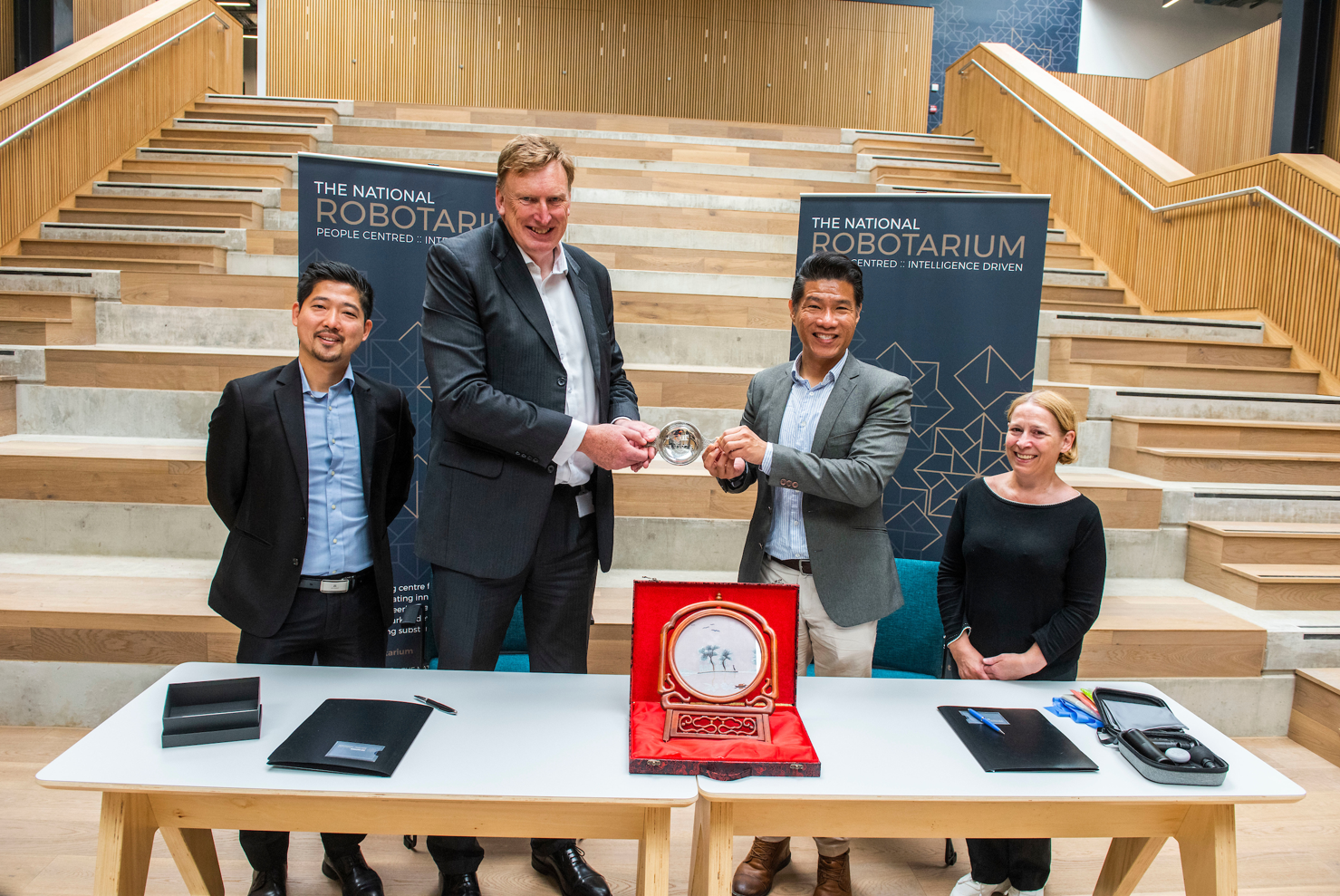
The National Robotarium entered into an international partner agreement with Robotics Australia Group (RAG), a non-profit national association that brings together companies, educational institutions, and public stakeholders to build a strong and sustainable interconnected robotics and autonomation ecosystem.
In a Letter of Intent signed by CEO of The National Robotarium, Stewart Miller and RAG CEO Nicci Rossouw in a virtual meeting on 2 December 2025, the two partners aim to develop joint initiatives and foster cooperation in areas including research and technology transfer, bilateral events and visits, and vocational and educational opportunities.
[clockwise from bottom: Stewart Miller, CEO and Steve Maclaren, COO of The National Robotarium, Nicci Rossouw, CEO of Robotics Australia Group]
This marks The National Robotarium’s second major international collaboration in 2025, following a Memorandum of Understanding signed in June with Robotekin, the Basque Association for Robotics and Automation. Together, these partnerships reinforce the centre’s commitment to building a globally connected robotics ecosystem that supports innovation, aligns regulatory frameworks, and accelerates technological progress.
Stewart Miller said: “Partnering with Robotics Australia Group marks an important step in our mission to build a globally interconnected robotics ecosystem. By combining our strengths, we can accelerate innovation, support emerging talent, and ensure that advances in robotics benefit industry and society worldwide.
“This agreement brings us closer to realising our ambition of becoming a truly globally significant centre for robotics.”
Nicci Rossouw said: “We are delighted to formalise our partnership with The National Robotarium. Together, we can build powerful pathways for collaboration that elevate research, talent development and industry capability across both nations.
“This relationship strengthens our shared vision for a thriving, sustainable robotics ecosystem.”
https://thenationalrobotarium.com/wp-content/uploads/Robotics-Australia-Group-e1765284080591.jpg12811813Louise Jackhttp://thenationalrobotarium.com/wp-content/uploads/Robotarium.pngLouise Jack2025-12-10 14:04:182025-12-10 14:04:18The National Robotarium signs strategic agreement with Robotics Australia Group to accelerate robotics innovation
On 2-3 September, The National Robotarium at Heriot-Watt University hosted The Scotland Forum, an initiative aimed at enhancing Scotland’s international engagement across economic development, intercultural relations and academic collaborations.
Led by Tasmina Ahmed-Sheikh OBE, former Member of UK Parliament for Ochil and South Perthshire, and facilitated with the Institute for Cultural Diplomacy, the event welcomed dignitaries and political leaders from across UK and European parliaments to explore how deeper engagement between Scotland and Europe could address pressing global challenges and generate strategic proposals and policy recommendations with the potential for national and global impact.
Keynote speakers at the forum, themed ‘Scotland’s Place in Europe: Promoting International Cooperation and Understanding’, included Former First Minister of Scotland, The Rt. Hon. Henry McLeish, Minister for Development Cooperation and Foreign Trade of Finland, Ville Skinnari, Former Prime Minister of Ireland, Bertie Ahern, Chair of the Lithuanian Green Party, Ieva Budraite, and Secretary of State for Exiting the European Union, Sir David Davis.
Speaking on behalf of the University were Associate Executive Dean for International and Partnerships, Professor Amos Haniff and Chief Operating Officer of The National Robotarium, Steve Maclaren, who welcomed guests to the global research institute for robotics and Artificial Intelligence on the first morning of the event, and spoke at that evening’s VIP dinner at Dynamic Earth.
Chief Operating Officer, Steve Maclaren (second left) and Professor Amos Haniff (furthest right) with Mark C. Donfried and representatives from The Institute for Cultural Diplomacy
Steve said: “It was honour to host so many great leaders and parliamentarians for The Scotland Forum and to contribute to discussions that could shape how Scotland and Europe work together on advancing innovation for years to come.
“As the UK’s National Robotarium, we are passionate about expanding our global networks and collaborating with a diverse range of partners that can support our mission to transform people’s lives, work and health through science, technology and robotics.”
As well as talks, panel discussions and workshops, the event included a gala dinner at Edinburgh Castle with a special lecture from lead singer and lyricist of Deep Purple, Ian Gillan.
https://thenationalrobotarium.com/wp-content/uploads/Scotland-Forum-group-pic-1000px.jpg6371000Louise Jackhttp://thenationalrobotarium.com/wp-content/uploads/Robotarium.pngLouise Jack2025-09-08 13:51:132025-09-08 14:54:56World leaders gather at The National Robotarium for international convention
A new tentacle-like underwater robot that can safely interact with offshore structures could help revolutionise how millions of kilometres of subsea infrastructure is inspected and maintained around the world.
Developed through a collaboration between the UK’s National Robotarium and Senai Cimatec in Brazil, the 1-metre-long flexible manipulator features a soft, bendy design that conforms to structures during contact. This offers significant advantages over conventional rigid manipulators when working near delicate or complex subsea equipment.
The soft robotic tentacle – pictured on display at the 2025 Goodwood Festival of Speed – will be showcased at the UK Robotics Expo on 18 September
The breakthrough addresses key challenges in offshore inspection, where subsea pipelines and equipment at depths reaching nearly 3000m must be regularly checked to ensure safety and prevent costly failures. With offshore infrastructure decommissioning costs estimated at over $100 billion by 2030, extending the safe operational life of existing pipelines and equipment delivers both significant economic savings and reduces environmental impact.
The robot, which has been designed and developed by engineers at the National Robotarium, the UK’s centre for robotics and AI at Heriot-Watt University, works by combining a flexible backbone with a system of tendon-like cables that control its movement. Special sensors help it understand its position and shape underwater, allowing the robot to make precise movements even in turbulent conditions. This makes it ideal for deploying from underwater vehicles to inspect offshore wind farms, as well as other offshore energy and marine infrastructure.
Tests conducted at the National Robotarium’s wave tank facility show the robot can position its tentacle-like arm with remarkable accuracy and maintain stability when subjected to external forces of up to 300g. Even when intentionally disturbed, it can correct its position and return to the desired state within seconds – a crucial capability for operation in unpredictable ocean environments.
Rowanne Miller, Project Manager at The National Robotarium
Rowanne Miller, Project Manager at the National Robotarium, said: “This breakthrough represents a significant milestone for the National Robotarium, showcasing our comprehensive end-to-end project delivery capabilities. Our team has taken this innovative underwater robot from initial concept through design and development to successful testing in real-world conditions. What makes this particularly exciting is that we’ve created a solution that doesn’t just incrementally improve existing technology – it fundamentally changes how we can approach underwater inspection tasks, opening up new possibilities for safer, more precise interaction with critical subsea infrastructure and potentially transforming how we maintain and protect our offshore assets for decades to come.”
Lucas Silva, Lead Researcher at SENAI CIMATEC, said: “We worked together with the National Robotarium to conceive an innovative take on underwater manipulation, opening up new use cases for the industry. This new branch of development represents an important and disruptive upgrade to our robotics development roadmap, and the seamless cooperation with The National Robotarium played a key role in this new achievement, setting new standards for future international partnerships”.
The technology is primarily aimed at offshore energy companies, underwater inspection service providers, and operators of subsea infrastructure who conduct regular safety assessments. Traditional inspection methods often require large vessels and human divers, creating both safety hazards and significant carbon footprints. It is hoped the ground-breaking innovation could enable smaller underwater vehicles to perform sophisticated inspection tasks, substantially reducing operational costs while improving personnel safety and environmental sustainability.
The project demonstrates how soft robotics – typically developed at small scales for delicate tasks – can be successfully scaled up to solve real-world engineering challenges in demanding environments.
The soft robotic tentacle will be on display at the inaugural UK Robotics Expo, taking place at The National Robotarium on Thursday 18 September.
https://thenationalrobotarium.com/wp-content/uploads/Cimatech-tentacle-at-Goodwood-FoS-e1756892780287.jpg10541000Louise Jackhttp://thenationalrobotarium.com/wp-content/uploads/Robotarium.pngLouise Jack2025-09-03 11:00:412025-09-03 11:00:41Tentacle-like underwater robot to make offshore inspections safer and more precise
The National Robotarium and Robotekin – Basque Association for Robotics and Automation have forged a new global partnership to advance innovation, research and skills development in Robotics and Autonomous Systems (RAS).
In July, the UK’s centre for robotics and AI at Heriot-Watt University welcomed a delegation from Robotekin, a not-for-profit consortium in the Basque Country, during which a Letter of Intent was signed by CEO of The National Robotarium, Stewart Miller, and Robotekin Director, Daniel Ruiz Corres. The letter outlines each organisation’s commitment to sharing knowledge and developing joint initiatives in areas including applied research and technology transfer, international projects, outreach and events.
[l-r] Daniel Ruiz Corres, Robotekin Director, and Stewart Miller, CEO of The National Robotarium sign the letter of intent (July 2025)
The delegation – which included Robotekin industry members Smartlog Group, Seaquenz, BIC Araba, Ikaslan, IKERLAN and DACO Ingeniería – followed a visit by National Robotarium Chief Operating Officer, Steve Maclaren, to Robotekin’s headquarters in Álava, Spain in December. During the visit, Steve presented on the National Robotarium’s holistic enterprise model that is advancing science in robotics and automation, and supporting early-stage technology companies. It was agreed that a reciprocal visit be arranged, paving the way towards a more formalised partnership.
Steve said: “Following my insightful visit to Robotekin’s headquarters last year, it was an honour to welcome the team and their associates to The National Robotarium. As well as getting a tour our state-of-the-art labs, the visit was hugely valuable in learning more about each other’s delivery models, and exploring opportunities to drive forward new collaborations.”
Steve Maclaren (centre) visited Robotekin in Spain in Dec 2025
Robotekin operates as a ‘cooperative ecosystem’, creating a link between R&D, education, manufacturing and user testing, rapidly driving new technological and business projects that address genuine industry and customer needs. The success of the Robotekin model could provide a blueprint for other nations looking to create a circular robotics supply chain that harnesses scientific excellence, private and government investment, and entrepreneurial spirit, manufacturing and production. Building a similar robotics ecosystem for Scotland is a key recommendation in The National Robotarium’s recent policy paper ‘Making Scotland a World Leader in Robotics’.
Stewart Miller said: “Scotland stands to gain significantly from a hub-and-spoke model like Robotekin. By acting as a physical hub for industry, government and science to work closely together on fast-tracking new robotic innovations, we not only benefit people’s lives but also create a driver for economic prosperity and talent retention.
“This partnership offers a valuable opportunity to explore alternative delivery models that could be key to securing long-term success for robotics in Scotland.”
https://thenationalrobotarium.com/wp-content/uploads/Robotekin-group-dinner-1000px.jpg7501000Louise Jackhttp://thenationalrobotarium.com/wp-content/uploads/Robotarium.pngLouise Jack2025-07-31 17:19:342025-07-31 17:21:20The National Robotarium forges new partnership with Robotekin
Senior representatives from international robotic technology company, Fourier Intelligence, were welcomed at the National Robotarium on Tuesday 12 July to co-sign a Memorandum of Understanding (MOU) with the new facility.
Fourier Global HQ CEO, Zen Koh, met with CEO of the National Robotarium, Stewart Miller, and colleagues, for a tour of the multimillion-pound, purpose-built facility, based at Heriot-Watt University’s Edinburgh campus. The facility will be the UK’s largest and most advanced applied research facility for robotics and artificial intelligence (AI) when it opens later this year.
The visit follows the generous in-kind contribution by Fourier of sophisticated robotic equipment that can be used to support upper and lower limb training and exercises. Scientists from Heriot-Watt and the University of Edinburgh will use the technology to underpin research and improve understanding of the use of robotics and AI for assisted living, movement, and patient rehabilitation.
“The National Robotarium will be the UK’s leading centre for robotics and artificial intelligence, developing solutions to global challenges.
“Signing the MOU with Fourier Intelligence was both an honour and an opportunity to highlight our commitment to work with companies on the cutting-edge of science and technology, and achieve our shared goals of advancing robotics on a global stage.” – Stewart Miller, CEO of the National Robotarium
Zen Koh said: “We are pleased to enter into this agreement with the National Robotarium and I am looking forward to further developing our technology for use by their robotics experts and clinicians to making our technology localised.
“Fourier Intelligence are at the forefront of developing and redefining interconnectable, intelligent robotics technology and I’m excited to see what we can accomplish together through this new relationship.”
We may request cookies to be set on your device. We use cookies to let us know when you visit our websites, how you interact with us, to enrich your user experience, and to customize your relationship with our website.
Click on the different category headings to find out more. You can also change some of your preferences. Note that blocking some types of cookies may impact your experience on our websites and the services we are able to offer.
Essential Website Cookies
These cookies are strictly necessary to provide you with services available through our website and to use some of its features.
Because these cookies are strictly necessary to deliver the website, refusing them will have impact how our site functions. You always can block or delete cookies by changing your browser settings and force blocking all cookies on this website. But this will always prompt you to accept/refuse cookies when revisiting our site.
We fully respect if you want to refuse cookies but to avoid asking you again and again kindly allow us to store a cookie for that. You are free to opt out any time or opt in for other cookies to get a better experience. If you refuse cookies we will remove all set cookies in our domain.
We provide you with a list of stored cookies on your computer in our domain so you can check what we stored. Due to security reasons we are not able to show or modify cookies from other domains. You can check these in your browser security settings.
Google Analytics Cookies
These cookies collect information that is used either in aggregate form to help us understand how our website is being used or how effective our marketing campaigns are, or to help us customize our website and application for you in order to enhance your experience.
If you do not want that we track your visit to our site you can disable tracking in your browser here:
Other external services
We also use different external services like Google Webfonts, Google Maps, and external Video providers. Since these providers may collect personal data like your IP address we allow you to block them here. Please be aware that this might heavily reduce the functionality and appearance of our site. Changes will take effect once you reload the page.
Google Webfont Settings:
Google Map Settings:
Google reCaptcha Settings:
Vimeo and Youtube video embeds:
Other cookies
The following cookies are also needed - You can choose if you want to allow them:
Privacy Policy
You can read about our cookies and privacy settings in detail on our Privacy Policy Page.