Two projects recently delivered by The National Robotarium, the UK’s centre for robotics and Artificial Intelligence at Heriot-Watt University, have been shortlisted for The Engineer C2i (Collaborate to Innovate) Awards 2025.
The awards, now in their tenth year, were launched to uncover and celebrate great examples of engineering collaboration and to recognise the role that engineers are playing in addressing some of the world’s biggest challenges.
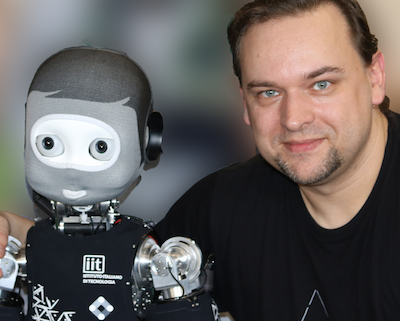
The 5G Future Farming: Robotics project worked with agricultural and telecommunications specialists to test autonomous robots for precision farming tasks in remote or rural environments
The National Robotarium is shortlisted in the Information, Data & Connectivity and Wild Card categories for the projects:
5G Future Farming: Robotics (in partnership with James Hutton Institute, Scotland 5G Centre, Boston Dynamics and Freshwave)
A collaboration between technology and agricultural research, this project developed 5G-connected robotics applications to enable farmers to implement precision agriculture techniques while addressing rural connectivity challenges.
UNITE (with Heriot-Watt University in partnership with Imperial College London, Fugro, and Frontier Robotics)
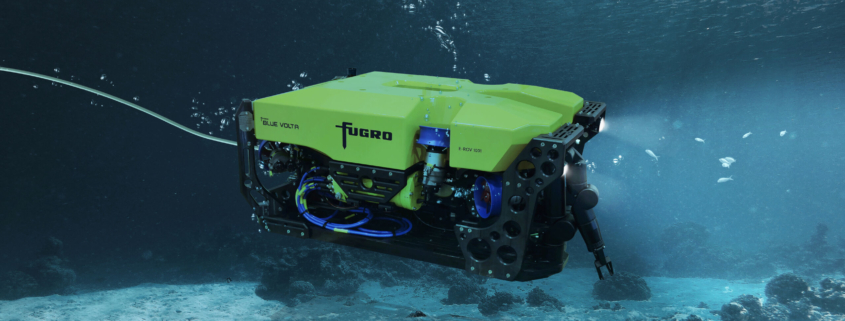
This 3-year project, supported by Engineering and Physical Sciences Research Council (EPSRC), is developing autonomous, electric remotely-operated vehicles (eROVs) to conduct maintenance and repair of offshore wind turbines.
Now a prestigious panel of leading UK engineers will judge the shortlisted submissions with the winners being announced at a special event, taking place on Thursday 26 February 2026 in London.
Frontier Robotics, a spinout from Heriot-Watt University, support the UNITE project’s aims to develop smart, AI-enabled autonomous ROVs for wind turbine maintenance
Chief Executive Officer at The National Robotarium, Stewart Miller said: “Being shortlisted in not one, but two, categories is a fantastic result for the teams involved in delivering these complex, visionary projects.
“At The National Robotarium our robotics engineers and research teams are pushing the boundaries of innovation, and advancing the rapid adoption of smart and autonomous robotics that can help improve productivity, sustainability and safety in different industries.”
Editor of The Engineer Jon Excell said:
“Once again, the Collaborate to Innovate awards has uncovered a remarkable crop of innovative projects and initiatives from across the world of engineering. Between them, this year’s shortlisted finalists, provide a compelling illustration of the technologies and trends that are shaping our future and the role that UK engineers are playing at the forefront of some of the most critical technology developments of our times.”
https://thenationalrobotarium.com/wp-content/uploads/C2i_Awards_25-29-Facebook_1350x1350Shortlisted.png13501350Louise Jackhttp://thenationalrobotarium.com/wp-content/uploads/Robotarium.pngLouise Jack2025-11-20 10:27:422025-11-20 11:25:57The National Robotarium makes the shortlist in The Engineer C2I Awards 2025
A robotics firm based at The National Robotarium has reached a significant milestone by making its first commercial sale with the Offshore Renewable Energy (ORE) Catapult, the UK’s leading technology innovation centre for offshore renewables.
Frontier Robotics, based at the UK’s centre for robotics and AI at Heriot-Watt University, has developed advanced visual sensing and autonomy technology for subsea robots which will now be deployed at several sites including ORE Catapult’s new simulation platform VDARE (Virtual Demonstration and Assessment for Robotic Environments) at its DARE (Digital, Autonomous and Robotics Engineering) Centre in Blyth.
The company’s state-of-the-art camera can be mounted onto a remotely operated vehicle (ROV) to take true to life imagery of offshore assets such as wind turbines, and floating offshore wind platforms. These images are then incorporated into ORE Catapult’s VDARE simulation to create virtually ‘real’ assets.
Dr Jonatan Scharff-Willners, CEO of Frontier Robotics
The unpredictable nature of the world’s oceans makes the inspection and maintenance of offshore assets challenging, with visibility in murky waters a particular obstacle. By leveraging advanced sensor fusion techniques with edge computing, Frontier Robotics’ system offers enhanced visual clarity, robust and reliable positioning and 3D mapping through Simultaneous Localisation and Mapping (SLAM) technology.
SLAM enables ROVs to create comprehensive 3D maps of their surroundings while simultaneously tracking their own position within those environments, providing the foundations for automated and autonomous operations.
The new technology addresses critical challenges for the UK’s offshore wind sector, where more than 2,600 turbines across 43 wind farms require up to three maintenance checks annually. These operations can account for up to 20% of total offshore wind emissions through vessel operations and helicopter transfers. Improved monitoring will enable operators to make faster, better-informed decisions about maintenance operations, reducing both costs and carbon footprint.
Jonatan Scharff Willners, CEO of Frontier Robotics, said:
“Offshore renewable asset inspection is a very challenging and hazardous task in the energy sector. With the UK’s ambitious offshore expansion plans, innovative systems that enhance safety and efficiency aren’t just beneficial – they’re essential.
“This sale to ORE Catapult is really important and helps demonstrate the value of our technology to the market. We’re grateful to the National Robotarium for their support. Being based there, we have access to world-class facilities and exceptional engineering talent and that has accelerated our development timeline.
“Our vision is to become the default autonomy provider for underwater inspections globally, transforming how the industry approaches maintenance and monitoring, and this sale is a major milestone in our journey to delivering that vision.”
Ken Chan, Robotics Operation Lead at ORE Catapult, said:
“Our VDARE simulation platform has been created to accurately represent real world offshore assets and environments, with data integrated into our simulations that respond in real time.
“We have conducted underwater trials using robotics systems to map subsea environments, and have imported data mapping seabed structures, water clarity, temperature and salt levels to create interactive 3D scenes built on accurate, real-world measurements.
“Our mission is to de-risk offshore robotics and accelerate development timelines through affordable, modular, and scalable test environments, and the technology we are now using from Frontier Robotics is supporting us to do that.”
Lisa Farrell, Business Development Manager at the National Robotarium, said:
“Seeing Frontier Robotics develop from incorporation to now securing its first sale demonstrates what’s possible when we properly support innovation in Scotland’s high-growth sectors. Its success creates benefits that extend far beyond one company – strengthening our robotics ecosystem while helping critical industries like offshore energy operate more sustainably.
“The sale to ORE Catapult is a particularly exciting development for us as it coincides with our recent signing of an MOU (Memorandum of Understanding) with ORE Catapult and recent launch of the Blue Robotarium in Orkney, both of which mark our commitment to creating an industry-led robotics cluster and building robotic capabilities to advance the energy transition.
“This is exactly why the National Robotarium exists – to help promising technologies move from concept to commercial reality. We create an environment where talented innovators can access specialised resources rarely found in one location.”
The Frontier Robotics Advisory Board after their inaugural meeting at The National Robotarium
High-profile appointments to expert advisory board
To support its growth trajectory, Frontier Robotics has strengthened its leadership with the appointment of an expert advisory board. Simon Reeve, former Director of Innovation at the Alan Turing Institute and VP of Technology and Innovation at Lloyd’s Register, will chair the board.
He is joined by Mary Jane Brouwers, a highly regarded leader in the Scottish investment ecosystem with over 20 years of experience in early-stage equity investments. The board is completed by Professor Yvan Petillot, a renowned expert in robotics and autonomous systems at Heriot-Watt University, co-founder and ex CTO of SeeByte, and academic co-lead at the National Robotarium.
In addition to their commercial success, Frontier Robotics has bolstered its already impressive funding track record with two new funding grants. The first, from Scottish Enterprise, has seen the firm assess the development of photorealistic, 3D interactive models to significantly decrease the processing time of more commonly used photogrammetry techniques.
The second grant is from the AI Safety Institute for a project the company is working on with partners including King’s College London, and SeaBot Maritime. This project will build and test a training and competence framework to assure the safe and responsible use of AI and autonomy in marine environments and provide a mechanism for the maritime workforce to upskill and adopt the use of the technology as AI advances within the sector.
https://thenationalrobotarium.com/wp-content/uploads/An-underwater-Remotely-Operated-Vehicle-for-inspecting-offshore-assets-.jpg7501000Louise Jackhttp://thenationalrobotarium.com/wp-content/uploads/Robotarium.pngLouise Jack2025-07-31 11:13:062025-07-31 15:32:58Frontier Robotics secures first commercial sale with ORE Catapult
The National Robotarium is supporting the development of new artificial intelligence and control systems that could enable underwater robots to operate autonomously in turbulent seas, potentially revolutionising maintenance and repair tasks for offshore wind turbines.
The UNITE project, an EPSRC Prosperity Partnership programme led by Heriot-Watt University in collaboration with Imperial College London, is creating new artificial intelligence and control systems in partnership with geo-data specialist Fugro and Heriot-Watt University spinout Frontier Robotics, supported by the National Robotarium, the UK’s centre for robotics and AI.
“The UNITE project was co-created with Fugro to develop the next generation of autonomy-enabled robotics solutions for offshore inspection and maintenance. We are especially interested in subsea inspection and manipulation in dynamic environments where existing solutions cannot be used.”
– Yvan Petillot, Professor of Robotics at Heriot Watt University and National Robotarium academic lead
“Our trials are showing promising results in enabling underwater robots to maintain stable contact with offshore structures in challenging conditions,” said David Morrison, Project Manager at the National Robotarium. “If successful, the technology could transform offshore wind maintenance, reducing fuel consumption of maintenance missions by up to 97% – from 7,000 litres per day to just 200 litres. This could significantly lower both operational costs and the carbon footprint of maintenance.”
The project demonstrates the National Robotarium’s role in bringing together established companies and emerging innovators. Through its laboratories and testing infrastructure, the facility enables rapid development and validation of commercial solutions. The technology being developed could reduce standard data collection time from three weeks to just three hours.
“With the exponential growth of offshore infrastructure, we need to look towards deploying more AI, robots and autonomy to enable the industry to take advantage of new technologies to work even more efficiently and to scale with the global demand,” said Jonatan Scharff Willners, CEO of Frontier Robotics. “It is great to work closely with Heriot-Watt University, the National Robotarium and Fugro to tackle these highly important problems, which are key components if we want to transition to renewable energy using a greener and more sustainable supply-chain.”
Mark Bruce, Global Product Manager of Next Generation ROV Systems at Fugro, said: “Our USVs and eROV’s deliver unmatched efficiency, hugely reduced environmental impact, and most importantly they eliminate human risk offshore by removing people from harm’s way. Our remote operations centres have been operating for ten years, during which time we have refined and improved our solutions.”
The National Robotarium provides companies with access to laboratories, testing facilities, and specialised equipment, alongside support for commercialisation. Companies working at the facility can connect with researchers, access funding opportunities, and engage with the UK’s broader robotics ecosystem.
The £1.4 million Underwater Intervention for Offshore Renewable Energies (UNITE) project is led by Professor Yvan Petillot from Heriot-Watt University, with Dr. Sen Wang leading Imperial College London’s contributions, and is funded through an EPSRC Prosperity Partnership, part of UK Research and Innovation.
The National Robotarium welcomes contact from energy companies and technology providers interested in exploring the commercial applications of this technology. Email nationalrobotarium@hw.ac.uk or contact our Business Development team.
https://thenationalrobotarium.com/wp-content/uploads/Surface-vessel-and-autonomous-underwater-robot-undergoing-trials-in-Heriot-Watt-Universitys-wave-tank-facility-GoPro-stills.jpg15362048Louise Jackhttp://thenationalrobotarium.com/wp-content/uploads/Robotarium.pngLouise Jack2024-10-24 00:01:272024-10-24 09:54:06National Robotarium accelerates industry development of wind farm robotics
The International Blue Economy Robotarium – dubbed the ‘Blue Robotarium’ – will bring together leading experts in science and industry to test and develop cutting-edge robotic technologies to revolutionise the global blue economy.
Over the coming months, the Blue Robotarium aims to:
Develop an expansive programme that explores learning and solutions related to robotics, AI and data management for the offshore wind and tidal energy sectors;
Rapidly advance the testing and development of robotic systems to improve the sustainability of marine industry operations;
Create a centre in Orkney for testing, certification and performance validation of new robotic, AI digital technologies;
Support and facilitate the safe deployment of new technologies, underpinned by expert support and management;
Stewart Miller, CEO of The National Robotarium, spearheaded the new consortium alongside Professor Sandy Kerr, Director, School of Energy, Geoscience, Infrastructure and Society at Heriot-Watt’s Orkney campus.
Stewart said: “This is a hugely exciting opportunity to showcase how the National Robotarium model can be adapted to drive robotic innovations for specific sectors.
“The International Blue Economy Robotarium will explore sustainable solutions that will enhance the offshore energy, marine and renewables industries through advanced technology.
“With access to a network of 400 service specialists, the Blue Robotarium will be a one-stop-shop for enterprising companies seeking to enhance efficiencies and improve sustainability using robotics.”
https://thenationalrobotarium.com/wp-content/uploads/IBER-all-energy-land-1.jpeg13372082Louise Jackhttp://thenationalrobotarium.com/wp-content/uploads/Robotarium.pngLouise Jack2025-05-14 16:32:312025-05-20 10:53:04New ‘Blue Robotarium’ aims to transform marine energy industry
The project team, which includes global geo-data specialists Fugro and Heriot-Watt spinout technology company Frontier Robotics, is developing advanced AI and autonomous systems for undertaking remote inspections of offshore wind farms to offer a safe, efficient and sustainable solution for global energy providers.
The Scottish KE awards, now in their 10th year, highlight the exceptional collaborations that deliver economic, environmental and social benefits for Scotland. UNITE has been nominated within the Multi-party Collaboration category, in recognition of the consortium’s innovative knowledge exchange, bringing together a legacy of science, industry expertise and emerging technologies to tackle a real-world challenge.
UNITE aims to develop autonomous, electric remotely-operated vehicles (eROVs) to conduct maintenance and repair on offshore wind turbines
Professor Yvan Petillot is academic co-lead at The National Robotarium and leads the UNITE project at Heriot-Watt.
He said: “It’s an honour to be shortlisted for a Scottish KE Award. By harnessing advanced robotics, artificial intelligence, and subsea engineering with the aim of transforming offshore maintenance and directly supporting Scotland’s net-zero ambitions, we think the UNITE project is an excellent example of truly impactful Knowledge Exchange.”
Amelia Whitelaw, Director of Interface, which organises the Awards, said: “At Interface, we are proud to deliver the Scottish Knowledge Exchange Awards on behalf of Scotland’s vibrant innovation ecosystem.
“These awards are more than just a celebration of achievements—they showcase the transformative power of collaboration between academia and industry. Each finalist represents the spirit of partnership, driving solutions that create lasting economic, environmental, and social impact.”
The Interface Scottish KE Awards will take place at Edinburgh Futures Institute on 19th March.
https://thenationalrobotarium.com/wp-content/uploads/KE-awards.png499706Louise Jackhttp://thenationalrobotarium.com/wp-content/uploads/Robotarium.pngLouise Jack2025-02-12 12:34:512025-02-12 12:40:25UNITE consortium shortlisted for Scottish Knowledge Exchange Award
Scientists from the Edinburgh Centre for Robotics and The National Robotarium are leading a UK Robotics Summer School this year, taking place from 2-6 June.
The unique, fully-immersive, 5-day programme will be held at Heriot-Watt University‘s Edinburgh campus, and cover topics including:
Reasoning, control, collaboration and learning in Robotics;
Bioinspired Robotics;
Generative AI;
Ethics, Validation and Inclusivity of AI;
Human-Robot Interaction
The programme is specifically tailored for Masters-level students and industry practitioners keen to learn, connect and understand the scientific, ethical and practical applications of robotics and Artificial Intelligence.
Dr Ingo Keller has been appointed as the first Head of Robotics at the National Robotarium, the UK’s centre for Robotics and Artificial Intelligence.
A software, AI and robotics engineer with over 20 years of experience in science and industry, Ingo will lead the facility’s growing team of robotics engineers as they test and develop new technologies and systems to address real-world challenges. Current projects include robotics for sectors including agriculture, construction, manufacturing, aerospace and fisheries.
Ingo has in-depth, hands-on experience with a multitude of robotic systems, including all phases of software development, life-cycle management and DevOps tooling. He has co-founded a number of start-up technology companies in software architecture and database management systems, developing a keen understanding of the potential of applied emerging technologies for addressing industry challenges.
Prior to his new role, he was Chief Technology Officer at Xihelm, a London-based robotic harvesting solutions company, where he worked while completing a PhD in Data Augmentation for Human-Robot Interaction at Heriot-Watt University, where the National Robotarium is based.
On his new appointment, Ingo said: “I’m delighted to join the National Robotarium team at this exciting stage of its development and lead on the creation of robotics, AI and engineering systems that can truly transform people’s lives and work. My goal is to get more robots out of the lab and into the wild, and being able to talk directly to industry leaders about their challenges means we can develop safe, practical, and effective robotic technologies that can be seamlessly integrated into society.
“I’m also passionate about sharing the knowledge and expertise of our talented team to build robotics skills in different sectors, ensuring people are equipped with the tools they need to operate and manage robotics and AI, and promoting the positive benefits of these technologies to all.”
Stewart Miller, Chief Executive Officer, said: “The appointment of Ingo as our first Head of Robotics is an important and exciting milestone for the National Robotarium. He is passionate about applying his extensive expertise to new and interdisciplinary problem spaces and will be a great ambassador, working with experts in all fields of science and industry to advance state-of-the-art robotics systems.”
https://thenationalrobotarium.com/wp-content/uploads/WebsitePic-400x400-1.png400400Louise Jackhttp://thenationalrobotarium.com/wp-content/uploads/Robotarium.pngLouise Jack2023-08-29 09:50:122023-10-24 12:06:29The National Robotarium appoints first Head of Robotics
Electric remotely operated vehicles (eROVs) that perform maintenance and repair tasks on offshore wind turbines are being developed by the National Robotarium in partnership with Fugro, the world’s leading Geo-data specialist. Deployed from Fugro’s uncrewed surface vessels (USVs), the companies are working closely together to explore how the offshore energy sector can benefit from advancing this autonomous technology.
The £1.4 million Underwater Intervention for Offshore Renewable Energies (UNITE) project aims to dramatically improve health and safety for workers by reducing the need for potentially hazardous offshore maintenance missions conducted by crewed support vessels.
The remotely operated robotic systems will address a number of additional sector challenges including supporting industry to reduce carbon emissions, improve offshore turbine productivity through reduced downtime, and make maintenance and repair exercises more cost-effective and timely.
The UK has more than 11,000 offshore wind assets around its shores, with thousands more planned by 2050. On average, each turbine requires up to three maintenance check-ups per year and this figure increases as turbines age and require more maintenance to stay fully operational.
Current industry maintenance methods involve vessels travelling into and working in areas of open ocean where a mix of trained divers and ship-based crews manually inspect and or deploy tele-operated robots for repair of individual wind turbines.
When applied to the whole of the UK’s offshore wind sector, this translates into potentially hundreds of thousands of crewed maintenance missions every year which are costly for business, contribute emissions to the environment and present a safety risk for workers.
In addition to supporting the uncrewed and remotely operated vessels, the pioneering research project will help develop autonomous and semi-autonomous ROVs capable of conducting subsea inspection, maintenance and repair tasks which can be monitored onshore whilst remotely deployed and operated from anywhere in the world.
Researchers will specifically focus on developing technologies which allow robots to build more accurate maps of the subsea terrain to better navigate obstacles and targets. The project will also explore how robots autonomously interact with underwater structures, such as grasping or moving objects, whilst being subject to external forces like changing currents or rough seas.
The project will be delivered by researchers from Heriot-Watt University and Imperial College London working within the National Robotarium, the UK’s leading AI and Robotics centre, in collaboration with Fugro and funded by the Engineering and Physical Science Research Council, part of UK Research and Innovation.
The National Robotarium is part of the Data-Driven Innovation initiative, supported by £21 million from the UK Government and £1.4 million from the Scottish Government. The initiative aims to turn Edinburgh into the data capital of Europe and is part of the wider £1.3 billion Edinburgh and South-East Scotland City Region Deal.
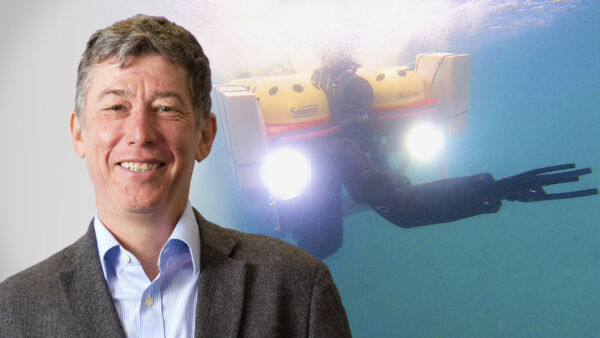
Co-academic lead at the National Robotarium, Prof. Yvan Petillot
Prof. Yvan Petillot is academic co-lead at the National Robotarium and principal investigator of the UNITE project. He said:
“We’re only a generation away from our obligation to deliver on our net zero promises by 2050 and 2045 in Scotland, so can’t afford to let the challenges faced by the offshore renewables sector slow down the construction and operation of essential, green energy assets like wind turbines.
“Remote inspection and repair using robotic systems deployed in the field and controlled from shore is within our grasp. The long-term ambition is for crewless boats to be able to do this autonomously without direct human control based on a predetermined maintenance cycle – critical if we’re to see the widespread adoption of robotics in the rapidly expanding offshore wind sector.
“The National Robotarium’s partnership with Fugro presents an exciting opportunity to develop this next generation of underwater technologies as well as the skills and expertise needed to support the transition to net zero. UNITE has enormous potential to power the UK’s offshore renewable sector and beyond, delivering worldwide economic and environmental impact that can benefit communities around the world.”
Mark Bruce, Global Product Manager – Next Generation ROV Systems at Fugro, said:
“As the expansion and influence of marine robotics stretches ever further across the marine industry, we are committed to leading the industry’s remote and autonomous revolution. Key to this is overcoming the challenges of remote operations by increasing our awareness and autonomy level in the sub-sea environment. It’s an exciting time as we bring more USVs and respective eROVs into the market, working on commercial projects across Europe providing greater agility, safety and sustainability.”
UK Government Minister for Scotland Malcolm Offord said:
“This pioneering research into remote robotic systems will create the next generation of underwater technologies that will reduce carbon emissions, increase productivity and make offshore work safer.
“The UK Government has invested £21 million in the National Robotarium to foster their world-leading research and support high quality jobs, investment and growth. This is part of £2.3 billion for regional projects levelling up right across Scotland.”
Scottish Government Wellbeing Economy Secretary Neil Gray said:
“This innovative research is another example of the valuable work conducted at the National Robotarium, which benefited from Scottish and UK Government support through the Edinburgh and South East Scotland City Region Deal.
“It recognises the growing and changing requirements of offshore wind businesses and can help boost productivity in an industry which is key to the just transition from fossil fuels and promises to create substantial numbers of well-paid green jobs.
“As outlined in the draft Energy Strategy and Just Transition Plan, delivering on our climate obligations is an absolute priority for this Government – but so too is our unwavering commitment to ensuring the journey to net zero is fair and just for everyone.”

https://thenationalrobotarium.com/wp-content/uploads/Fugro-Blue-Volta®-eROV-on-the-seafloor-scaled-1.jpg15712560Louise Jackhttp://thenationalrobotarium.com/wp-content/uploads/Robotarium.pngLouise Jack2023-06-01 09:26:122023-11-22 14:57:14Crewless maintenance vessels to support offshore wind farm repairs
Experts at the new National Robotarium in Edinburgh and their industrial partners have launched a £1.3 million project to work out if robots could be used to help humans build lasers.
Manufacturing lasers is a lengthy and delicate process, with individual components aligned step-by-step as each device is assembled.
Currently, the process requires dedicated manufacturing lines, which makes it difficult and expensive for the companies that produce lasers to respond quickly to changes in demand from their markets.
The new three-year project, funded by the UKRI Engineering and Physical Sciences Research Council (EPSRC), aims to discover if robots could be used to carry out some of the most repetitive and time-consuming assembly and alignment steps in the manufacturing process, which would then free up humans to concentrate on the important testing and quality-control steps.
Announcement of the groundbreaking research project comes as the National Robotarium officially opened the doors to its new state-of-art £22.4 million facility in Edinburgh on 28th September, 2022. Utilising expertise from both Heriot-Watt University and the University of Edinburgh, it is the most advanced centre for robotics and AI in the UK and houses extensive world-class facilities for researchers and businesses.
Lasers will play an important role in the newly opened facility – the site has a dedicated laser laboratory, and its projects include developing robots that will use the devices across a wide range of applications, from remote sensing for agriculture through to diagnosis and treatment in medicine.
Researchers from the National Robotarium will be joined in their laser project by industrial experts from optical components manufacturer Gooch & Housego, aerospace giant Leonardo and laser maker Luxinar.
The National Robotarium is part of the Data-Driven Innovation initiative, supported by £21 million from the UK Government and £1.4 million from the Scottish Government. The initiative aims to turn Edinburgh into the data capital of Europe and is part of the wider £1.3 billion Edinburgh and South-East Scotland City Region Deal.
Project leader and ultra lab lead at the National Robotarium, Dr Richard Carter, said: “This project will push our understanding of robots’ capabilities to the limit.
“No one knows if robots will be capable of carrying out such complex and intuitive tasks, and so we’ll be working with experienced personnel from throughout the industry to find out.
“Making lasers is a delicate and highly skilled job, with many repetitive steps to make sure each component is aligned as it’s assembled into the device.
“If we can design robots that can carry out many of those repetitive steps then we will be able to improve the quality of the jobs for the talented experts who make these lasers and free them up to work on the important testing and quality assurance steps in the process.”
Dr Carter added: “One of the activities we’ll undertake during this project is to film experts assembling lasers and then ask them questions about what they do at each step.
“So much of the manufacturing process is down to human intuition and experience, and it’s really difficult to teach those factors to a machine.
“If we can develop robots and control systems that can carry out these tasks then the results will have applications in other fields too.”
News of the new project came as the National Robotarium were gold sponsors of the Scotland Automation & Robotics Show, which forms part of the wider Scottish Manufacturing & Supply Chain Conference & Exhibition, at the Scottish Event Campus in Glasgow on 13 October
https://thenationalrobotarium.com/wp-content/uploads/Laser-green-scaled.jpg23562560Louise Jackhttp://thenationalrobotarium.com/wp-content/uploads/Robotarium.pngLouise Jack2022-10-13 14:19:012023-09-27 17:14:00£1.3m project investigates if robots can be used to build lasers
We may request cookies to be set on your device. We use cookies to let us know when you visit our websites, how you interact with us, to enrich your user experience, and to customize your relationship with our website.
Click on the different category headings to find out more. You can also change some of your preferences. Note that blocking some types of cookies may impact your experience on our websites and the services we are able to offer.
Essential Website Cookies
These cookies are strictly necessary to provide you with services available through our website and to use some of its features.
Because these cookies are strictly necessary to deliver the website, refusing them will have impact how our site functions. You always can block or delete cookies by changing your browser settings and force blocking all cookies on this website. But this will always prompt you to accept/refuse cookies when revisiting our site.
We fully respect if you want to refuse cookies but to avoid asking you again and again kindly allow us to store a cookie for that. You are free to opt out any time or opt in for other cookies to get a better experience. If you refuse cookies we will remove all set cookies in our domain.
We provide you with a list of stored cookies on your computer in our domain so you can check what we stored. Due to security reasons we are not able to show or modify cookies from other domains. You can check these in your browser security settings.
Google Analytics Cookies
These cookies collect information that is used either in aggregate form to help us understand how our website is being used or how effective our marketing campaigns are, or to help us customize our website and application for you in order to enhance your experience.
If you do not want that we track your visit to our site you can disable tracking in your browser here:
Other external services
We also use different external services like Google Webfonts, Google Maps, and external Video providers. Since these providers may collect personal data like your IP address we allow you to block them here. Please be aware that this might heavily reduce the functionality and appearance of our site. Changes will take effect once you reload the page.
Google Webfont Settings:
Google Map Settings:
Google reCaptcha Settings:
Vimeo and Youtube video embeds:
Other cookies
The following cookies are also needed - You can choose if you want to allow them:
Privacy Policy
You can read about our cookies and privacy settings in detail on our Privacy Policy Page.